
The Ripple Effect: Why Your Small Acts of Giving Matter More Than You Think
Building Communities Through Everyday Generosity

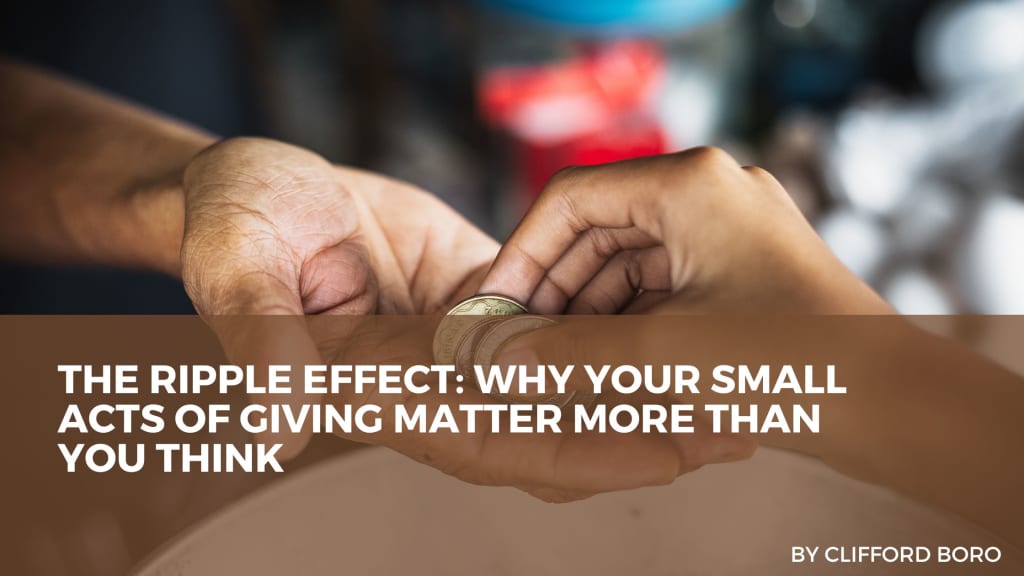
We often picture philanthropy as the domain of billionaires cutting oversized checks or foundations with endowments larger than some countries' GDPs. It's easy to believe that unless you're pledging millions, your contribution barely registers in the grand scheme of things. But this perspective misses something fundamental about how community change actually happens.
I discovered this truth on a rainy Tuesday morning while serving breakfast at my local shelter. A woman named Elaine approached me after receiving her meal. "You've been here every week for the past three months," she said, surprising me that she'd noticed. "Seeing the same faces keeps me going. Consistency matters more than people realize."
Her words stayed with me. In our pursuit of making a big splash, we often undervalue the profound impact of showing up regularly in small ways.
Research backs this up. Studies show that communities thrive not primarily through occasional large donations but through consistent, interconnected acts of giving and volunteering. These create what sociologists call "social capital" – the invisible infrastructure of relationships and trust that allows neighborhoods to weather challenges and grow stronger.
Consider the mathematics of community impact: If one person donates $1,000 once a year, that's valuable. But if ten people contribute two hours weekly at a community garden that feeds dozens of families, the cumulative effect over a year transforms lives while building connections that extend far beyond the original contribution.
This isn't to diminish the importance of financial giving. Money matters tremendously. But philanthropy's richest potential lies in its ability to weave people together through shared purpose, not just redistribute resources.
I've witnessed this firsthand in my own neighborhood. Three years ago, our community center was struggling to stay open. Rather than seeking a single large donor, we created a network of micro-contributions: monthly donors giving $10-25, high school students offering tutoring hours, retirees sharing professional skills, and local businesses providing in-kind services.
The result wasn't just a solvent community center – it was a revitalized neighborhood where people now know each other's names and stories. The center became a hub where connections formed that have since launched small businesses, support groups, and civic initiatives nobody could have planned centrally.
This approach to philanthropy – what I call "relational giving" – offers something traditional top-down charity often doesn't: dignity for everyone involved. When giving becomes a two-way exchange where everyone contributes according to their abilities, it eliminates the uncomfortable power dynamic between "helper" and "helped."
If you're looking to make a difference but feel limited by resources, consider these principles:
Start where you are. Your greatest contribution might be your profession's expertise, your network, your compassionate listening, or simply your reliable presence.
Think sustainability over splash. A small monthly donation or weekly volunteer commitment creates more lasting impact than a single grand gesture.
Connect the dots. The most effective community builders are often those who simply introduce people with complementary needs and resources to each other.
Recognize intangible contributions. The parent who translates at school meetings, the teenager who checks on elderly neighbors, the business owner who hires locally – these actions form philanthropy's backbone.
The most transformative philanthropic work often happens without press releases or naming opportunities. It happens when ordinary people decide that their community's wellbeing is partially their responsibility, and then act accordingly, day after day.
As Elaine taught me that rainy morning, consistency creates trust. Trust builds relationships. Relationships spark collaboration. And collaboration – not money alone – is what ultimately transforms communities.
So while we rightfully celebrate the world-changing potential of major philanthropy, let's not overlook the equally powerful force of many people giving what they can, where they are, with remarkable consistency. In the mathematics of community change, it's often multiplication – not addition – that yields the most profound results.
Your small acts matter more than you think. They always have.
About the Creator
Keep reading
More stories from writers in 01 and other communities.
A Love Forboding
The chipped stone slope caused unbearable footing. I slid, skirting on my heels. I cast my shield, relinquishing my guard to stay upright. Left with my double-edge and a prayer to the maker, I skated toward my objective. The earthly stubble gave way to solid ground. I found myself restored, a trail of dust in my wake.
By James U. Rizzi8 days ago in Fiction




Comments
There are no comments for this story
Be the first to respond and start the conversation.