
The Reality Check of AI: 78% Adoption Yet Over 90% Dissatisfied With Generative AI ROI
Exploring the Discrepancy: High AI Adoption, Low Satisfaction with Generative AI ROI

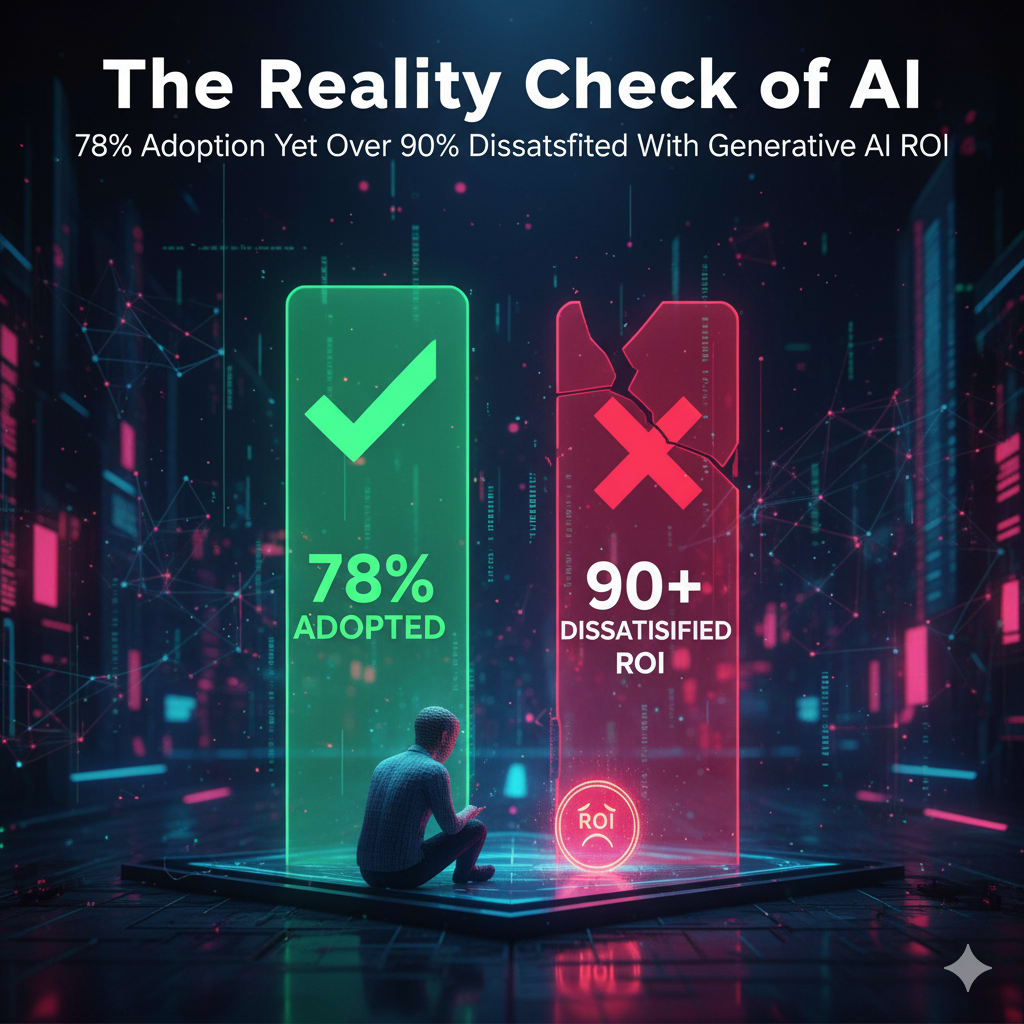
Artificial Intelligence (AI) has become one of the most disruptive forces in modern business, reinventing operations, automation, and innovation across industries. Businesses from all across the world have rushed to include generative AI solutions like ChatGPT, Midjourney, and Gemini into their processes in recent years. However, the return on investment (ROI) from generative AI is still significantly lower than anticipated, even with the fanfare and high adoption rates.
According to recent polls, 78% of businesses have implemented AI in some capacity, but more than 90% are unhappy with the return on investment (ROI) from generative AI projects. This is an intriguing conundrum.
This brings up a crucial query: why aren't companies utilizing AI to its fullest extent if it is such a transformative force? Let's examine the factors contributing to this discontent and how businesses might adjust their strategy for significant AI-driven outcomes.
The State of AI Today: Passion Exceeds Performance
The promise of efficiency, automation, and competitive advantage has caused the use of AI to soar. In addition to automating marketing, enhancing customer service, and even producing code, businesses view generative AI as a tool for creativity, productivity, and problem-solving.
However, a lot of businesses threw caution to the wind and integrated AI without a defined plan. Companies made significant investments in AI tools in an effort to "not fall behind," but they neglected important components like scalability, data infrastructure, governance, and staff training.
Because of this, implementation is frequently dispersed, comprising a mix of pilots, proofs of concept, and incomplete deployments that don't deliver quantifiable commercial results.
Essentially, execution is the problem, not AI.
Why Businesses Struggle to See ROI from Generative AI
Even while generative AI is still quite popular, there are a number of underlying issues that lead to the ROI gap:
1. Insufficient Strategic Vision
Instead of using AI for business purposes, many organizations do it for trend value. Without a specified aim or demonstrable outcome, the technology becomes an expense, not an investment.
2. Inadequate Infrastructure and Data Quality
AI thrives on data. However, generative AI outputs are frequently erroneous or irrelevant if organizations rely on out-of-date, inconsistent, or compartmentalized data, which results in subpar insights and lost effort.
3. Underestimating the Human Element
AI cannot function independently. Human oversight, fine-tuning, and contextual decision-making are essential for success. Many businesses lack skilled workers who can incorporate AI findings into their daily operations.
4. An excessive focus on tools Rather than Use Cases
Instead of concentrating on "how AI can solve our problem," businesses concentrate on "which AI tool to use." Value generation and scalability are constrained by this tool-first mentality.
5. Inadequate Evaluation of Performance
Evaluating ROI is practically impossible without precise measurements, such as time saved, cost decreased, or revenue earned. Success stories involving generative AI are uncommon since most businesses don't monitor important KPIs.
A Crucial Difference Between Generative and Conventional AI
Through recommendation systems, automation, and predictive analytics, traditional AI has been providing consistent returns on investment for years. However, generative AI works differently, employing machine learning models to create text, code, design, or content.
While standard AI improves efficiency, generative AI focuses on invention and creation, typically needing vast computational power and data resources. This raises operating expenses and complicates ROI calculations. Furthermore, generative AI necessitates ongoing investment rather than a one-time setup because its output quality is dependent on training data and fine-tuning.
Therefore, generative AI's return on investment is highly dependent on customization, data accuracy, and domain expertise, whereas classical AI is dependable and predictable.
Closing the Distance: How Companies Can Optimize Generative AI Return on Investment
Despite the difficulties, a realistic and well-organized AI plan can help shrink the ROI gap. Organizations can go from experimentation to value generation in the following ways:
1. Establish Specific Business Goals
Begin by asking "why." Align AI deployment with tangible goals such as lowering customer support time, boosting personalization, or automating repetitive procedures. Every AI project needs to have a quantifiable goal.
2. Make an Investment in Superior Data
Effective AI performance is based on clean, organized, and labeled data. For precise model training, provide data pipelines that minimize redundancy and facilitate real-time processing.
3. Upskill Your Workforce
AI systems require human intelligence to function. Employees should receive training on how to assess results, comprehend AI's limitations, and incorporate insights into decisions for better results.
4. Pay Attention to Scalable Use Cases
Find two or three scalable use cases that can yield quantifiable return on investment instead of trying out several low-impact pilots. AI-powered chatbots for round-the-clock customer service or marketing teams using automated content creation are two examples.
5. Work with Partners and AI Experts
Employing or collaborating with a seasoned generative AI development company will guarantee best practices in data management, model creation, and performance optimization while streamlining deployment and lowering trial-and-error expenses.
6. Measure, Monitor, and Optimize
Monitor key performance indicators (KPIs) such as customer satisfaction, cost savings, operational efficiency, and conversion rates. Maintain accuracy by routinely assessing model performance and retraining as necessary.
The Unspoken Reality: AI ROI Is Time-Dependant
The irrational expectation of instant profits is a primary cause of discontent. Many firms want AI to produce instant outcomes within weeks or months. However, feedback loops, constant learning, and improvement are how effective AI systems develop.
It takes perseverance and constant optimization to create a solid return on investment. Better outcomes are achieved by companies who make strategic investments and consider AI as a long-term capability rather than a temporary fix. The success of AI, like any significant change, hinges on foresight, preparation, and flexibility.
Beyond ROI: Assessing AI's Actual Value
ROI is an important statistic, but it doesn't fully account for the benefits of AI transformation. Intangible advantages of generative AI include new business models, improved decision-making, more customer involvement, and quicker innovation.
For example, automation lowers operating expenses and human error, while AI-generated insights can uncover untapped business potential. The true impact of adopting AI becomes more evident and significant when these indirect benefits are taken into account.
To put it briefly, businesses should assess both qualitative and quantitative ROI (revenue, cost savings, and customer experience, respectively).
Generative AI's Future: From Excitement to Development
The euphoria around AI is rapidly coming to an end. As the technology develops, businesses are realizing that incorporating AI into their core business models, rather than viewing it as a stand-alone innovation experiment, is the key to success.
Companies that are prepared for the future will prioritize ethical governance, data openness, human-AI cooperation, and sustainable AI adoption. When applied properly, generative AI can revolutionize industries by fusing automation and creativity.
The next stage of AI development will focus on efficacy, or how well businesses convert AI skills into quantifiable, long-term business benefits, rather than adoption rates.
In Conclusion
Even though 78% of businesses have adopted AI, the fact that more than 90% are unhappy with ROI serves as a warning to the sector. The implementation of AI is the problem, not the technology itself. AI development services must use careful planning, high-quality data, knowledgeable staff, and continuous optimization to replace hype-driven adoption.
Although generative AI has enormous potential to revolutionize workflows and unleash creativity, achieving its return on investment requires perseverance, accuracy, and purpose. The truth is quite clear: the value AI adds to people, processes, and profits is what will determine its success, not the quantity of adoptions.
About the Creator
Tarun Nagar
Tarun Nagar is the CEO of Dev Technosys, a leading blockchain development company. With a vision for innovation, he drives the company to deliver cutting-edge solutions in blockchain and decentralized technologies.
Keep reading
More stories from Tarun Nagar and writers in 01 and other communities.
Train Your Chatbot on a Complete YouTube Channel Without Spending a Dime
Chatbot technology is developing quickly in the field of artificial intelligence. Companies and content producers are searching for more intelligent approaches to efficiently engage users, automate interactions, and respond instantly. Using a whole YouTube channel to educate a chatbot is one creative method that enables it to comprehend all content and offer thoughtful, context-aware responses.
By Tarun Nagar3 months ago in 01
Jeff Bezos reveals the No. 1 secret behind Amazon’s trillion-dollar success, has a unique advice for young people
Jeff Bezos reveals the No.1 secret behind the company’s trillion-dollar success. He said that it can be advantageous for any company if they pay attention to customer instead of your competitor, giving a classic example of customer-driven innovation Amazon Prime. Jeff Bezos also advised young entrepreneurs to gain foundational skills through entry-level jobs like those at McDonald’s, emphasizing responsibility and resilience.
By Dena Falken Esq3 days ago in 01
Why Your Construction Business Needs a Mobile Concrete Mixer
Are you tired of waiting for concrete deliveries? Do you want more control over your construction projects? A mobile concrete mixer might be the solution you need. These machines bring concrete production directly to your job site. They eliminate delays and give you fresh concrete whenever required. In this article, we will explore how they work and why they matter. We will also discuss key factors to consider when choosing one. By the end, you will understand how a self loading concrete mixer can improve your operations. Let’s dive in and learn more about this valuable equipment.
By consrtuctionmachinesabout 14 hours ago in 01
Day 4 of Quitting
If this is how sobriety feels, maybe it’s better to go through life a little buzzed… this, along with other hits like, I want to kill myself, I wish I was dead, and I’m going to throw myself off a bridge have been the only thoughts on rotation these past few days. I promise myself that if, in a month, I still feel like this (‘this’ meaning despondent, full of rage, and simultaneously numb) I can go back to smoking. Until mid-February though? Nicotine is off the table.
By sleepy drafts5 days ago in Longevity


Comments
There are no comments for this story
Be the first to respond and start the conversation.