
The Real Economics of AI Development in 2025: A Deep Dive into Cost, Complexity, and Value
Introduction: Why Understanding AI Costs Matters


Artificial Intelligence (AI) has shifted from a buzzword to a backbone technology driving innovation across industries. Whether it’s predictive algorithms in finance, generative tools in design, or autonomous systems in manufacturing — AI is redefining how businesses operate.
Yet, as adoption accelerates, one question consistently shapes boardroom conversations: What does it actually cost to develop an AI solution?
This article takes a deep, research-backed look into the true cost structure of AI development, exploring the hidden layers that influence pricing — from data pipelines and model design to infrastructure and maintenance. In 2025, AI development isn’t just a technical challenge; it’s an economic one.
1. Why AI Development Costs Are Complex by Nature
Unlike traditional software, AI systems are dynamic, data-dependent, and continuously evolving. The total cost of AI development is influenced not just by the hours of coding but by how much intelligence, accuracy, and autonomy the system must achieve.
- Three interdependent pillars define AI project costs:
- Data — The foundation of all learning models
- Computational Infrastructure — The hardware and cloud power behind training and deployment
Expertise and Talent — The specialized human capital building, tuning, and maintaining AI models
Let’s dissect each of these with research-backed insight.
2. Data: The Hidden Engine of AI Economics
Data isn’t just an input — it’s the raw material that determines how intelligent a model can become. Collecting, cleansing, and structuring quality data often consumes 30–40% of total AI project budgets.
Data Sourcing and Preparation
Raw Data Acquisition: Companies may spend thousands acquiring domain-specific datasets. For example, a financial AI model may require years of market and transaction data.
Annotation and Labeling: For computer vision or NLP systems, human-led labeling remains a critical cost. The global data annotation market exceeded $2.5 billion in 2024, driven by generative AI demand.
Data Privacy and Governance: Compliance with frameworks like GDPR or HIPAA adds costs for anonymization, access control, and storage audits.
Even with the rise of synthetic data generation, which reduces dependency on human labeling, achieving realistic model performance requires robust data pipelines and validation systems — investments that quickly add up.
3. The Computational Layer: Powering Model Intelligence
Training an AI model requires enormous computing power. Modern models, especially deep learning and large language models (LLMs), rely on GPUs and TPUs capable of parallel data processing.
Infrastructure Options
Cloud-Based AI Platforms: AWS SageMaker, Google Vertex AI, and Azure ML offer flexibility but come with recurring costs based on compute usage.
On-Premise Systems: Suitable for enterprises prioritizing data security, though initial setup costs can exceed $250,000 for GPU clusters.
Hybrid Deployment: The emerging trend of Edge AI — combining local inference with cloud training — optimizes both performance and cost.
The training phase alone can represent 20–30% of a project’s total expenditure, especially for generative or reinforcement learning models that require iterative fine-tuning over time.
4. The Talent Factor: Human Intelligence Behind Artificial Intelligence
AI isn’t automated magic; it’s engineered by highly specialized experts. Building a successful AI project requires collaboration across multiple disciplines:
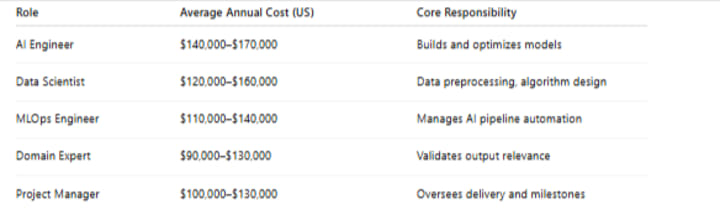
Startups often partner with AI development companies to access these multidisciplinary teams without building full in-house units, saving up to 35% in operational costs.
5. Project Complexity: The Multiplier Effect
No two AI projects cost the same. The nature and complexity of the task determine everything — from data requirements to the depth of neural architecture.
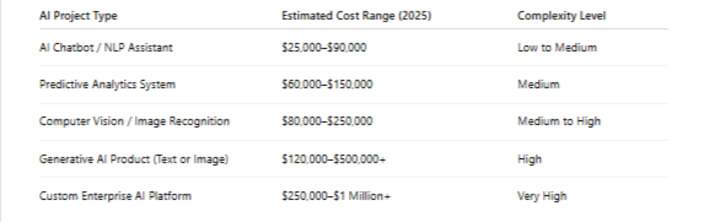
Each layer of customization — such as real-time processing, multi-language support, or adaptive learning — increases cost nonlinearly.
6. The Cost of Scaling and Integration
Once an AI system is developed, integrating it into existing business workflows introduces a new layer of complexity. Deployment costs can represent 15–25% of total expenses, especially for systems needing real-time inference or API-based integrations.
- Edge Deployments for low-latency industrial AI.
- API Management and Security to protect data flow.
- Model Optimization for lower inference costs on production servers.
Ignoring these operational aspects often leads to underbudgeted projects that later require re-engineering for scalability.
7. Post-Deployment: Maintenance, Monitoring, and Model Drift
AI models are not static. Over time, changes in data patterns can degrade performance — a phenomenon known as model drift. This makes continuous monitoring and retraining essential for accuracy and trustworthiness.
Ongoing Costs Include:
- Regular performance audits
- Model retraining with updated datasets
- Infrastructure monitoring
- Compliance and version tracking
Maintenance typically costs 15–20% annually of the original AI investment. However, integrating MLOps pipelines and AutoML systems can cut recurring costs by up to 30%.
8. Cost Optimization Strategies: Building Smart, Not Just Strong
The most successful AI-driven organizations of 2025 are not those that spend the most but those that spend strategically.
Key cost-efficient practices include:
Leveraging Pre-Trained Models — Instead of training from scratch, fine-tuning existing models (like GPT, Claude, or Llama) reduces both data and compute needs.
Synthetic Data for Training — Lowers annotation costs and accelerates iteration.
Automating AI Workflows (MLOps) — Streamlines development and deployment.
Adopting a Phased Development Approach — Start with a prototype, then scale with validated ROI.
Partnering with an AI Development Company — Access end-to-end delivery expertise under a controlled budget.
9. The ROI Perspective: Beyond Cost into Value
Treating AI purely as an expense misses its strategic potential. Businesses that adopt AI see returns across multiple vectors: operational efficiency, customer personalization, and predictive insights.
A 2025 McKinsey report suggests companies investing strategically in AI can achieve ROI multiples of 3–5x within 24 months — largely due to automation savings and improved decision accuracy.
For example:
- Financial firms using predictive AI reduce fraud losses by 40%.
- Healthcare systems using diagnostic AI cut misdiagnosis rates by 25%.
- Manufacturers integrating computer vision reduce defects by up to 60%.
The point: while AI development carries a significant upfront cost, it translates into measurable long-term competitive advantage.
10. The Future Outlook: Cost Evolution Beyond 2025
As the AI ecosystem matures, several trends are reshaping the economics of development:
- Open-Source AI Models are reducing entry barriers for startups.
- AutoML Platforms enable non-technical teams to create models faster.
- Quantum AI and Federated Learning may redefine cost structures by decentralizing compute and data access.
- Regulatory Frameworks will continue influencing compliance costs — especially in finance and healthcare sectors.
By 2030, the cost of developing a high-performance AI solution is expected to decrease by 40–50% as reusable AI architectures and open model libraries dominate the landscape.
Conclusion: Understanding Cost as a Catalyst for Value
AI development cost in 2025 is more than a price tag — it’s a reflection of a company’s ambition, data maturity, and innovation strategy. The smartest organizations are not those that minimize costs, but those that align investments with strategic outcomes.
As enterprises move toward a more AI-centric future, the key lies in balancing innovation with efficiency — building intelligent systems that not only learn but also deliver measurable business impact.
About the Creator
Vitarag Shah
Vitarag Shah is an SEO expert with 7 years of experience, specializing in digital growth and online visibility.
Keep reading
More stories from Vitarag Shah and writers in 01 and other communities.
Data Engineering in Startups: How to Manage Data Effectively
TL;DR Startups generate vast amounts of data but often lack the right infrastructure to harness it effectively. Data engineering services provide scalable solutions for managing, storing, processing, and analyzing data, enabling startups to make informed decisions, improve customer experiences, and stay competitive. By focusing on modern data pipelines, cloud-based platforms, and best practices like governance and automation, startups can transform raw data into actionable insights while keeping costs under control.
By Vitarag Shah5 months ago in 01
How Tax Outsourcing Companies Are Helping U.S. Businesses Stay Compliant and Profitable
Taxes are one of the most unavoidable parts of doing business in the United States. Whether you’re running a small startup or managing a growing company, tax compliance can quickly turn into a major headache. This is where Tax Outsourcing Companies have become a game-changer for businesses across the USA. By handing over complex tax responsibilities to professionals, companies are finding smarter ways to save time, reduce errors, and stay compliant with ever-changing tax laws.
By Outsourced Bookkeeping Solutions4 days ago in 01
Elon Musk called medical school "pointless," but Jeff Bezos wants Gen Z to finish college before starting their own companies — as AI threatens entry-level jobs
The job market is becoming volatile by the minute as generative AI becomes more prevalent and gains broad adoption across organizations worldwide. Last year, Salesforce CEO Marc Benioff revealed that the company is seriously debating hiring software engineers, citing "incredible productivity gains" from agentic AIs.
By Dena Falken Esqa day ago in 01
Wild Card Weekend Recap: What Happens Now?
I think I figured out why I love Wild Card Weekend so much. It's because it's the first playoff anything of the calendar year. The NFL season starts in the fall, and once upon a time, the champion was crowned either on or slightly before New Year's. The evolution of the NFL schedule has resulted in the playoffs starting just into the New Year, and currently, the final week of the season falls on the first weekend of the New Year, with Wild Card Weekend coming a week after that. So yes, chronologically, the NFL's Wild Card Weekend serves as the first playoff anything of the calendar year.
By Clyde E. Dawkins4 days ago in Unbalanced




Comments
There are no comments for this story
Be the first to respond and start the conversation.