
The Nature of Time: Exploring the Past, Present, and Future
Are All Moments of Time Existing Simultaneously?

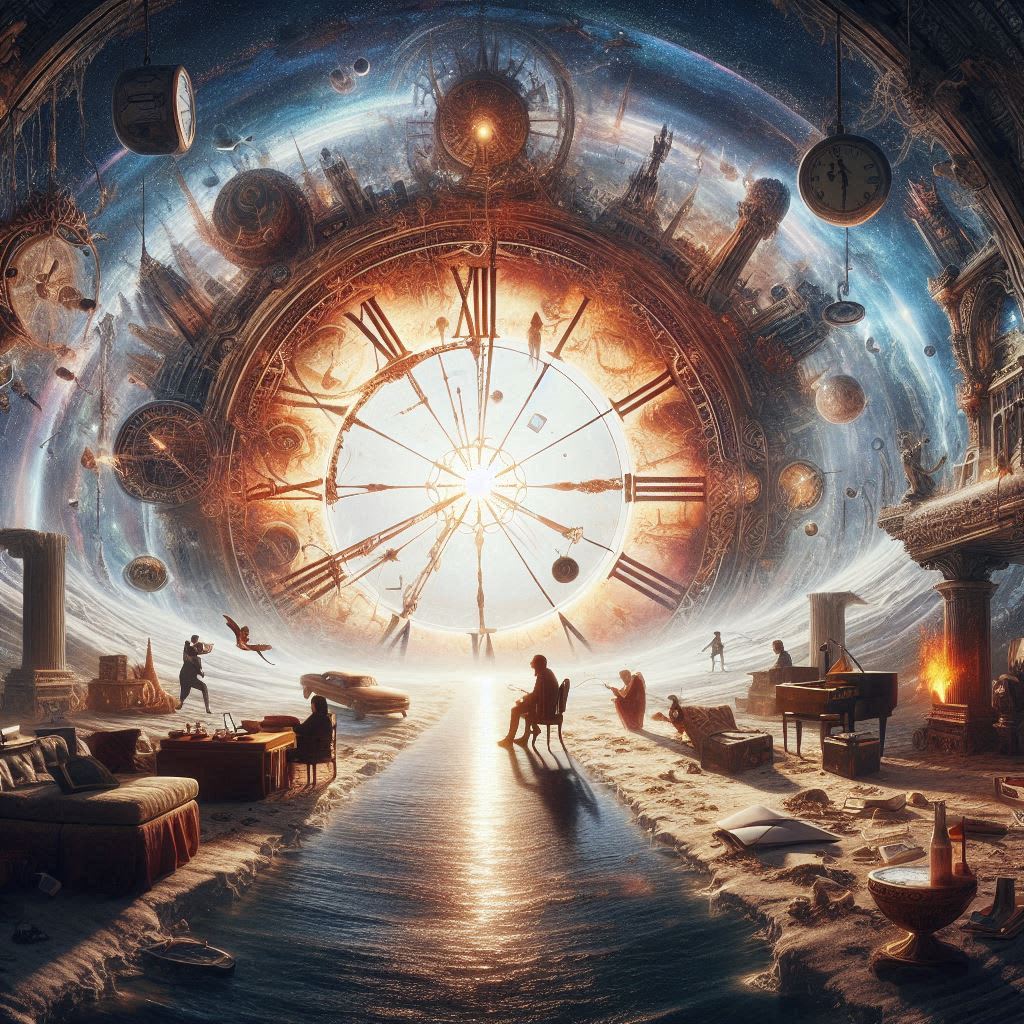
Do our past, present, and future coexist right now? This seemingly philosophical question could lead us to a surprising conclusion: they might. Understanding the nature of time is one of the most challenging concepts in physics, philosophy, and our everyday experience. This article explores the intriguing ideas surrounding time, drawing from modern theories in physics to engage with the implications of time's nature.
### **Time as a Linear Sequence**
Initially, we often perceive time as a linear sequence—a film reel where each frame captures a single moment. In this view, the present moment is the only reality we experience. As we move through life, we continuously transition from one moment to the next: the past fades away, while the future remains unseen and unformed. This perspective aligns with our daily experiences—births, deaths, and myriad life events create a dynamic tapestry that seems to move continuously forward.
### **The Block Universe Theory**
However, what if we consider an alternative perspective? Imagine the universe as a collection of snapshots, akin to a stack of pictures. Each image represents a moment in time, with every event—be it the birth of a star or a person missing a bus—captured in a static snapshot. This theory, known as the **block universe**, posits that the past, present, and future all exist simultaneously, each moment equally real.
#### **Einstein and the Relativity of Time**
According to Einstein's theory of relativity, space and time are intertwined into a single continuum known as **spacetime**. This concept challenges the conventional view of time as an absolute flow. Instead, time is perceived differently based on relative motion through space. As you move through the universe, your experience of "now" may differ from someone else's based on their speed and location. For example, two observers moving at different velocities will experience different "nows," illustrating how subjective our experience of time can be.
### **Cosmic Democracy: The Validity of All Observers**
The principle of **cosmic democracy** suggests that all observers have equally valid experiences of time. This means that each observer's present moment—no matter how different—holds validity in the universe. Consequently, your past and future exist simultaneously, just as real as the present you perceive.
#### **Intergalactic Examples**
To illustrate this concept, consider three hypothetical alien spaceships located millions of light-years away from Earth:
1. **Stationary Spaceship**: An alien spaceship hovering in space relative to Earth shares the same "now" as us. A video call would allow communication in real-time.
2. **Spaceship Moving Away**: An alien spaceship traveling away at a high speed experiences a different present. If we could connect with them, they might discuss events that occurred on Earth decades ago, like the 1924 discovery of distant galaxies.
3. **Spaceship Approaching**: Conversely, another spaceship approaching us would experience a “now” that relates to future events on Earth, possibly discussing developments expected in 2124.
### **The Illusion of Free Will and Determinism**
If past, present, and future coexist, does that mean the future is predetermined? Many might find this notion unsettling, as it challenges our sense of agency. If all events are fixed within the block universe, can we truly make choices? This line of reasoning suggests our perceptions of decision-making might be illusions—decisions could be preordained moments in time, already written into the cosmic fabric since the Big Bang.
### **The Quantum Conundrum**
However, quantum mechanics introduces complexity. Quantum particles exhibit behaviors that are fundamentally unpredictable. For example, the decay of a radioactive atom occurs at random intervals, meaning we can only determine probabilities—not certainties. This randomness raises the question: if the future can’t be predetermined, how can it coexist with the past?
#### **A Growing Block Universe**
Perhaps a more fitting model is a **growing block universe**, where the past remains fixed while the present and future continuously evolve. This perspective allows us to embrace the uncertainty of quantum events while still acknowledging the flow of time. Each moment emerges as new experiences and events unfold, shaping our individual timelines.
### **Conclusion: The Mystery of Time**
The nature of time remains one of humanity's greatest mysteries. While traditional views present time as a movie with a linear progression, relativity complicates this understanding, suggesting multiple, equally valid nows. As we explore these concepts, we find that both the past and future coexist in a complex interplay of reality, shaped by our observations and choices.
Ultimately, we can engage with this cosmic riddle while navigating our lives—deciding to catch that bus, make new memories, or explore the vast universe that lies beyond our immediate perceptions. Whether time is a predetermined block or a growing tapestry, our understanding continues to evolve, revealing the intricacies of existence itself.
About the Creator
THiNK
Think - Your go-to destination for exploring captivating mysteries, insightful psychology, intriguing facts, and the latest news. Our mission is to spark curiosity and inspire learning. Join us as we uncover the unknown!
8 Secrets Women Will Never Tell Men
1. She Notices How You Talk About Other Women The way you speak about other women says a lot about your character. If you constantly criticize, objectify, or disrespect women, she notices. Even casual jokes or comments can reveal your deeper attitudes. Many women quietly evaluate whether a man respects women in general, not just the woman he is trying to impress.
By The Story Scribeabout 11 hours ago in 01
Digital Detox: Why It Is Becoming Popular in a Hyperconnected World
Digital Detox: Why It Is Becoming Popular in a Hyperconnected World In today’s fast-moving digital age, it is almost impossible to imagine life without smartphones, laptops, and social media. Screens dominate our daily routines from the time we wake up until we go to bed. Notifications, emails, reels, news alerts, and endless scrolling have become a normal part of life. However, a growing number of people are now choosing to step back. This movement is known as a digital detox, and it is becoming increasingly popular across the world.
By Farida Kabir7 days ago in 01
A More Human Vocal
When we launched Vocal nearly a decade ago, the world was a very different place. LLMs did not exist, and stories were created one at a time by people sitting down to write, revise, and share something personal. Many of our assumptions about publishing, trust, and participation were built for a world where effort and output were inseparable.
By Justin @ Vocal6 days ago in Resources




Comments
There are no comments for this story
Be the first to respond and start the conversation.