
The Double-Edged Impact of Social Media
How social media shapes our connections, our choices, and our mental well-being in today’s digital world

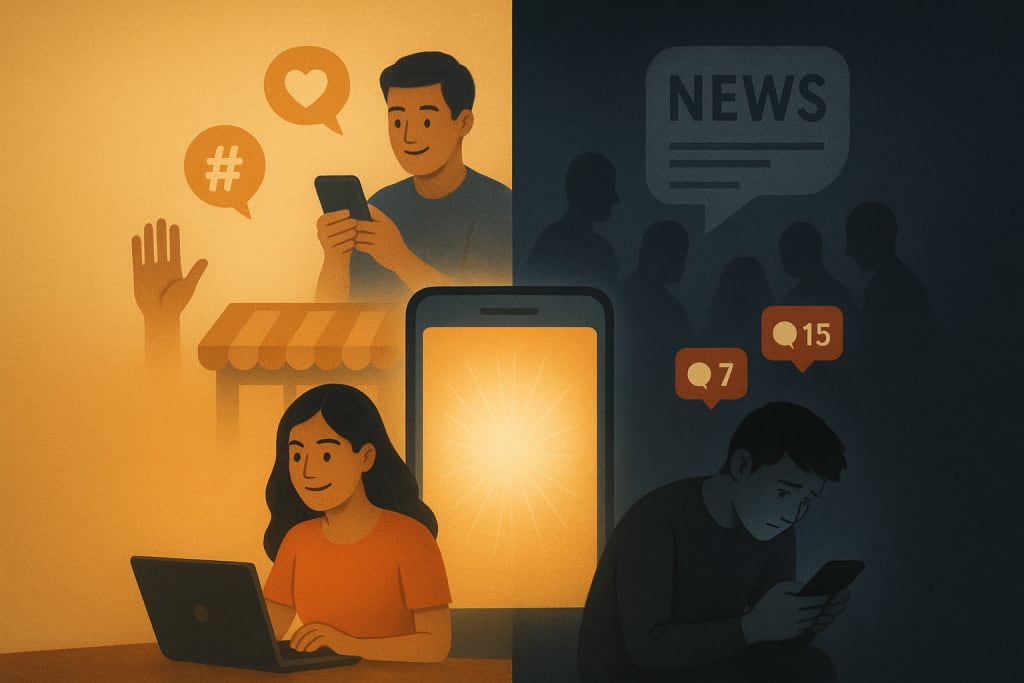
In today’s world, it is nearly impossible to ignore the presence of social media. What began as a way to connect friends and share memories has grown into a massive global network influencing how we communicate, learn, shop, and even think. From Facebook and Instagram to TikTok and X, social media is woven into our daily routines. Its impact is undeniable, but it is also deeply complex—filled with both opportunities and challenges.
On the positive side, social media has given millions of people a voice. In earlier times, only those with access to large platforms like newspapers or television could share their perspectives. Now, anyone with an internet connection can express opinions, showcase creativity, or share their life with the world. A small business owner can advertise to thousands of potential customers without spending heavily on traditional marketing. Artists, writers, and musicians have been discovered through a single viral post, changing their lives overnight.
Education has also benefited greatly. Students can watch tutorials, join online study groups, and follow lectures from teachers across the globe. During the COVID-19 pandemic, when schools and universities closed their doors, social media platforms became crucial tools for learning and connection. They allowed teachers to share resources, motivated students to stay engaged, and kept the spirit of learning alive in difficult times.
Social media has also brought attention to social issues that might otherwise remain hidden. Hashtags like #MeToo and #BlackLivesMatter showed the world how powerful collective voices can be. People who once felt isolated in their struggles found communities of support and solidarity. In times of natural disasters, such as earthquakes or floods, social media often spreads emergency information faster than television news, helping save lives.
Yet, for all these positive contributions, social media has an equally strong negative side. One of the most alarming issues is misinformation. False news spreads at lightning speed, often outpacing reliable sources. People can be misled by rumors, conspiracy theories, or manipulated videos, which in turn fuels confusion, mistrust, and even conflict.
Mental health is another area where social media’s impact is concerning. Constant comparisons to others—based on carefully edited photos and highlight reels—can leave people feeling insecure. A teenager scrolling through endless pictures of “perfect lives” may start to believe their own reality is not enough. Studies show rising levels of anxiety, depression, and low self-esteem linked to heavy social media use, especially among young people.
Addiction is an issue many of us recognize in our own habits. How often do we pick up our phones just to “check for a second,” only to lose track of time? Hours slip away as we scroll, swipe, and refresh. Notifications are designed to grab attention, pulling us back into apps again and again. This constant cycle reduces productivity, disturbs sleep, and can weaken real-life relationships. People may sit together at a table, yet each is absorbed in their own screen, missing the chance for genuine human connection.
The influence of social media on politics and society is also profound. Algorithms often show us content that aligns with our beliefs, creating “echo chambers.” Instead of encouraging dialogue, this can lead to greater division. People become less willing to hear opposing views, and debates often spiral into hostility rather than understanding.
The big question is: how do we handle all this? Social media is not something we can—or should—completely abandon. Its benefits are real and important. The challenge lies in how we use it. Practicing mindful habits, such as setting time limits, fact-checking information before sharing, and following accounts that inspire positivity, can make the experience healthier. Parents should guide their children in responsible online behavior, and schools can include digital literacy to prepare students for the realities of the online world.
At the same time, tech companies must take responsibility. Stricter regulations against cyberbullying, hate speech, and fake news are urgently needed. Platforms should design tools that encourage balance instead of endless scrolling. Governments, educators, and communities also play a role in spreading awareness about safe and ethical online practices.
Ultimately, social media is like a mirror. It reflects human creativity, kindness, and unity, but also fear, anger, and division. Whether it becomes a tool for growth or a source of harm depends largely on us, the users. By approaching it with awareness and responsibility, we can ensure it strengthens our lives rather than weakens them.
The impact of social media is not just a story of technology—it is a story of humanity. And as with every tool, its true value lies in how wisely we choose to use it.
About the Creator
Jack Nod
Real stories with heart and fire—meant to inspire, heal, and awaken. If it moves you, read it. If it lifts you, share it. Tips and pledges fuel the journey. Follow for more truth, growth, and power. ✍️🔥✨
Web3 Mobile Apps: What Actually Changes When You Build One
If you spend enough time around product teams, you’ll notice that Web3 tends to enter conversations in two very different ways. Sometimes it shows up as marketing language — the “future of the internet” narrative. Other times it appears as a practical engineering question: what actually changes when parts of your mobile stack stop living on your own servers?
By Valeriia Shulga4 days ago in 01



Comments
There are no comments for this story
Be the first to respond and start the conversation.