
The Complete Guide to Real-World Asset Tokenization
Unlocking Physical Assets Through Blockchain, Fractional Ownership, and Digital Liquidity

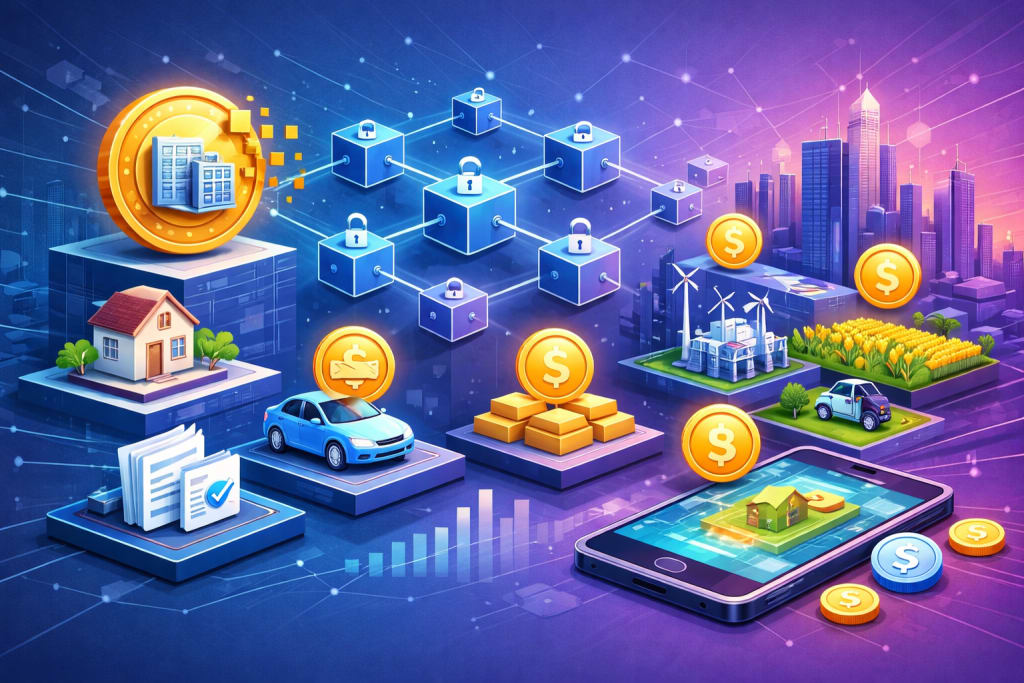
The global financial system is undergoing a structural transformation driven by blockchain technology, digital infrastructure, and the need for more accessible investment models. At the center of this evolution lies real world asset tokenization, a process that converts tangible and intangible assets into digital tokens on a blockchain. This shift is redefining how assets are owned, traded, financed, and managed across industries.
For decades, ownership of assets such as real estate, commodities, infrastructure, and private equity has been restricted by geographic barriers, regulatory friction, limited liquidity, and high capital requirements. Tokenization changes this equation by enabling fractional ownership, programmable compliance, transparent recordkeeping, and global investor participation. The result is a more efficient and inclusive financial ecosystem.
This guide explores the foundations, mechanisms, benefits, challenges, and future of real world asset tokenization, with a particular focus on how real estate tokenization is reshaping property markets worldwide.
Understanding Real-World Asset Tokenization
Real world asset tokenization refers to the process of representing ownership rights of a physical or traditional financial asset as a digital token on a blockchain network. Each token reflects a share or claim in the underlying asset and can be transferred, traded, or programmed according to predefined smart contract rules.
The core idea is straightforward. Instead of relying solely on paper documentation and centralized registries, ownership is recorded digitally on a decentralized ledger. These digital tokens can represent full ownership, fractional shares, debt claims, or revenue participation rights.
The assets suitable for tokenization include real estate properties, commercial buildings, art collections, infrastructure projects, commodities, private equity funds, and even intellectual property rights. Among these, real estate has emerged as one of the most promising and widely adopted categories.
Real Estate Tokenization is particularly compelling because property markets are historically illiquid, capital intensive, and geographically constrained. Tokenization introduces flexibility, liquidity, and accessibility to a traditionally rigid asset class.
How Real-World Asset Tokenization Works
The tokenization process typically begins with asset identification and legal structuring. The asset owner works with legal advisors to determine how ownership rights will be represented. This may involve creating a special purpose vehicle or legal entity that holds the asset. The digital tokens then represent shares in that entity.
Once the legal structure is established, smart contracts are developed on a blockchain network. These smart contracts define the rules for token issuance, transfer restrictions, compliance requirements, and distribution of returns.
After development, the tokens are minted and issued to investors through a compliant distribution process. Investors complete required verification steps and receive digital tokens in their wallets. Ownership transfers are recorded on the blockchain, ensuring transparency and immutability.
For real estate projects, Real Estate Tokenization Platform Development plays a crucial role in integrating legal compliance, investor onboarding, asset management, and reporting tools into a seamless ecosystem. A robust Real Estate Tokenization Platform ensures that investors can view performance metrics, manage their holdings, and participate in governance processes.
The Strategic Importance of Real Estate Tokenization
Real estate represents one of the largest asset classes globally, yet it has historically been inaccessible to smaller investors. Traditional real estate investments often require significant upfront capital and involve lengthy transaction processes.
Real Estate Tokenization addresses these limitations by enabling fractional ownership. Instead of purchasing an entire property, investors can acquire smaller tokenized shares. This reduces capital barriers and allows for diversified portfolios.
Liquidity is another major advantage. Conventional property transactions can take months to complete. Tokenized real estate assets can be traded more efficiently within compliant secondary markets, improving capital flexibility for investors.
Institutional investors are also recognizing the benefits. Many Real Estate Tokenization company providers are working with asset managers, developers, and funds to digitize portfolios and enhance operational efficiency. Real Estate Tokenization Services now extend beyond simple token issuance to include asset lifecycle management, investor communications, and automated revenue distribution.
Key Benefits of Real-World Asset Tokenization
One of the most transformative benefits of tokenization is enhanced liquidity. Illiquid assets such as commercial properties and private equity stakes can be divided into tradable units. This creates dynamic markets that allow investors to enter and exit positions more easily.
Another major benefit is increased transparency. Blockchain technology provides a tamper resistant ledger of transactions. Investors gain clearer insights into ownership records, transaction histories, and asset performance.
Operational efficiency is also significantly improved. Smart contracts automate tasks such as dividend distributions, rent payments, and compliance checks. This reduces administrative costs and minimizes manual errors.
Tokenization further enables global access. Investors from different jurisdictions can participate in opportunities that were previously limited by geography. A properly designed Real Estate Tokenization Platform supports cross border participation while maintaining regulatory compliance.
Legal and Regulatory Foundations
Despite its transformative potential, real world asset tokenization must operate within established legal frameworks. Tokenized assets are often classified as securities, which means they are subject to securities laws and investor protection regulations.
Regulatory clarity varies across jurisdictions. Some regions have introduced progressive frameworks to encourage innovation, while others are still developing policies. Compliance remains a critical factor for long term success.
Real Estate Tokenization Development Services typically include regulatory consulting, legal structuring, and compliance integration to ensure that token offerings meet jurisdictional requirements. A responsible Real Estate Tokenization Development company prioritizes legal alignment and investor protection as foundational elements of any project.
Custody and asset backing are also essential considerations. Investors must have confidence that tokens are fully backed by legally enforceable rights to the underlying asset. Proper documentation and third party audits help build trust in the ecosystem.
Technology Infrastructure Behind Tokenization
Blockchain networks form the technological backbone of tokenization. These networks provide decentralized ledgers that record transactions in a secure and transparent manner.
Smart contracts are programmable scripts deployed on the blockchain that automate key functions. They handle token issuance, transfer restrictions, dividend calculations, and governance voting mechanisms.
A well designed Real Estate Tokenization Platform integrates blockchain functionality with user friendly interfaces. Investors should be able to register, complete identity verification, review investment documents, and track performance without needing deep technical knowledge.
Security remains paramount. Platforms must implement robust cybersecurity protocols, wallet management solutions, and data protection mechanisms. Any vulnerability can undermine investor confidence and disrupt operations.
Scalability is another key concern. As adoption grows, platforms must handle increasing transaction volumes without compromising performance. Advanced Real Estate Tokenization Platform Development focuses on creating scalable architectures capable of supporting institutional grade operations.
Use Cases Across Industries
While real estate leads the adoption curve, other sectors are embracing tokenization as well. Infrastructure projects can be tokenized to attract global funding for large scale developments. Commodities such as gold and agricultural assets can be digitized to enhance trading efficiency.
Private equity and venture capital funds are exploring tokenization to streamline capital formation and investor onboarding. Art and collectibles markets are leveraging digital tokens to democratize access to high value works.
However, Real Estate Tokenization continues to stand out due to the scale and stability of property markets. Residential complexes, commercial towers, hospitality properties, and industrial facilities are increasingly being structured through tokenized investment vehicles.
Challenges and Risk Considerations
Despite its promise, real world asset tokenization faces several challenges. Regulatory uncertainty remains a concern in certain jurisdictions. Rapid technological innovation can outpace legal frameworks, creating temporary gaps.
Market education is another hurdle. Many investors and asset owners are still unfamiliar with blockchain technology and digital wallets. Clear communication and transparent processes are essential to building trust.
Liquidity expectations must also be managed carefully. While tokenization improves transferability, secondary markets must develop sufficient depth and participation to ensure meaningful liquidity.
Technology risks, including smart contract vulnerabilities and cybersecurity threats, require proactive risk management strategies. A reputable Real Estate Tokenization company invests heavily in audits, testing, and ongoing monitoring to mitigate these risks.
Institutional Adoption and Market Momentum
Institutional adoption is accelerating as financial institutions explore blockchain based settlement systems and digital asset strategies. Large asset managers are piloting tokenized funds, and banks are experimenting with digital bond issuances.
Real estate developers are partnering with Real Estate Tokenization Development company providers to access new pools of capital. This approach enables them to diversify funding sources and engage a broader investor base.
As more success stories emerge, confidence in the model continues to grow. Institutional participation brings additional credibility and encourages regulatory bodies to refine supportive frameworks.
Real Estate Tokenization Services are evolving from experimental pilot projects to fully integrated financial solutions. This shift signals a broader transformation in how capital markets operate.
The Future of Real-World Asset Tokenization
The future of real world asset tokenization appears promising as technological maturity, regulatory clarity, and institutional participation converge. Interoperability between blockchain networks will likely improve, enabling seamless asset transfers across platforms.
Digital identity systems and automated compliance tools will enhance investor onboarding and cross border participation. Artificial intelligence may also play a role in risk assessment and portfolio optimization within tokenized ecosystems.
Real Estate Tokenization Platform Development is expected to become more standardized, with modular frameworks that can be adapted to various asset classes. As best practices emerge, costs may decrease and adoption barriers may diminish.
Over time, tokenization could become a foundational layer of digital finance. Traditional securities markets may integrate blockchain infrastructure to enhance transparency and efficiency.
Conclusion: A Transformative Financial Paradigm
Real world asset tokenization represents more than a technological trend. It is a structural shift in how assets are owned, managed, and exchanged. By combining blockchain technology with established legal frameworks, tokenization bridges the gap between traditional finance and digital innovation.
Real Estate Tokenization stands at the forefront of this transformation, unlocking liquidity, accessibility, and operational efficiency in one of the world’s largest asset classes. Through advanced Real Estate Tokenization Platform Development and comprehensive Real Estate Tokenization Development Services, asset owners and investors are reshaping property markets for a digital era.
As regulatory frameworks mature and institutional confidence strengthens, tokenization is poised to redefine capital markets on a global scale. The journey is still evolving, but the direction is clear. The digitization of real world assets is not a temporary experiment. It is the foundation of a more transparent, inclusive, and efficient financial future.
About the Creator
Ethan hunt
Ethan is a blockchain and Web3 specialist focused on building decentralized ecosystems that enhance transparency, security, and global accessibility.
Keep reading
More stories from Ethan hunt and writers in 01 and other communities.
Tokenized Real Estate Platform Economics: Revenue Models and Growth Strategies
Tokenized real estate is no longer a niche experiment at the intersection of blockchain and property markets. It is becoming a structured financial ecosystem where platforms act as digital infrastructure providers, enabling asset owners, investors, and institutions to transact fractional property ownership at scale. While much of the public conversation focuses on technology and regulatory innovation, the real long term sustainability of this sector depends on platform economics.
By Ethan huntabout 13 hours ago in 01
How Does the Cleo App Work? Meet the AI That Roasts Your Spending Habits
I reckon y’all are tired of those dusty banking apps that look like they were designed in 1998. Real talk, most financial tools are about as exciting as watching paint dry in a humidity wave. Enter Cleo. It is 2026, and if you are still asking how does the cleo app work, you are missing out on the only AI that has the stones to call you out for your 2 a.m. taco runs.
By Sherry Walker6 days ago in 01
What Happens To Your Brain When You Stop Multitasking
Digital technology is the culprit that is causing us to doom scroll when tired, disengaged and unmotivated with the content that motivated you to log onto your device to consume in the first place. That is only the beginning. In the modern workplace (and even when filing cabinets were around, I confirmed this with my adopted parents to get my facts right); reading files while you are supposed to be present to the caller on the other end of the phone line is another classic example of multitasking that causes your brain (although adaptable and intelligent) to lose focus and concentration.
By Justine Crowley5 days ago in Psyche




Comments
There are no comments for this story
Be the first to respond and start the conversation.