
The Awkward Truth About Doing Good: Why I Almost Quit Volunteering
What nobody tells you about community service—and why the messy, uncomfortable parts matter most

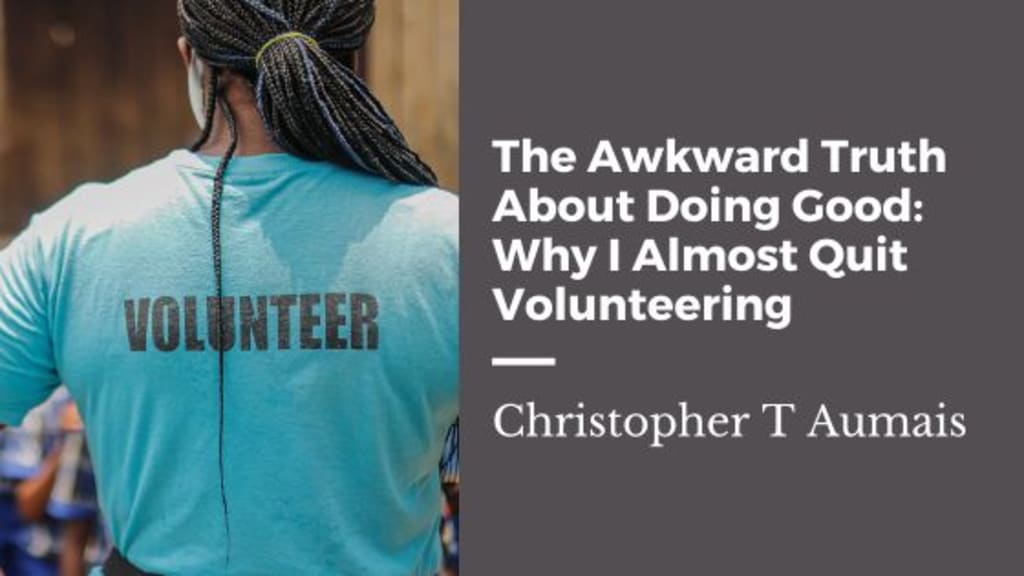
I almost walked out of my first homeless shelter shift. Not because of what I saw, but because of what I felt: completely useless.
I'd shown up with good intentions and zero practical skills. The other volunteers moved with practiced efficiency—they knew where supplies were kept, how to navigate the intake system, which residents needed extra attention. Meanwhile, I stood there holding a ladle like it was radioactive, wondering if I was actually making anything worse.
"First time?" asked Marcus, one of the regular volunteers, as I fumbled with serving portions. When I nodded sheepishly, he laughed. "Yeah, we can tell. Don't worry—everyone starts somewhere. I couldn't even work the coffee maker my first week."
That moment of honest acknowledgment changed everything for me. Because here's what all the inspiring volunteer recruitment videos don't tell you: doing good is awkward at first, and sometimes it stays awkward.
The Instagram vs. Reality Gap
Social media has created this glossy version of community service where everyone looks fulfilled and purposeful from day one. Beautiful photos of volunteers hugging grateful recipients, inspirational quotes about changing the world, carefully curated moments of meaningful connection.
The reality is messier. You'll probably show up to your first food bank shift and realize you have no idea how to talk to someone whose circumstances are completely different from yours. You might volunteer at a literacy program and discover that an eight-year-old's reading struggles are way more complex than you imagined. You could join a community garden project and kill more plants than you nurture.
This disconnect between expectation and reality causes a lot of people to quit early. They interpret initial awkwardness as evidence they're not "good at" volunteering, instead of recognizing it as the normal learning curve of any meaningful activity.
The Value of Being Bad at Something
Here's a radical thought: maybe being initially terrible at community service is actually valuable. When you don't know what you're doing, you have to listen more carefully. You ask questions instead of making assumptions. You're forced to be humble instead of assuming you have all the answers.
During my third shelter shift, I was paired with Robert, a man about my age who'd been staying there for six months. Instead of trying to "help" him, I found myself genuinely curious about his story. Turns out he had a background in electronics—something I knew nothing about. We ended up having a fascinating conversation about circuit boards while we folded laundry.
I learned more about resilience and adaptability in that one conversation than in months of reading about homelessness online. But it only happened because I wasn't trying to be the expert or the savior. I was just being genuinely clueless, which paradoxically made me a better listener.
The Long Game of Small Contributions
Another uncomfortable truth: most community involvement doesn't produce dramatic, visible results. You won't see immediate transformations or get regular validation that you're making a difference. Progress happens in increments so small they're almost invisible day-to-day.
I've been tutoring kids at the local community center for two years now. Some days feel productive—a student finally grasps long division, or writes a story they're proud of. Other days feel like spinning wheels. Kids are distracted, I can't explain concepts clearly, nothing clicks.
But then I run into former students at the grocery store, and they wave excitedly and tell me about their favorite classes. Or a parent mentions that their child looks forward to our sessions all week. These small indicators of impact are easy to miss if you're looking for dramatic transformation stories.
Embracing the Ordinary
The most sustainable community involvement isn't heroic—it's ordinary. It's showing up consistently even when you don't feel particularly inspired. It's doing mundane tasks that keep organizations running. It's building relationships slowly, over months and years, without keeping score.
My friend Janet has been delivering meals to homebound seniors for fifteen years. She doesn't post about it on social media or mention it in casual conversation. She just shows up every Tuesday with food and conversation, week after week. Several of her regular recipients now consider her family.
That kind of quiet, persistent care doesn't make headlines, but it's the backbone of healthy communities.
Permission to Start Imperfectly
If you've been hesitating to get involved in your community because you don't feel qualified or prepared, consider this your permission to start anyway. Bring your awkwardness, your questions, your uncertainty. The people and organizations you want to help aren't looking for polished volunteers—they're looking for reliable ones.
Find something that genuinely interests you, commit to showing up regularly for at least three months, and be prepared to feel uncomfortable sometimes. The discomfort isn't a bug in the system—it's a feature that keeps you learning and growing.
About the Creator
Christopher T Aumais
Based in Los Angeles, CA, Christopher Aumais is a distinguished trial lawyer and the Founder and Partner at GGA LLP, where he has practiced since 2020. Learn more by visiting christopheraumais.org.
Keep reading
More stories from Christopher T Aumais and writers in 01 and other communities.
The Ripple Effect: How Small Acts of Giving Create Waves of Change
When Maria started volunteering at her local food bank three years ago, she had no idea that her two hours every Saturday would spark a movement that would feed thousands. What began as a personal desire to give back during a difficult period in her life has now evolved into a community network of over 200 volunteers, three satellite locations, and partnerships with local farms and restaurants. Maria's story illustrates a fundamental truth about philanthropy and community involvement: the most profound changes often begin with the smallest gestures.
By Christopher T Aumais4 months ago in 01
Japan Smart Doorbell Market Size and Forecast 2025–2033
Market Snapshot The Japan Smart Doorbell Market is expected to reach US$ 736.05 million by 2033, up from US$ 212.53 million in 2024, expanding at a robust CAGR of 14.8% from 2025 to 2033. Rapid urbanization, increasing adoption of smart home technologies, and rising demand for home security systems are driving market growth. Advancements in AI, video analytics, and wireless connectivity are further strengthening consumer demand for smart doorbell systems.
By jaiklin Fanandish3 days ago in 01


Comments
There are no comments for this story
Be the first to respond and start the conversation.