
The 3D Technology Frontier: A Comprehensive Market Analysis
Exploring Innovation Pathways, Industry Adoption, and Competitive Dynamics

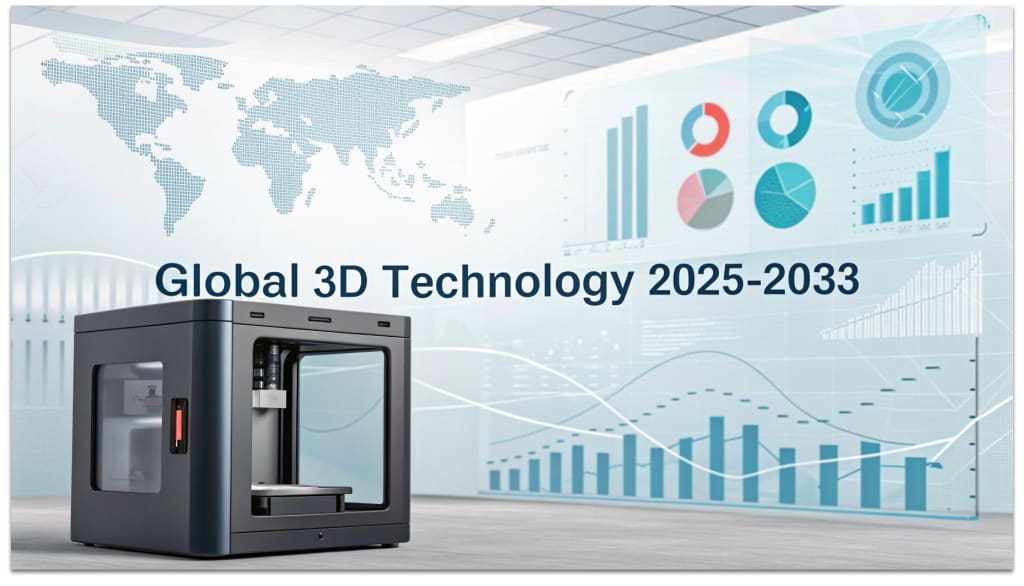
The 3D technology market is no longer a monolithic sector defined by high-end cinema or niche prototyping. In 2024 and beyond, it represents a convergent ecosystem where hardware (3D printing and scanning), software (CAD, BIM, and CGI), and display technologies (AR/VR/MR) intersect. This shift is driving a "spatial revolution" that is fundamentally altering how products are designed, manufactured, and consumed.
1. Market Overview and Valuation
The global 3D technology market is currently experiencing a double-digit compound annual growth rate (CAGR), projected to reach nearly $1 trillion in total ecosystem value by the early 2030s. This growth is fueled by the transition from "flat" digital experiences to immersive, three-dimensional workflows across healthcare, aerospace, retail, and entertainment.
2. The Three Pillars of the 3D Market
To analyze this market effectively, we must categorize it into three distinct but interdependent pillars:
A. 3D Creation and Design (Software)
This segment includes Computer-Aided Design (CAD), Building Information Modeling (BIM), and 3D modeling software.
Trend: The shift toward Cloud-Native CAD. Traditional desktop-bound software is being replaced by collaborative, browser-based platforms (like Onshape or Canva’s 3D acquisitions) that allow global teams to edit models in real-time.
Driver: The integration of AI-assisted modeling, where "text-to-3D" prompts allow designers to generate complex base meshes instantly.
B. 3D Capture and Scanning (Metrology)
3D scanning technology—using LiDAR, Structured Light, or Photogrammetry—is the bridge between the physical and digital worlds.
Focus: Digital Twins. Industrial plants, historical sites, and even human bodies are being scanned to create exact digital replicas for simulation and monitoring.
Consumer Impact: The inclusion of LiDAR in high-end smartphones has democratized 3D scanning, allowing small business owners to create 3D assets for e-commerce with a mobile device.
C. 3D Realization (Hardware & Output)
This involves both physical output (3D Printing/Additive Manufacturing) and visual output (AR/VR/Holography).
Additive Manufacturing (AM): Moving from "prototyping" to "production." Companies are now 3D printing end-use parts in titanium, carbon fiber, and even bio-inks for medical implants.
Spatial Computing: The release of high-fidelity "Mixed Reality" headsets is shifting the market from pure Virtual Reality (isolation) to Augmented Reality (integration), where 3D digital objects coexist in the user's physical room.
3. High-Impact Industry Verticals
Healthcare: The "Digital Patient"
3D technology is arguably most transformative in medicine.
Bioprinting: Research is moving toward printing vascularized tissue and skin for burn victims.
Surgical Planning: Surgeons now use 3D-printed replicas of a patient's specific organ or tumor to "practice" a complex surgery before making an incision.
Custom Prosthetics: 3D scanning allows for perfectly fitted, low-cost prosthetic limbs, particularly impactful in developing nations and war zones.
Aerospace and Defense: Lightweighting
In the aerospace market, "weight is cost."
Generative Design: AI designs 3D structures that look "organic" (like bone) to provide maximum strength with minimum material. These shapes can only be manufactured via 3D printing.
Supply Chain Resilience: Instead of stocking thousands of spare parts, the military is moving toward "Digital Warehouses" where parts are printed on-site or on-ship when needed.
E-Commerce and Retail: The "Try-Before-You-Buy" 2.0
3D Visualization: Retailers (like IKEA or Amazon) use 3D models to allow customers to place furniture in their homes via AR.
Conversion Rates: Statistics show that products with 3D/AR viewing options have up to a 40% higher conversion rate and significantly lower return rates.
4. The Rise of the Industrial Metaverse
While "Metaverse" became a buzzword in social media, the Industrial Metaverse is a concrete market reality. Major players like NVIDIA (with Omniverse) and Siemens are building 3D environments where entire factories are simulated before a single brick is laid.
Predictive Maintenance: By connecting IoT sensors to a 3D digital twin, engineers can see a "live" 3D heat map of a factory and predict when a machine will fail.
Training: Training workers in a 3D simulation of a high-risk environment (like an oil rig or nuclear plant) reduces accidents and travel costs.
5. Key Market Drivers and Catalysts
Advancements in Materials Science: The 3D printing market is expanding because we can now print with "High-Performance Polymers" and conductive inks, allowing for the 3D printing of electronics.
5G and Edge Computing: High-fidelity 3D models require massive bandwidth. The rollout of 5G allows for the streaming of complex 3D environments to mobile devices without lag.
Sustainability Mandates: 3D printing is "additive," meaning it only uses the material needed. Compared to "subtractive" manufacturing (milling/carving), it drastically reduces raw material waste.
6. Challenges and Barriers to Entry
High Initial Capex
Industrial-grade 3D printers and high-end 3D design talent remain expensive. For many SMEs, the ROI is clear, but the "entry price" is a hurdle.
Standardization and Intellectual Property
As 3D scanning becomes easier, "digital piracy" of physical objects becomes a risk. If a person can scan a designer chair and print it at home, how do brands protect their IP?
The Talent Gap
There is a worldwide shortage of "Spatial Engineers" and 3D Technical Artists. Learning to design in three dimensions requires a different cognitive approach than traditional 2D graphic design.
7. Regional Market Dynamics
North America: Leading in software development and aerospace applications. Home to the majority of "Spatial Computing" pioneers.
Europe: Particularly Germany, is the global hub for industrial 3D printing (Additive Manufacturing), driven by its strong automotive and engineering heritage.
Asia-Pacific: The manufacturing powerhouse. China and Japan are rapidly adopting 3D technology for mass-market electronics and increasingly for 3D-printed construction (houses and infrastructure).
8. Conclusion: The Dimensional Shift
The 3D technology market is transitioning from a "feature" to a "foundation." In the near future, we will view 2D screens and traditional manufacturing as historical limitations. The market's future lies in Hyper-Personalization—where every shoe, medical implant, and car component is 3D-scanned for the individual and 3D-printed on demand.
For stakeholders, the opportunity lies not just in the hardware, but in the Data Layer: the 3D models, the digital twins, and the software that manages the "digital thread" from a 3D scan to a 3D-printed reality.
Key Takeaways for Decision Makers:
Prioritize Digital Twins: Organizations should begin digitizing physical assets now to prepare for AI-driven simulation.
Invest in Materials Knowledge: The value in 3D printing is shifting from the printer to the material (metal, bio, recycled).
Spatial Commerce is Essential: For B2C brands, 3D visualization is no longer a luxury; it is becoming a standard consumer expectation.
About the Creator
Rahul Pal
Market research professional with expertise in analyzing trends, consumer behavior, and market dynamics. Skilled in delivering actionable insights to support strategic decision-making and drive business growth across diverse industries.
The Battery of Trust: How Phone Charging Habits Relate to Honesty in Location Sharing
Hey there. Over years of building location-sharing tools, I've noticed a pattern that rarely gets discussed: the link between a phone's battery life and the health of a relationship built on digital trust. It sounds odd, right? But think about it. The most common technical excuse for a location tracker failing is, "My phone died." While sometimes true, this dead battery can often be a symptom, not just a cause—a digital tell that signals a deeper disconnect.
By Olivia Martinez4 days ago in 01
Why Germany Is Emerging as a Prime Market for Institutional-Grade White Label Crypto Wallets in 2026
Germany just issued its 100th crypto custody license under the updated Financial Instruments Act. Deutsche Bank launched digital asset custody services for institutional clients. The German government holds 50,000 BTC making it one of the largest sovereign cryptocurrency holders in Europe. If you're building institutional-grade white-label crypto wallet solutions and wondering where to focus in 2026, Germany isn't just attractive it's essential.
By Matthew Haws2 days ago in 01
Instructions Included Challenge Winners
For the Instructions Included challenge, we asked writers to tell a story through instructions and to trust the form to carry what could not be said outright. Across the top entries, that trust paid off in many different ways.
By Vocal Curation Team3 days ago in Resources




Comments
There are no comments for this story
Be the first to respond and start the conversation.