

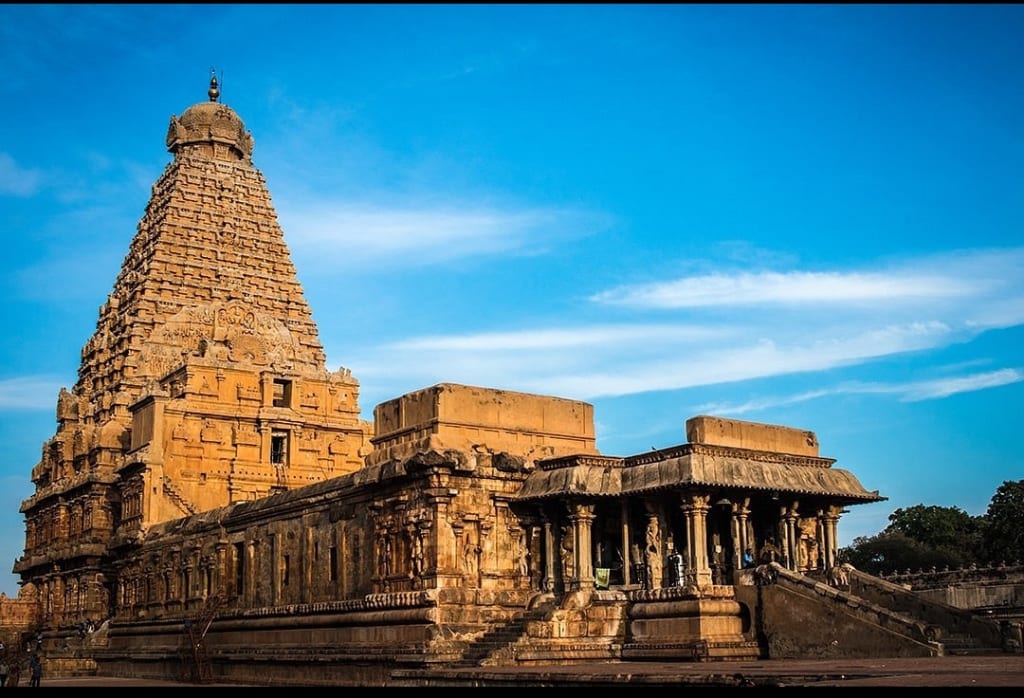
The Brihadeeswarar Temple, also known as the Peruvudaiyar Kovil or RajaRajeswara Temple, is a Hindu temple located in the city of Thanjavur in the Indian state of Tamil Nadu.
The temple, which is dedicated to Lord Shiva, was built during the reign of the Chola dynasty in the 11th century AD and is considered one of the most significant architectural achievements of the Chola period.
History
The Brihadeeswarar Temple was built by the Chola king Raja Raja Chola I in 1010 AD.
The construction of the temple took seven years to complete, and it is said that over 130,000 tons of granite was used to build the temple.
The temple was built to celebrate the king’s victory over the Pandyas and the Cheras, and it was designed to reflect the king’s glory and his devotion to Lord Shiva.
Architecture
The Brihadeeswarar Temple is a prime example of the Dravidian style of architecture, which is characterized by its use of stone and its intricate carvings and sculptures.
The temple is built on a rectangular platform, and its main feature is a 216-foot-tall tower, known as the vimana or gopuram.
The tower is made of granite and is topped by a dome-shaped structure made of bronze.
The tower is decorated with intricate carvings and sculptures, including depictions of various gods and goddesses.
Inside the temple, there is a large hall known as the Nandi Mandapam, which is home to a massive statue of Nandi, the sacred bull of Lord Shiva.
The statue is carved from a single stone and is said to be one of the largest of its kind in the world.
The temple also houses several shrines dedicated to different deities, including Lord Shiva and his consort, Goddess Parvati.
Significance
The Brihadeeswarar Temple is considered one of the most significant Hindu temples in the world and is a UNESCO World Heritage Site.
The temple is revered for its architecture, which is a testament to the skill and craftsmanship of the Chola dynasty.
It is also considered an important pilgrimage site for devotees of Lord Shiva, who come from all over the world to offer their prayers and seek his blessings.
In conclusion, the Brihadeeswarar Temple in Thanjavur is a magnificent example of ancient Indian architecture and a testament to the devotion of the Chola dynasty to Lord Shiva.
Its intricate carvings, massive size, and historical significance make it a must-visit site for anyone interested in Indian history and culture.
Why Tamil Nadu Celebrating King Raja Raja Chola’s Birthday Is A Masterstroke In Symbolism
Shaivism refers to the organized worship of Shiva.
Shaivism, along with Vaishnavism (worship of Vishnu) and Shaktism (worship of the divine goddess), are believed to have formed the three principal pillars of modern Hinduism.
Shaivism, however, predates formal ‘Hindusim’.
A mural depicting 10th-11th century Tamil ruler Raja Raja Chola at the Brihadeshwara temple he built | WikiCommons
Nearly a month after controversy over whether the 10th-century Dravidian ruler Raja Raja Chola was Hindu or not, the Tamil Nadu government has decided to mark November 3, the legendary ruler’s birth anniversary, as a state event.
The Dravida Munnetra Kazhagham (DMK) government has announced in an official statement that November 3 shall henceforth be celebrated as an annual state event to mark the birth anniversary of the Chola ruler who recently came back into the limelight after the success of the Mani Ratnam film Ponniyin Selvan: I. The film, featuring Bollywood actress Aishwarya Rai along with Vikram and Trisha Krishnan, is based on a fictionalised account of Raja Raja Chola’s life.
Related Stories
More Than A Mythical Persona: An Atheist’s Take On Shiva
How Shiva Became A Political Revolutionary Symbol In Kerala
Countering The Brahmin Shiva: Dravidian Discourse As An Antidote To Hindu Nationalism
Following the release of the film in Tamil, Telugu, Malayalam and Hindi languages, controversy erupted in the first week of October when National Award-winning Tamil director Vetrimaaran, at an event, claimed that the BJP was trying to steal their identity by appropriating Tamil icons.
Apparently irked by the depiction of the Chola ruler as a Hindu king in the film, an agitated Vetrimaaran said, “Raja Raja Chola wasn’t Hindu but they (BJP) are trying to steal our identity.
They have already tried to saffronise Thiruvalluvar. We should never allow that”.
The remarks did not sit well with BJP and its leaders doubled down on the claim that Raja Raja Chola was indeed Hindu.
“I am not well versed with history like Vetrimaaran, but let him point out two churches and mosques built by Raja Raja Chola.
He called himself Sivapadha Sekaran. Wasn’t he a Hindu then?” BJP leader H Raja argued.
Archana Hande’s installation ‘My Kottige’ is her innovative take on urbanisation and changing times. In her artwork, she has arranged discarded things as a witness of their time and space
The Nepal Picture Library showcases photos of women from that country, both ordinary and celebrated, so that history doesn’t forget them
Australian artist Richard Bell maps the spirit of the aboriginal resistance by setting up a tent at Aspinwall House in Kochi. Named the ‘Aboriginal Embassy’, the tent is a symbol of neglect, dispossession and resistance
Painting Dream Sequences For Collective Healing
Nepal-based artist Mekh Limbu feels that while it is important to talk about suffering and suppression, conversations around the process of healing are equally important. Through his paintings, which depict dream sequences, he is striving to preserve Adivasi tradition and language
“There was no name called ‘Hindu religion’ during Raja Raja Chola’s period. There was Vainavam, Shivam, and Samanam, and it was the British who coined the term Hindu since they didn’t know how to refer to it collectively.
It is similar to how they changed Thuthukudi into Tuticorin,” Haasan had said.
Telangana governor Tamilisai Soundararajan joined the chorus and ominously warned against alleged attempts that were being made to conceal the Hindu cultural identity of key personalities in Tamil Nadu.
The comments led to a war of words between BJP and ruling DMK as well.
DMK leader TKS Elangovan cited the reportedly “well documented” conflicts between Shaivite and Vaishnavite rulers of South India to support the claim that Raja Raja Chola was a Shaivite king, not a Hindu king.
“King Hiranya was a Shaivite who had a Vishnu-worshipping son, and Vishnu chose to kill him with his own avatar of Narasimha.
The politics used to be different then.
There were two different philosophies and they fought each other. They were not one,” Elangovan said.
In response, BJP leaders like BL Santosh claimed that Raja Raja Chola was not a Dravidian king at all since there was no Tamil Nadu at the time of his reign.
The contesting claims to his legacy today, over a millennium since his death, perhaps shed a glimpse of the importance of the king’s contribution to Tamil history.
So who is Raja Raja Chola and was he indeed Hindu?
This is not the first time that Raja Raja Chola has caused controversy in modern-day India.
In 2019, Madras High Court quashed a plea against filmmaker Pa Ranjith who had claimed that Raja Raja Chola and other Chola dynasty rulers had oppressed Dalits.
The complaint against Pa Ranjith contended that the filmmaker’s comments were creating caste-based divisions.
So who really was Raja Raja Chola?
Raja Raja Chola or Rajaraja I was a ruler of the Chola dynasty who reigned form from 985 CE – 1014 CE.
Historians describe him as one of the most powerful Tamil kings whose expansionist governance restored the influence of the Chola dynasty in the region by annexing vast swathes of key Pandya strongholds.
His reign not only helped the Cholas become an influential force in South India but also across the Indian Ocean with the empire spreading roots to Sri Lanka, Lakhwadweep and parts of the Maldives among other nations.
Present-day states like Kerala (named Kandalur Salai at the time) and Karnataka (Tadigaipadi) were also under Raja Raja Chola’s control.
He is known to have been a ruthless and skilled conqueror but also renowned for his administrative acumen.
He initiated land survey projects and reorganized his kingdom into smaller constituencies like ‘valanadus’ in what can be viewed as a medieval precursor to contemporary federalism.
He vouched for local self-governance and audits and made local bodies such as village-level assemblies autonomous.
History vs Ontology
But what about his religion? Was Raja Raja Chola Hindu? Were the Cholas practicing Hindu kings? The ruler is credited with building the enormous Brihadisvara Temple in Thanjavur dedicated to the worship of Shiva.
The temple recently got the UNESCO world heritage tag. Walls of the temple depict murals of the king.
This leads many to the claim that the Chola king was a Shiva-worshipping Hindu.
However, Shiva worship or Shaivism predates formal “Hinduism” as it exists now.
The term “Hindus” or “Hinduism” was created by the British who emerged centuries after Raja Raja Chola’s reign, which ended in 947 CE.
At that time, Hinduism did not exist as a single entity and using Hinduism to describe the oeuvre of religious expressions and movements like Shaivism as “Hindu” might be a misnomer, at least when describing the medieval period.
Devotional and monistic Shaivism, for instance, was a prominent religion, even in the 1st millennium CE.
How Shaivism evolved into a foundational structure for Hinduism over the years is a question for another essay but it is safe to say that at the time Raja Raha Chola was practicing it, he identified himself as a devout Saivite (worshipper of Shiva), not a Hindu, with a religious identity the same as modern-day practicing Hindus.
That being said, commentators have argued that though Hindusim did not exist in its formal form at the time, Sanatan Dharam did and Shaivism was part of it. Sanatan Dharam is often referred to not as a religion but as a way of life and is seen as a precursor to Hinduism. Unlike Abrahamic religions like Islam and Christianity, Hinduism is seen by many as an essentially uncodified combination of doctrines and denominations without any set ecclesiastical order or rules.
Some historians feel that attempts to assimilate these religious identities with affinities to contemporary Hinduism under one ‘Hindu’ umbrella are intended to serve political narratives that pit Indian rulers as “Hindu” as opposed to “Islamic invaders” such as the Mughals.
In an interview with The Economic Times, historian Anjana Krishnan said that though they had a tradition of building “pallipadai temples” and followed multifarious Shiva worship cults, the debate around proving them Hindu today is primarily intended at pitting them against Muslim or Mughal rulers in a reductionist attempt to divide India’s chequered and complex religious history into neat blacks and white (read Hindu Muslim) boxes.
Speaking to The Quint, historians like Richard H Davis from New York’s Bard College of Annandale-on-Hudson confirmed that there was neither the idea of a single, unified religion uniting various “groups or communities that worshiped Shiva, Vishnu, the goddess, and other deities” at the time of Raja Raja Chola and that such a classification was a much later evolution.
Davis also clarified that while building the Shiva temple, Raja Raja Chola was more likely to have considered himself a Shiva worshipper under Shaivism rather than Shiva worshipper under Hinduism.
So was Raja Raja Chola Hindu? The question thus becomes not just a matter of history but of ontology. Of what is and isn’t Hindu.
Of what is and isn’t. If Raja Raja is not Hindu since Hinduism did not exist in its current shape and form at the time, then is BJP’s BL Santosh right in claiming he isn’t Dravidian either since Tamil Nadu also did not exist in its current form?
About the Creator
Mysterious World with Poorni 🤔.
"Discover the unknown and explore the unexplained with our mysterious world channel. From unsolved mysteries and legends to strange phenomena and supernatural occurrences, we delve into the enigmatic and uncharted territories of our world."
Keep reading
More stories from Mysterious World with Poorni 🤔. and writers in 01 and other communities.
Oscar Award 2023
The Academy Awards, commonly known as the Oscars, are an annual ceremony honoring achievements in the film industry. The awards were first presented in 1929, and they have since become one of the most prestigious honors in the industry. Here is a brief history of the Oscars:
By Mysterious World with Poorni 🤔.3 years ago in 01
Ranga Raya Eragamreddy Unveils Multi-Agent AI Framework Transforming EV Fleet Energy Management
November 2025. A new milestone in electric vehicle (EV) energy intelligence has been set by Ranga Raya Reddy Eragamreddy, Senior Software Engineer at General Motors, whose latest research introduces a multi-agent reinforcement learning (MARL) framework capable of coordinating large-scale EV fleets with unprecedented efficiency and grid awareness.
By Oliver Jones Jr.about 6 hours ago in 01
I was in a Toxic Relationship, with my Workplace
“You got that?” My ex yelled. His hands were balled into fists at his side. At six foot three, he towered over me. A normal person would have been afraid, but I looked up a video of George Lopez repeatedly saying, “I got this,” and showed it to him. I had grown used to this treatment, so much so that I didn’t blink when he ripped the phone from my hand and threw it across the room.
By Jade M.6 days ago in Confessions




Comments
There are no comments for this story
Be the first to respond and start the conversation.