
Taxi App Development Cost: Full Breakdown & Guide (2026)
Planning a ride-hailing startup? See the real taxi app development cost for 2026. Avoid budget traps and learn why some apps fail before they even launch.


Building a ride-sharing platform is a massive headache. I reckon most founders jump in thinking they can clone Uber for the price of a used sedan. That is a recipe for a quick exit. Software is never a one-and-done purchase.
Last year, a mate tried to build a local delivery service. He lowballed the dev team and ended up with a map that crashed whenever two people ordered at once. It was a total car crash. You need to understand the taxi app development cost before writing checks.
The Brutal Truth About Taxi App Development Cost
Let me explain something. A "cheap" app usually ends up costing triple in the long run. I have seen it happen a dozen times. You spend forty grand on a buggy mess, then fifty more to fix the broken code.
Why Your Initial Budget Estimate Is Probably Wrong
Most quotes you get from sales reps are pure fantasy. They want your signature, so they ignore the nasty bits. Things like edge-case logic for lost GPS signals or multi-currency support are rarely in the first draft.
I might be wrong on this but developers often underestimate their own work. They think in ideal scenarios. But real life is messy. Drivers lose signal in tunnels. Payments fail. These small things eat up your development hours like crazy.
Minimum Viable Product Prices vs Market Reality
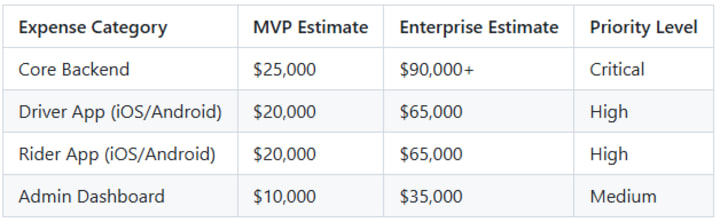
Starting small is smart. A basic MVP might set you back sixty to eighty thousand dollars. But wait. That is just for one platform. If you want iOS and Android, you are looking at double the work and double the testing.
Statista shows the ride-hailing market hitting $165 billion by 2028. Everyone wants a slice. But you cannot compete with a basic app anymore. Users expect a slick interface. If your app looks like it was made in 2012, they will delete it.
Technical Pillars That Drain Your Bank Account
The frontend is just the tip of the iceberg. The backend is where the real money disappears. Think about it this way. You are building a massive logic engine that needs to make decisions in milliseconds.
The Hidden Heavy Lifting of Real-Time Dispatch
Matching a driver to a rider is not a simple database query. It involves distance, traffic, driver ratings, and vehicle type. Doing this for one pair is easy. Doing it for five thousand pairs simultaneously requires serious engineering muscle.
"Scaling a logistics stack is not just about servers. It is about the math of moving things through physical space efficiently." — Gergely Orosz, The Pragmatic Engineer, [Source 7]
Mapping APIs and the Monthly Billing Nightmare
Google Maps is not free once you hit scale. In fact, it gets hella expensive. I have seen startups get a ten-thousand-dollar bill because they forgot to optimize their API calls. You need a team that knows how to cache data.
If you are fixin' to launch in a major city, your map usage will skyrocket. It is worth looking at an app development company philadelphia to help you navigate these licensing hurdles without going broke. They know the local tech stack requirements better than most.
Payment Gateways and Security Compliance Fees
You are handling people's money. That means PCI compliance. It means encryption. Not gonna lie, this part is boring but vital. You cannot afford a data breach. Hackers love targeting small apps with weak security.
Regional Price Wars and Talent Sourcing
Where you hire matters. A lot. But do not just go for the lowest hourly rate. I once worked with a team that charged twenty dollars an hour. It took them four hours to do what a pro did in one.
Why Local Knowledge Trumps Cheap Labor Every Time
A dev in a different time zone might not get your local regulations. For example, taxi laws in Texas are different from those in London. You need people who can bake those rules into the app logic.
Stick with me here. If your team cannot jump on a call during your business hours, progress slows to a crawl. It is tidy when things work, but it is tamping when they do not. Local communication is a massive hidden feature.
Comparing Global Development Rates in 2026
Prices have shifted. US rates for top-tier engineers now sit between $150 and $250 per hour. Eastern Europe is climbing too, now around $60 to $90. You might find cheaper in South Asia, but you have to manage them hard.
"Software is a leverage game. One great engineer is worth ten average ones. If you pay for mediocrity, you get a mediocre business." — @naval, [Source 6]
Operational Overheads Beyond the Initial Build
Congratulations, your app is live. Now the real bills start. You have to keep the lights on. Many founders forget that the launch is only the beginning of the taxi app development cost cycle.
Server Infrastructure and Cloud Scaling Expenses
AWS and Azure are great. They also want your money. As your user base grows, your server costs will climb. You need an architect who can set up auto-scaling so you do not crash during peak hours.
Plot twist. Sometimes the best way to save money is to spend more on optimization early. A well-written piece of code uses less CPU. Less CPU means a lower monthly cloud bill. It is a long game.
Maintenance Cycles and Post-Launch Survival
Android and iOS update their systems every year. If you do not update your app, it will break. Period. Budget at least 20% of your initial build cost for yearly maintenance. It is not optional.
Real talk. Most apps die because the founders ran out of cash for marketing and maintenance. They spent everything on the build. Do not be that person. Keep a war chest ready for the post-launch grind.
Future Trends Shaping the 2026 Budget
The world is changing fast. By 2026, a basic taxi app will not be enough to win. You have to look at what is coming next. If you do not, you are just building yesterday's tech.
Autonomous Vehicle Ready Architectures
We are not quite at Level 5 autonomy everywhere, but the tech is close. Your app needs to be ready to talk to self-driving fleets. This requires a different kind of dispatch logic. It adds cost now but saves you later.
Grand View Research suggests the on-demand market will grow 16.5% annually. Much of that will be driven by automation. If your backend is too rigid to adapt, you will be left behind by the robots.
AI-Driven Dynamic Pricing Models
Fixed prices are dead. You need algorithms that watch the weather, traffic, and local events. This is pure data science. It is expensive to build, but it maximizes your profit per ride.
"The business is about the platform. We are constantly investing in the tech that keeps drivers busy and riders happy. It never stops." — Dara Khosrowshahi, Uber CEO, [Source 5]
Actually, scratch that. It is not just about keeping them happy. It is about keeping the math sustainable. If your pricing is wrong, you lose money on every mile. AI helps you find the sweet spot in real-time.
Frequently Asked Questions
Q: How much should I budget for a taxi app in 2026?
A: You should expect to spend between $100,000 and $250,000 for a professional-grade platform. This covers the rider app, driver app, and a robust backend.
Q: Can I use a white-label solution to save money?
A: Yes, you can. It is much cheaper, often under $10,000. However, you will have very little control over the features and your app will look like everyone else's.
Q: How long does it take to develop a custom taxi app?
A: A typical project takes six to nine months. This includes design, coding, testing, and getting through the app store approval process.
Q: What is the biggest hidden cost in taxi app development?
A: Third-party API fees. Services like Google Maps, Twilio for SMS, and payment processors can eat a huge chunk of your monthly revenue if not managed.
Building this kind of tech is a marathon. You need a canny team and a realistic wallet. If you try to cut corners, the market will find out. But if you build it right, the rewards are braw.
I reckon you are ready to start. Just remember that the code is only half the battle. The other half is surviving the first year of operations. Good luck out there, mate. You are gonna need it.
The taxi app development cost is a moving target. Keep your eyes on the data and your hands on the wheel. This industry does not wait for slow movers or thin budgets. Ensure your 2026 strategy includes enough room for the unexpected.
About the Creator
Keep reading
More stories from Samantha Blake and writers in 01 and other communities.
Average Cost of Mobile App Development: Guide & Pricing (2026)
Asking for a fixed price on software is like asking a builder to quote a house without knowing if you want a shed or a skyscraper. I reckon most founders start this journey with a number in their head that is frankly, all hat and no cattle.
By Samantha Blake7 days ago in 01
What Does a Fitness App Actually Cost to Build in 2026
Calculating what a fitness app actually cost to build in 2026 is complex. You must look beyond simple hourly rates. The fitness technology landscape has shifted significantly recently. Basic tracking is no longer enough for users. Apps now require hyper-personalized, AI-driven coaching. They also need immersive and engaging experiences. For entrepreneurs, the investment is no longer just about coding. It is about building a data-secure ecosystem. You must also focus on high-retention systems.
By Devin Rosario4 days ago in 01
How to Fix 400 Bad Request Error Fast (3 Simple Steps)
Ever hit a sudden bad page and wondered why your browser can't talk to the site? A 400 malformed request error happens when the server refuses a client-side input it can’t parse. In plain terms, your browser sent a broken or corrupted request that the site could not understand.
By Majed Alzhrani5 days ago in 01
Worth the Wait: Puerto Viejo, Costa Rica
Beach bumming in a small Caribbean beach town sounded like a perfect way to end our 6-month trip through Mexico and Central America. Or so we thought. The foul, fishy stench of rotten seaweed hit our nostrils as we stepped from the cramped bus and looked out at a rather depressing, empty, and underwhelming black sand beach. It was pouring with rain, and we had to quickly fish out our ponchos. We thought, this couldn’t be it, could it?
By Sh*t Happens - Lost Girl Travel3 days ago in Wander



Comments
There are no comments for this story
Be the first to respond and start the conversation.