
Software & Application Maintenance Support Services
What Business Needs to Know


Post-Deployment Support & Maintenance
Building software is just the beginning. Keeping it alive—secure, stable, and adaptable—is where the real challenge (and value) lies. In 2025, application maintenance and support is no longer optional. It's a strategic IT function that can make or break a business.
Today’s digital infrastructure is a mess of patched legacy systems, custom workflows no one wants to touch, and silent integrations that keep mission-critical operations moving. When something breaks, it’s not “just an IT issue.” It’s stalled operations, frustrated users, potential security breaches, and compliance risks rolled into one.
Modern businesses—especially small and mid-sized companies without in-house tech teams—can’t afford to treat support as an afterthought.
Software support isn’t just about fixing bugs anymore; it’s about preventing them. It’s about avoiding disruption, keeping IT costs predictable, and ensuring your systems evolve with your business—not against it.
What Are Software & Application Maintenance Support Services?
Once software is deployed, it doesn’t just run itself. Applications evolve, environments change, and user expectations shift. That’s where software and application maintenance support services come in—they keep your systems stable, secure, and aligned with business needs long after launch day.
These services fall under three main categories: Support, Maintenance, and Application Management. While they’re often used interchangeably, they serve distinct purposes.
Definitions: Support vs. Maintenance vs. Application Management
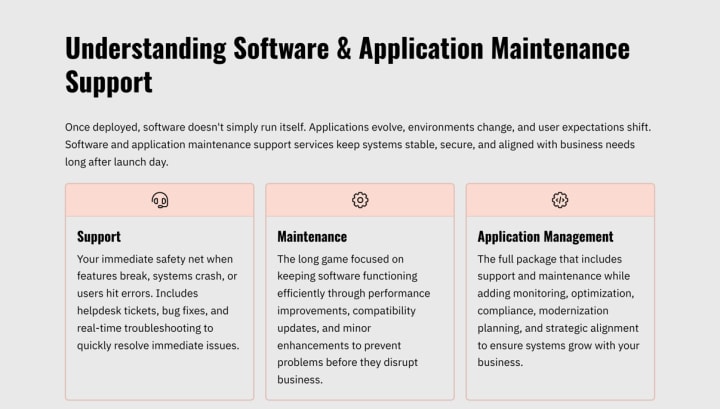
Support is your immediate safety net. When a feature breaks, a system crashes, or a user hits an error, support is what kicks in. Think helpdesk tickets, bug fixes, and real-time troubleshooting.
Maintenance is the long game. It’s the ongoing effort to keep software functioning efficiently—through performance improvements, compatibility updates, and minor enhancements. It helps prevent problems before they disrupt your business.
Application Management Services (AMS) go further. AMS is the full package: it includes support and maintenance but adds monitoring, optimization, compliance, modernization planning, and strategic alignment. It’s not just about keeping the lights on—it’s about making sure your systems grow with your business.
Four Types of Maintenance
Maintenance isn’t one-size-fits-all. It typically falls into four categories, each targeting a different need:
- Corrective Maintenance. Fixes bugs, errors, and failures found after deployment. It’s reactive, often triggered by user reports or monitoring alerts. This accounts for 20–25% of all maintenance work.
- Adaptive Maintenance. Adjusts your software to keep it compatible with new environments—whether it’s a new operating system, browser update, or regulatory change. It makes up roughly 15–20% of maintenance tasks.
- Perfective Maintenance. Enhances performance and usability based on user feedback or evolving requirements. It’s the biggest category, representing 25–30% of maintenance efforts.
- Preventive Maintenance. Identifies and addresses potential issues before they cause problems. Think of it as regular health checks for your code—code cleanups, database optimizations, security reviews. Around 10–15% of maintenance work falls into this category.

Tiered Support Levels: L1, L2, L3
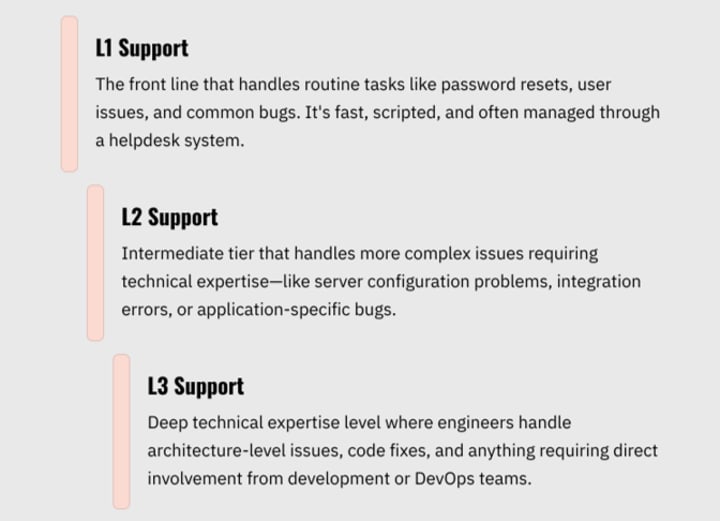
To deliver efficient support, service providers often structure teams into three escalation tiers:
- L1 Support – The front line. Handles routine tasks like password resets, user issues, and common bugs. It’s fast, scripted, and often managed through a helpdesk.
- L2 Support – Intermediate tier. Handles more complex issues that require technical expertise—like server configuration problems, integration errors, or app-specific bugs.
- L3 Support – Deep technical expertise. L3 engineers handle architecture-level issues, code fixes, and anything that requires direct involvement from development or DevOps teams.
Together, these tiers ensure that every issue gets the right level of attention—fast.
How the Market Is Evolving
Most teams don’t wake up thinking, “Let’s overhaul our support model today.” They wake up to Slack alerts, Jira queues, and a backlog of bugs nobody owns.
But here’s the quiet shift: the old model of support—reactive, ticket-based, and siloed—is breaking under pressure. The new model is embedded, automated, predictive, and deeply tied to delivery pipelines.
If your current support playbook was written five years ago, it’s already outdated. Here’s what’s changing—and what you can actually do about it.
1. From Firefighting to Forecasting
Smart monitoring tools detect issues like latency spikes or resource creep before users notice. You act on trend deviations, not outages. This reduces downtime and eliminates the 2 a.m. surprise.
2. AI and Automation as Multipliers
AI now handles triage, groups similar tickets, and suggests fixes based on past issues. It removes repetitive work so engineers can focus on solving the actual problem.
3. Support Lives in the CI/CD Pipeline
Support built into your release flow—tracking what changed, when, and why. That visibility makes it easier to prevent issues and faster to resolve them.
4. Outcomes > Hours
Hourly billing is being replaced with SLAs tied to uptime, resolution speed, and ticket reduction. If your support provider isn’t aligned with your success metrics, you’re paying for effort—not results.
5. The Support Role Has Evolved
Support engineers now write scripts, maintain observability, and automate fixes. They’re embedded in product and DevOps loops.
Common Pain Points in Application Support
These are the issues that consistently block teams, delay delivery, and increase operational risk. Fixing them is about improving performance, reducing cost, and staying compliant.
1. Downtime Costs (Across Industries)
Downtime has clear, measurable impact: lost transactions, missed SLAs, and internal productivity hits.
In finance, a 1-hour outage during trading = missed deals, reporting failures.
In logistics, delayed systems impact dispatch and delivery, creating a ripple across partners.
In SaaS, every incident increases churn and support workload.
What matters is not “if” downtime happens—but how fast you detect it, contain it, and recover. Many companies lack baseline metrics and auto-remediation paths, which turns small issues into prolonged outages.
2. Compliance Risks (HIPAA, GDPR, PCI)
Support often touches regulated systems—but doesn’t always follow compliant processes.
Missed patches or delayed upgrades can expose known vulnerabilities.
Logging and monitoring gaps reduce audit readiness.
Lack of role-based access or encryption handling leads to violations.
If your support model doesn’t include regular vulnerability checks, access audits, and SLA-tracked patch windows, you’re accumulating risk—especially in healthcare, finance, and retail.
3. Technical Debt & Legacy Systems
Legacy code, unclear ownership, and missing documentation all slow down incident resolution.
Support spends too much time re-learning systems instead of solving issues.
Fixes get delayed because making changes feels unsafe or too costly.
Every workaround increases future support load.
If your support team frequently says “I don’t know what this touches” or “Let’s leave it alone,” you’re in a reactive loop. The fix isn’t heroic effort—it’s traceability, documentation, and automated tests.
Conclusion
In 2025, application maintenance and support is about building systems that scale without surprises, meet compliance without friction, and stay available without burning out your team. That requires a shift—from reactive fixes to proactive systems, from hourly tickets to outcome-based accountability, and from siloed support to integrated delivery.
If your team is still firefighting, if downtime still catches you off guard, or if legacy systems slow every fix—you’re not alone. But the solutions are clear: automated monitoring, modern escalation paths, real-time metrics, and embedded support practices that work with your CI/CD, not around it.
Support is now a product discipline. And like any good product, it should improve over time. That starts with knowing where your gaps are—and taking practical steps to close them.
About the Creator
Alex Natskovich
Entrepreneur, engineer, Founder & CEO at MEV with a fundamental belief that every problem is an opportunity in disguise. Passionate about helping businesses win with the right technology.
Keep reading
More stories from Alex Natskovich and writers in 01 and other communities.
When Hospital AI Falls Flat
The first time the hospital team saw their new AI assistant, it felt like a glimpse of the future. The idea was simple. Patients would have a digital companion they could talk to about their own care. They could ask what a lab value meant, what a new medication was for, or what to expect after discharge. The assistant would pull in data from existing systems and explain it in plain language.
By Alex Natskovich28 days ago in 01
The Cultural Evolution of Handbags: From Utility to Identity
Handbags have long existed at the intersection of function, culture, and personal identity. Far beyond simple carriers, handbags reflect social change, craftsmanship traditions, and shifting ideas of self-expression. From early utilitarian pouches to contemporary luxury statements such as Loewe Bags, the handbag’s journey mirrors broader movements in fashion and society.
By charliesamuelabout 16 hours ago in 01
How Kaito Projects Are Structuring Post-TGE Marketing in 2026?
The Token Generation Event (TGE) marks a critical milestone for any blockchain project, but in 2026, the real challenge begins immediately afterward. The success of a project no longer depends solely on its launch; post-TGE marketing strategies have become essential for long-term growth. Kaito projects, in particular, are designing structured post-TGE strategies that go beyond hype, focusing instead on community engagement, token utility, liquidity management, and long-term sustainability.
By Jack santo5 days ago in 01
Let's Don't Do This
"I just can't do this anymore..." "Do what?" What can't you do? Put gas in your own car? I swear to God you make me take care of everything, don't you? You know I'm on my way to work right now but that never stops you from bothering me, does it?"
By Shirley Belk7 days ago in Fiction


Comments
There are no comments for this story
Be the first to respond and start the conversation.