
Shopify vs Custom Website: Choosing the Best Investment for 2024
Shopify vs Custom Website

Are you planning to build your own website with Shopify?
Are you concerned about making the right choice to develop a website for your business project?
If yes, this is the article that you will have to read to get the maximum benefits. If you really want to build a strong website, you might encounter these questions: Shopify vs Custom website
In this article , we will help you to answer all these questions. Our journey will start from learning about Shopify , Custom Websites and WordPress and we learn about pros and cons of all of these. Then we will be discussing the major differences between shopify and custom websites and also learn the right strategy to make the right decision.
What is Shopify?
Shopify is a user-friendly e-commerce platform that allows users to build and manage online stores, sell products, and accept payments. Shopify offers tools for product listings, inventory management, and payment processing. You can use it to sell on social media, blogs, websites, and other marketplaces.. In general, in-built templates are provided by Shopify. These built templates help the client to choose one of the templates among all. This can be very beneficial for small businesses. Shopify
What type of platform is Shopify?
Is Shopify A Paid Platform Or Free Of Cost?
Shopify is a subscription based platform.It is a subscription-based software-as-a-service (SaaS) platform, and plans range from $15–$299 per month, depending on the features. In addition to the monthly fee, there are also transaction fees and additional fees if you use a payment processor other than Shopify.
Are built-in templates good for your business websites?
This is the question that we generally encounter, when we decide what to choose between built-in templates or custom websites. Here’s an analysis of the pros and cons of using built-in templates to help you decide if they suit your business needs.
PROS:
Cost Effective: Built-in templates are cheaper as compared to those of self-built templates. Moreover, their development costs are also minimal.
Time-Efficient: These templates have pre-designed layouts and are faster than the custom websites.
Easy to use: Most templates are designed to be user-friendly, even for those without technical expertise. Many platforms with built-in templates offer drag-and-drop builders for easy customization.
Professional Designs: Many designs are designed by professionals for business purposes
Functionality: Templates often come with built-in features like contact forms, galleries, and e-commerce capabilities. Templates from reputable sources are often updated to fix bugs and improve security. The templates are quite user-friendly.
Advantages Of Using Shopify For Web Development
CONS:
Limited Customization: Templates can be limiting in terms of layout and design flexibility. Customizing beyond the provided options can be difficult. That is why the scope of customization is limited.
Branding Limitations: The number of brands in these templates are limited.Templates might not fully support unique branding elements such as custom animations or interactive features.
Dependence on template providers: You are dependent on the template provider for updates and support. If the provider discontinues the template, you may face issues.
Performance: The templates might be saturated with some features which are of no use to you. This might have a negative impact on the performance of the site.
Cost-factor: Most of the templates and other features are paid. That is why they are not that cost effective, in the long term. They might seem to be cheaper in starting but in long duration they are not.
Other issues: In built-in templates, it is very difficult to make changes. Sometimes, we have to apply CSS in a forced manner. It is very difficult to make changes in the templates.
Disadvantages Of Built-In Templates
Disadvantages Of Built-In Templates
What is a Custom Website?
A custom website is a website that is designed and developed from scratch, designed specifically to meet the unique needs and requirements of a business or individual. Unlike websites built using pre-designed templates, a custom website provides complete flexibility and control over the design, functionality, and user experience.
Are Custom Websites Paid?
Yes, developing a custom website typically involves costs, as it requires the expertise of professional web designers, developers, and possibly other specialists. Therefore, most of the custom websites are paid.
Are Custom Websites Suitable For Business Projects?
Yes, custom websites are highly suitable for business projects, particularly those with specific needs, unique branding, or complex functionalities. Moreover, we can easily understand their usage in the following section where we discuss the major pros and cons of a custom website.
PROS:
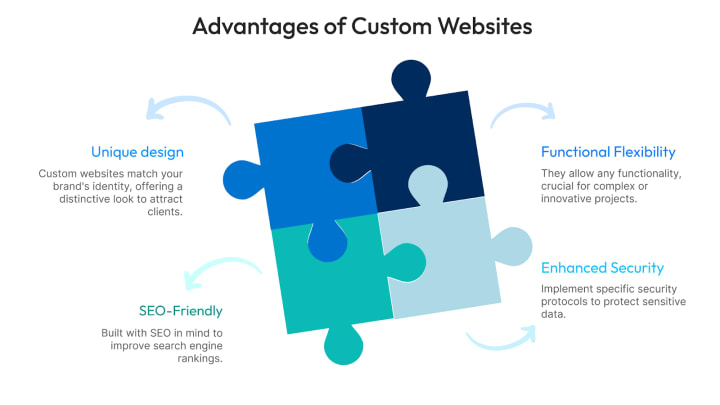
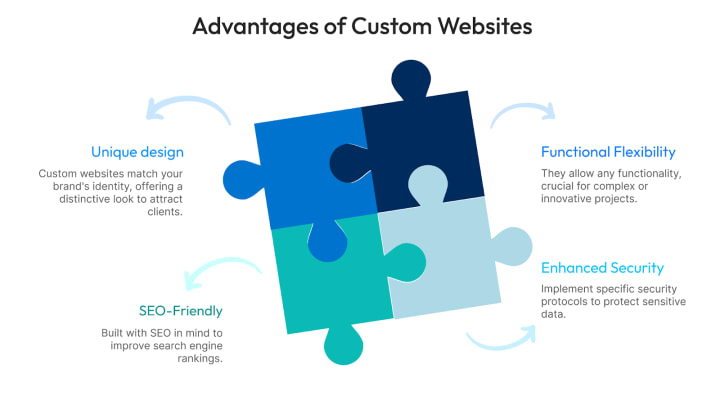
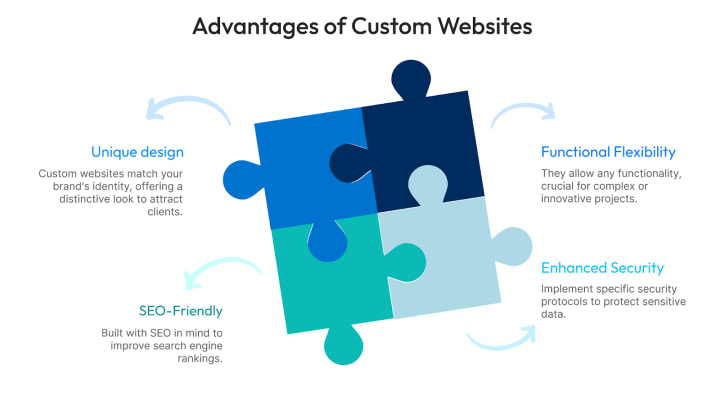
Unique design: Custom websites are designed to match your brand’s unique identity, ensuring a distinctive look and feel. These designs are generally made to attract the clients.
Flexibility: Custom websites provide the flexibility to implement any functionality, which can be critical and useful also for complex or innovative projects.
SEO: Custom websites can be built with SEO in mind from the ground up, improving your chances of ranking higher in search engine results.
Security Measures: Custom websites can implement particular security protocols as per your business needs, protecting the sensitive data. Regulations: Custom websites can be designed to meet industry-specific regulations and standards, such as GDPR, HIPAA, etc.
CONS:
Higher Initial Cost: Custom websites generally have higher upfront costs compared to template-based solutions due to the particular design and development process.
Time Required: Developing a custom website takes more time, from initial planning and design to development, testing, and deployment.
Professional Help: Requires access to skilled web designers and developers, either in-house or through a reputable web development agency.
Complexity: Implementing updates or adding new features might require developer intervention and this is generally complex to do.
Is the arena of tools limited to Shopify and Custom Website? Well, we have many such tools available in the market. One of them is
WordPress. Let us learn about WordPress in detail:
What is WordPress?
WordPress is one of the most popular content management systems (CMS) available, powering over 40% of all websites on the internet. It’s known for its ease of use, flexibility, and large ecosystem of plugins and themes.
Is WordPress useful for business projects?
Yes, it is highly useful in many of the business projects and tasks due its flexibility and easy usage. Now, let us analyze the major pros and cons of the wordpress:
PROS:
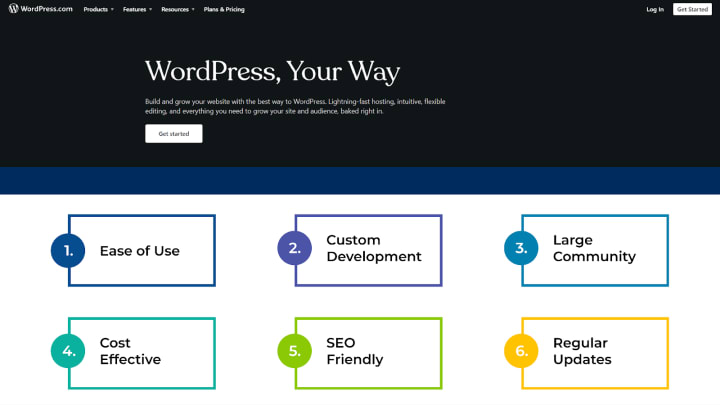
Ease of use: WordPress has an intuitive interface that is easy to use, even for beginners. It doesn’t require extensive technical knowledge. It is quite user friendly.
Custom Development: For those with technical skills, WordPress offers extensive customization options through custom themes and plugins.
Large Community: WordPress has a vast community of developers, designers, and users who contribute to forums, create tutorials, and develop plugins and themes.
Cost Effective: The core WordPress software is free to use. Costs come from hosting, premium themes, and plugins.
SEO: WordPress is built with SEO in mind, offering clean code and various plugins like Yoast SEO to enhance your site’s search engine optimization.
WordPress Your Way
CONS:
Security: Being popular, WordPress sites can be targets for hackers. Using security plugins and best practices is essential.
Compatibility Issues: Plugins and themes from different developers can sometimes conflict, causing functionality issues.
Speed-Optimization: Without proper optimization, WordPress sites can become slow, especially with many plugins installed.
Regular Updates: Frequent updates improve security, add features, and enhance performance.
We have analyzed the pros and cons of all the three major topics. Now, let us see the difference between Shopify and a custom website.
About the Creator
Werbooz Private Limited
Werbooz offers a range of digital services including custom website solutions. With a team of skilled professionals, they transform ideas into stunning digital experiences, ensuring startups and businesses succeed in the digital landscape.
Keep reading
More stories from Werbooz Private Limited and writers in 01 and other communities.
Component Libraries: Should You Build Your Own or Use a Prebuilt One?
Component libraries are a vital tool in web application development in maintaining uniform design, shortening the time taken to develop web applications and improving reusability of the code. Some developers find this dilemma; should they create a component library or use an existing one? In addition, they help reduce the struggle while building well-designed and interactive websites because of the availability of animation-oriented UIs such as Accentricity UI among others. Now, let’s get more to the point in order to help you find the right way.
By Werbooz Private Limitedabout a year ago in 01
How Application Modernization Services Drive Digital Transformation
Many organizations still rely on legacy systems that were built years—or even decades—ago. While these systems may have served businesses well in the past, they often struggle to keep up with today’s rapidly evolving digital landscape. Slow performance, security vulnerabilities, lack of scalability, and limited integration capabilities can prevent companies from innovating and delivering modern digital experiences.
By Ian Barnarda day ago in 01
How Crypto Arbitrage Bots Find Opportunities Humans Often Miss
The cryptocurrency market operates 24 hours a day, seven days a week, across hundreds of trading platforms around the world. Unlike traditional financial markets that follow fixed trading hours, crypto markets are constantly active, creating continuous fluctuations in asset prices. Because different exchanges operate independently, the same cryptocurrency can sometimes be priced slightly differently across platforms. These price differences create opportunities for a trading strategy known as arbitrage.
By smithtaylor3 days ago in 01
Why Didn't Anyone Tell Us
Men, move along. This is not for you. This is for the women. I was forty-five when I began menopause. It is pretty young for that to be going on in a woman’s life, but I had undiagnosed PCOS, my entire life. Thank you to all the gynecologists I had seen my entire life. That in itself should encourage women to keep seeking second opinions, especially when you are not getting correct answers or any at all.
By Alexandra Grant2 days ago in Humans



Comments (1)
Great article