
SEC Chair Paul Atkins Proposes New Crypto Token Categories — And It Could Change Everything
For the first time, the SEC openly admits most digital assets may not be securities.

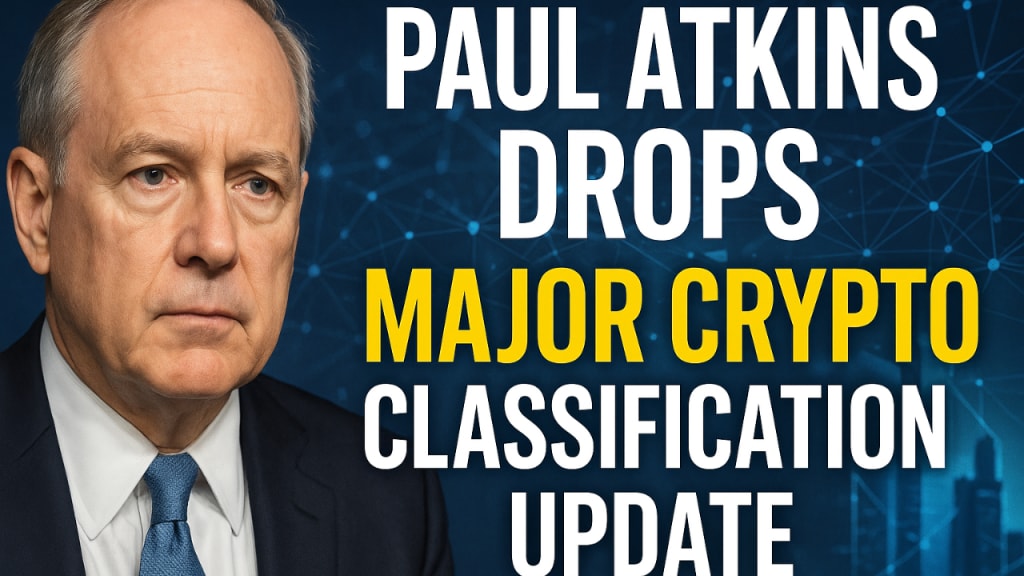
For the first time in years, the U.S. Securities and Exchange Commission is speaking clearly about crypto — and the message is surprising.
According to SEC Chair Paul Atkins, most cryptocurrencies are not securities.
Not in theory.
Not in practice.
Not under the agency’s new approach.
This marks one of the biggest policy shifts in modern crypto history, and it’s happening as a result of “Project Crypto,” an initiative Atkins says was launched earlier this year as part of the broader regulatory realignment under President Donald Trump.
And for an industry desperate for clarity, this could be the beginning of the regulatory framework it has been waiting for.
A Token Taxonomy America Actually Understands
Speaking at the Federal Reserve Bank of Philadelphia, Atkins laid out a simple idea that somehow took regulators a decade to articulate:
Not all crypto is the same — so it shouldn’t be regulated the same.
Instead of forcing every token into the securities bucket, Atkins outlined four categories that the SEC believes will form a “coherent token taxonomy” moving forward:
Digital commodities or network tokens
Digital collectibles
Digital tools
Tokenized securities
For anyone who has lived through the chaos of the last eight years — lawsuits, conflicting statements, “regulation by enforcement,” and endless uncertainty — this clarity feels like a revolution.
Because under this model, most cryptocurrencies would not be considered securities.
What Isn’t a Security? More Than You Think.
Atkins explained that digital commodities — tokens that power decentralized networks — should not fall under securities law.
The same goes for digital collectibles (think NFTs) and digital tools (utility-style tokens used for access or functionality).
Why?
Because buyers of these assets are not expecting profits “from the essential managerial efforts of others,” which is the core requirement of the Howey Test.
In other words:
If a token is used to run a network → Not a security
If a token is bought as a collectible → Not a security
If a token is a tool to access a product → Not a security
This is the kind of distinction crypto has been begging regulators to acknowledge for years.
And now the SEC is finally saying it out loud.
What Is a Security? Tokenized Financial Instruments
The one category that clearly does fall under securities law:
tokenized securities — digital assets representing ownership of stocks, bonds, or other financial instruments.
This is traditional finance, just on-chain.
So the classification makes sense.
But Atkins didn’t stop there.
He added a nuance that has massive implications for past enforcement actions — and future innovation.
A Token Can Start as a Security… and Stop Being One
This is the statement crypto lawyers will be quoting for the next decade:
“Once the investment contract can be understood to have run its course, the token may continue to trade, but those trades are no longer securities transactions simply by virtue of the token’s origin story.”
Translation?
A token that initially meets the Howey Test can evolve beyond it once:
the network becomes decentralized,
managerial efforts are no longer driving value,
and buyers no longer rely on an issuer.
In other words, a token’s past does not define its future.
This is groundbreaking.
It acknowledges something the crypto industry has known for years but could never get regulators to say publicly:
A token can transition out of being a security.
That single sentence could reshape how projects launch, grow, and decentralize.
The Beginning of a New Regulatory Era?
If Atkins’ framework becomes the official stance of the SEC, it would mark a major departure from the last decade of ambiguity and antagonism.
Instead of assuming crypto is guilty until proven otherwise, the agency may finally be adopting a more nuanced view of digital assets — one that aligns with how people actually use them.
It also signals something bigger:
The United States may finally be preparing to compete in global crypto innovation, not chase it away.
The framework isn’t final.
Congress still needs to act.
But for the first time in years, the direction feels constructive instead of destructive.
Crypto might finally be getting the clarity it deserves.
Final Line
After years of confusion, lawsuits, and mixed signals, the SEC is finally saying the quiet part out loud:
most crypto isn’t a security — and the future of digital assets deserves a better framework.
Author’s Note
This article was created with the assistance of advanced AI — a tool I will continue using to break down regulatory developments, analyze policy shifts, and deliver clear insights as crypto enters a new era of legitimacy.
About the Creator
Crypto Robot
Welcome to Crypto Robot! 🤖
Stay ahead of the game with the latest crypto news, financial advice, and actionable investment insights. Whether you're a trader or just starting your crypto journey, Crypto Robot is here to guide you.
Keep reading
More stories from Crypto Robot and writers in 01 and other communities.
Why Is Crypto Crashing Despite All the Good News? The Real Reasons Behind the Bear Market
Crypto is drowning in good news — and somehow still crashing. Bitcoin, Solana, Ethereum, and XRP have all fallen more than 20% from their recent highs, officially pushing the market into bear territory.
By Crypto Robot2 months ago in 01
Blockchain Tracing: A Key Tool in Crypto Asset Recovery
The cryptocurrency ecosystem has expanded rapidly, with billions of dollars in digital assets now in circulation across thousands of blockchains. However, this growth has been accompanied by significant risks, including hacks, scams, phishing attacks, and user errors such as lost private keys or forgotten seed phrases. In 2025, reported losses from crypto-related incidents exceeded several billion dollars, highlighting the persistent vulnerability of digital assets. Unlike traditional banking systems with reversible transactions and centralized oversight, blockchain's decentralized and immutable nature makes recovery difficult once funds are transferred. As a result, blockchain tracing has emerged as an essential method for identifying fund flows, attributing activity, and supporting recovery efforts in actionable cases.
By Garry Oneal2 days ago in 01
Top Enterprise Software Development Companies in 2026
The use of enterprise software has become imperative in the efforts by businesses to optimize, become more efficient, and grow in a safe digital competitive space. The adoption of cloud technology, artificial intelligence, automation, and data technologies, especially within the current digital era, means that businesses are seeking the help of skilled software partners.
By Olivia Cartera day ago in 01




Comments
There are no comments for this story
Be the first to respond and start the conversation.