
Scientist have invented the unexpected!
Turning light into super solid is a big move
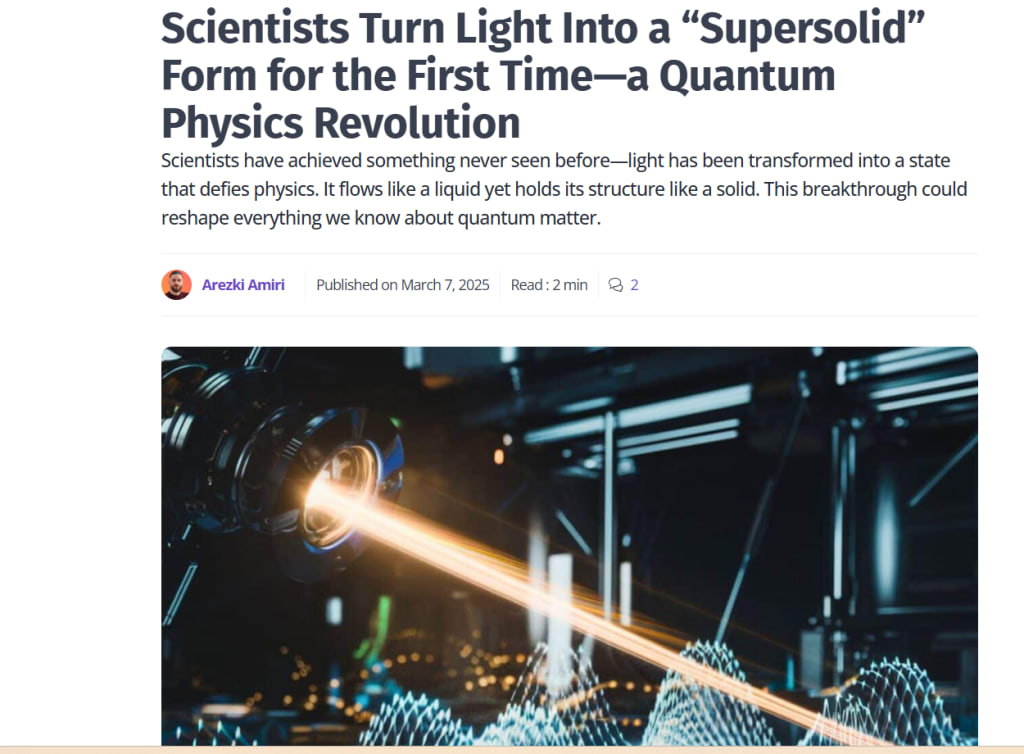
Light has fascinated scientists and philosophers for centuries, being both a wave and a particle. But in a revolutionary advance, scientists have been able to make light behave like a super solid—a material that possesses the solidity of a solid and the frictionless flow of a superfluid. This challenges centuries of ideas about the nature of light and promises new hope in quantum physics and exotic materials.
Light, in its natural state, is massless and non-interacting with itself under normal conditions. It moves unimpeded, free from the binding conditions that describe normal matter. However, researchers have long wondered if under the right conditions, photons—light's particle constituents—could be coaxed into behaving more like normal matter. By confining and manipulating light in highly optimized environments, scientists have been able to get photons to interact with each other, ultimately forming a structured state that resembles a solid. This achievement is a huge step forward in understanding and controlling quantum materials.
One of the most promising ways of achieving this state is by using Bose-Einstein condensates (BECs), a state of matter which occurs when a gas of bosons is cooled to temperatures only slightly above absolute zero. In these very cold conditions, particles lose their individual properties and begin to behave as a single quantum entity. In 2017, researchers at ETH Zurich had shown the demonstration of a super solid state in ultracold rubidium atoms in an optical cavity. By controlling the atoms with precisely engineered laser fields, they were able to achieve a state in which the atoms were simultaneously a solid and a superfluid.
Following this work, additional work explored making light itself exhibit supersolidity. In 2020, MIT and other physicists developed a system where photons were trapped and made to interact in a way that mimicked the behavior of heavy particles. They achieved this by trapping photons in a specially designed medium, like an optical cavity with nonlinear materials that controlled the way light particles interacted. In this setup, the photons gained effective mass and began to form ordered, lattice-like structures, similar to the rigid arrangement of atoms in a solid. At the same time, these photons retained the characteristic of frictionless motion, a feature of superfluidity. This duality is what characterizes a super solid.

The possible implications of this research are vast. Super solids, whether composed of atoms or manipulated photons, hold the promise of revolutionary advances in quantum technology. They could result in new types of quantum computers that take advantage of the strange properties of supersolids to compute information faster and more efficiently. Moreover, light control in such a manner would pave the way for new possibilities in photonic materials, which can be employed to enhance optical communications systems, laser technology, and even simple physics experiments challenging the nature of reality at the quantum level.
Despite these advances, work on super solids using light remains in its early days. There is much still unknown about the stability, scalability, and utility of this strange state of matter. But the reality that light, something that for a long time had been considered intangible and massless, can be converted into an organized, interactive state bewilders our customary understanding of physics. The more research that is done, the greater the chances that scientists will discover even more astonishing characteristics of light, expanding the limits of what might be accomplished in both basic science and technological development.
This discovery is not only a milestone in condensed matter physics but an indication of the creativity and wonder of humanity. To be able to transform light into a super solid—something previously confined to theory only—helps to demonstrate that our understanding of the universe is still growing, and with every new advancement, there are new opportunities for the future.
About the Creator
Keep reading
More stories from Suriya Akter and writers in 01 and other communities.
I know you have never heard about this planet before!
Far outside the bounds of our own solar system, in the constellation of Pisces, is a planet that defies everything we've ever known about worlds. This exoplanet, WASP-76b, is something that cannot be found in our corner of the universe. It is a hot, metallic, stormy planet where the sky is ablaze with blistering heat, and the air is thick with iron vapor. At night, something absolutely amazing happens—the fiery metal precipitates and rains down from the sky in molten iron.
By Suriya Akter12 months ago in 01




Comments
There are no comments for this story
Be the first to respond and start the conversation.