
Scaling Your AEC Firm: 7 Reasons a Dedicated BIM Strategy Wins Over the Gig Economy
From Project-Based Freelancing to Institutional Growth: Why Consistency is the New Competitive Advantage in AEC.

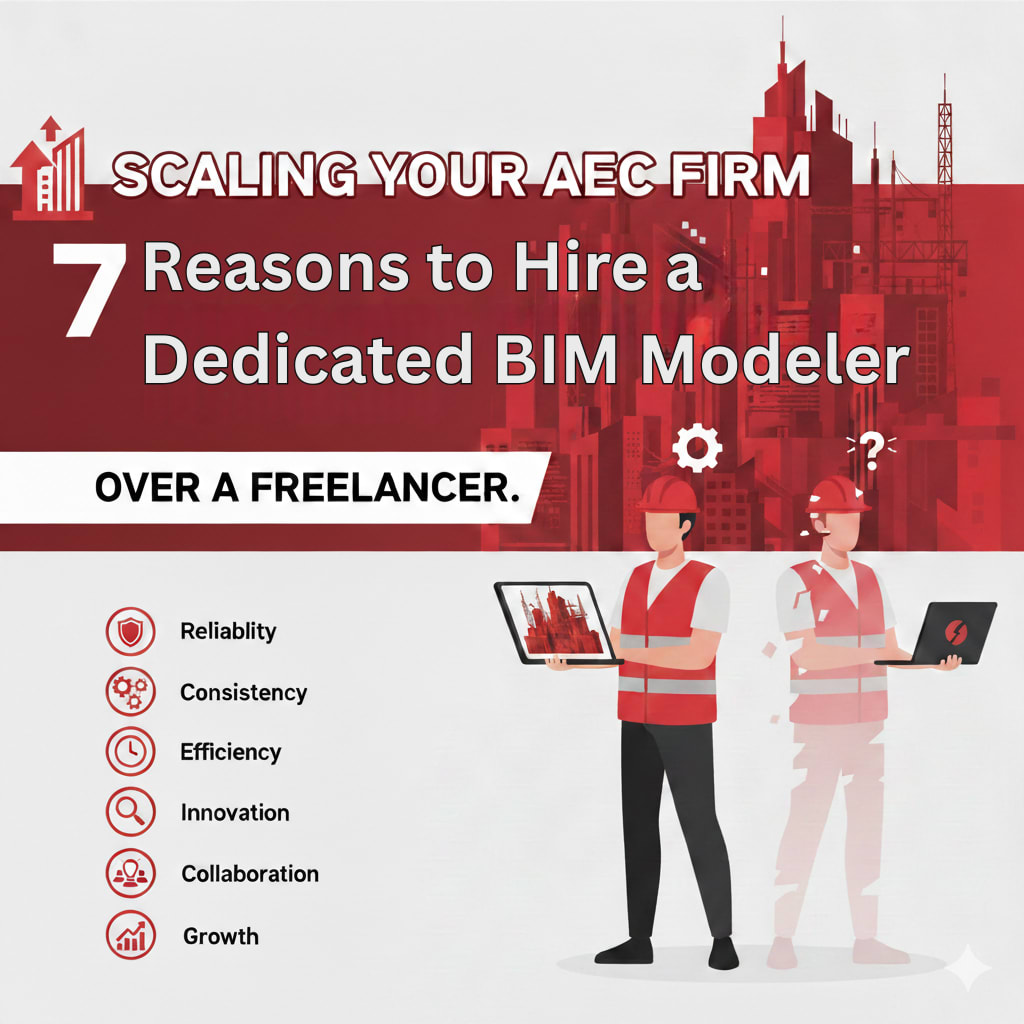
The $15.8 Trillion Opportunity: Why Structural Integrity Matters in Your Scaling Strategy
The global construction market is on a trajectory to reach $15.8 trillion by 2030. Yet, a sobering report from McKinsey reveals that industry productivity has stagnated, averaging only 1% annual growth over the last twenty years. For many Architecture, Engineering, and Construction (AEC) firms, the hurdle isn't a lack of opportunity—it’s the capacity to deliver with surgical precision.
As boutique studios evolve into mid-sized powerhouses, the "gig economy" approach to Building Information Modeling (BIM) often hits a glass ceiling. While freelancers provide a temporary band-aid for project overflows, a dedicated BIM partnership is becoming the hallmark of firms that successfully bridge the gap between "getting by" and truly scaling up.
The Digital Backbone: Beyond Transactional Drafting
Scaling an AEC firm requires more than just "extra hands"; it requires a digital backbone. In today’s market, BIM is a functional and regulatory necessity rather than a luxury. However, the nuances of ISO 19650 standards and Level 3 BIM maturity require a consistency that short-term freelance relationships rarely sustain.
When a firm chooses to hire a dedicated BIM modeller, they aren't just purchasing hours; they are cultivating institutional knowledge.
1. Preserving Your "Architectural DNA"
Every firm has a specific "DNA"—a unique method for handling Revit families, layering, and annotation. Freelancers, often balancing 3–5 clients, naturally lean toward their own established workflows. This often results in "model drift," where every project file behaves differently, creating internal chaos. A dedicated resource adopts your standards as their own. Since Dodge Data & Analytics identifies "standardization of workflows" as a top driver for BIM ROI, this alignment is critical for your bottom line.
2. Eliminating the "Context Switching" Tax
Research from the American Society of Civil Engineers (ASCE) points to information loss during handoffs as a leading cause of rework. In a freelance model, project-specific intuition often vanishes once the invoice is settled. Conversely, a dedicated modeller retains the "why" behind design decisions made during the schematic phase. This longitudinal memory can reduce RFI cycles by an estimated 20–30%.
3. Professional-Grade Data Security
In an era of increasing cybersecurity threats to physical infrastructure, the AEC sector is a high-value target. Working with a structured dedicated resource provider offers security layers that independent contractors cannot provide. This includes:
Encrypted Data Transfer: Utilizing secure VPNs and BIM 360 environments.
Enforceable Legal Protections: Robust NDAs and clear IP ownership.
Hardware Redundant Environments: Ensuring your data doesn't sit on a personal laptop in a public space.
4. Cultural Integration vs. Software Access
High-growth firms thrive on a Common Data Environment (CDE). Integration here isn't just about technical access; it’s about team culture. A dedicated BIM modeller acts as a virtual extension of your team, attending coordination meetings and troubleshooting in real-time. This synchronization is vital for "Just-in-Time" (JIT) modeling—allowing the team to pivot instantly when a structural change occurs, rather than waiting 48 hours for a freelancer to become available.
5. Proactive Clash Detection
A Stanford CIFE study found that BIM can reduce contract values by up to 10% through effective clash detection. However, this requires an intuitive understanding of a firm’s specific engineering constraints. Dedicated modellers learn your preferences over time, allowing them to anticipate clashes before they appear in the model—a skill developed through collaboration, not short-term tasks.
6. Managing the "S-Curve" of Growth
The biggest challenge for AEC leaders is having too much work for current staff, but not quite enough to justify a local, high-salary hire with full benefits. The dedicated model provides a "middle path," allowing you to scale production capacity by 100% or more without the fixed overhead of physical office space or the price volatility of the freelance market.
7. Navigating Global Compliance
As you scale into new regions, you encounter a minefield of varying building codes and BIM mandates, such as Singapore’s BCA guidelines or the UK’s specific mandates. A dedicated partner brings experience across multiple jurisdictions, ensuring your models are compliant from day one, whether the project is in London, Dubai, or New York.
A Path Forward: Transitioning Your Firm
To move away from fragmented freelance reliance, consider these three steps:
Audit Rework Hours: Quantify how much time is wasted "fixing" external files.
Standardize Your Tech Stack: Ensure your partner uses identical software versions to prevent file corruption.
The Pilot Test: Transition one complex project to a dedicated modeller to benchmark quality against previous efforts.
The future of AEC belongs to those who prioritize collaboration over transactions. As Digital Twins and AI-driven design become standard, the need for a stable, dedicated digital workforce will only intensify. Firms that invest in these partnerships today are building the infrastructure to dominate the high-margin projects of tomorrow.
About the Creator
Tesla Outsourcing Services LLC
Since 2007, Tesla Outsourcing Services LLC has delivered BIM, CAD, VDC, and engineering design solutions for AEC firms worldwide
- Flexible Pricing
- Industry Best Quality
- Expert Architects and Engineers
- 4H: Honesty, Humility, Hard Work, Harmony
Keep reading
More stories from Tesla Outsourcing Services LLC and writers in 01 and other communities.
Life Cycle Analysis and Performance Evaluation using BIM
As there is a global push towards more sustainable development, the construction industry is also adopting practises to meet its sustainability goals. Lifecycle analysis and performance evaluation are two important aspects of sustainable construction. Building Information Modelling, also known as BIM, is an effective tool that is used to implement lifecycle analysis and performance evaluation. In this article, we will discuss in length how lifecycle analysis and BIM can be used to achieve sustainable construction.
By Tesla Outsourcing Services LLC3 years ago in 01
Can Crypto Rewards Programs Help Make Digital Currency Mainstream?
Digital currencies have changed how a lot of people think about money. Crypto gave people new ways to send payments, invest, and use financial tools online. Still, for many people, it’s not part of everyday life. For now, it still feels separate from how people usually spend money. Is it too futuristic? Too confusing? Or just different than what we’re used to? It’s probably a combination of everything.
By Mark Arthurabout 15 hours ago in 01


Comments
There are no comments for this story
Be the first to respond and start the conversation.