
Roadmap to Content Marketing
Should you expedite your social media first or SEO? Does running your Google ads before building an SEO-tuned website make a difference?

Content Marketing produces the most effective result when deployed strategically and step-by-step. So, where do you start? At what stage of the process should you deploy Google Ads or Social Media Ads? Should you build a social media presence for your brand first or create a presence on the search engine? At what stage should you deploy PPC-Ads? At what stage of a buyer's journey should you retort to email marketing & newsletters? All these are summarized in our Roadmap to Content Marketing.
Roadmap to Content Marketing:
Content marketing is the most valued form of marketing right now. Ask any veteran marketer, and they will agree. IoT and integrated digital platforms mean prospects are always looking for a way to engage with brands. Ease of information access means that users conduct their research before purchasing. Because of this, content marketing is becoming interactive. Add to that the advent of Data Analytics, and behavioral and intent-based data are becoming priceless. Due to these reasons, Content Marketing is getting hyper-personalized.
Content will drive your website traffic and social media engagement and help you reach your ideal audience. Because content marketing is so broad and massive, marketers often need help to narrow down the activities. But above all, they need to catch up on resonating with the audience to gain the strategic implementation of content marketing via different channels.
No matter what funnel you follow, guiding your buyer through every stage requires carefully aligning your messages with the buyer's intent and the stage at which they are. Lack of this results in haphazard execution of content strategy, incorrect measurement of metrics, pointless stuffing of content, and no impact to show for it. Many organizations have tons of content lying either idle or have gone cold, failing to bring any traffic. As a result, content marketing gets blamed for failing to fetch the desired results. Hence, it is unsurprising & evident that over 90% of the content gets no traffic from Google. (Source: https://ahrefs.com/blog/search-traffic-study/)
All of these can be solved by implementing a long-term vision. And building a Roadmap to Content Marketing is the perfect way to go about it. It gives you a clear path to follow and adequately maps the activities you must execute at every step.
A content marketing roadmap is a methodology to implement and visualize your plan centered around your goals and objectives to produce a seamless and cohesive experience for the audience. The Content Marketing Roadmap will help you meet your deadlines, be better organized, and give you a sense of direction to gauge your marketing efforts.
Why do you need a content marketing roadmap?
What blueprint is to an architecture, content marketing roadmap is to a marketer!
Firstly, you can plan in advance and streamline your marketing efforts. A detailed content marketing roadmap helps you prioritize your tasks. Based on the buyer's stage, you can (well in advance) create relevant activities to engage them. Brands often launch their communication all at once across various platforms. This can be a bad strategy. You must identify your traffic magnet platform first. The platform that is fetching maximum traffic. Using your most visited platform for redirections is ideal for growing your presence across average-performing platforms. You can visualize such nuances better with a content marketing roadmap. Not only do you prioritize better, but you also plan in advance.
Secondly, because roadmaps enable you to prioritize your activities in advance, aligning your sales and marketing efforts is easier. From product launches to creating relevant digital campaigns, you will be able to focus on minute details that can significantly impact your marketing strategies. A lack of content marketing roadmap makes marketers go round & round on a red herring chase. A direct result of it is disconnected and discontinuous sales and marketing efforts. A sound roadmap will help you align each aspect of the campaign. This gives you a cohesiveness across isolated platforms to build a consistent brand identity.
Thirdly, roadmaps are a great way to visualize your progress. Today, many project management tools come with an interactive dashboard that enables you to visualize your campaign timeline. You can also calculate your team's burnout rate and the potential you can achieve with your team. These parameters will help you manage your team better, thereby reducing burnout and increasing potential.
And most importantly, a roadmap ensures everything you and your team do is aligned with your overall marketing goals. Randomly creating content will go dead and cold with no measurable output. A content marketing roadmap focuses on your overall marketing ROI and objectives. Everything you do has a purpose with a marketing roadmap.
Building a fail-proof Content Marketing Roadmap:
The following content marketing roadmap is a series of actions you can pre-plan irrespective of your client, industry, and trends. As per the objective for the project, you can tweak the roadmap, but the overall outline remains the same. If you want to build a content marketing roadmap from scratch, the following steps will help you get started.
The roadmap has been designed considering how we can build the brand for the client while being customer-centric. The roadmap also ensures the user will be assisted at every touchpoint in the buyer's journey from discovery to the post-purchase phase. Each step in the roadmap has its utility and dos & don'ts.
Start with building an organic presence:
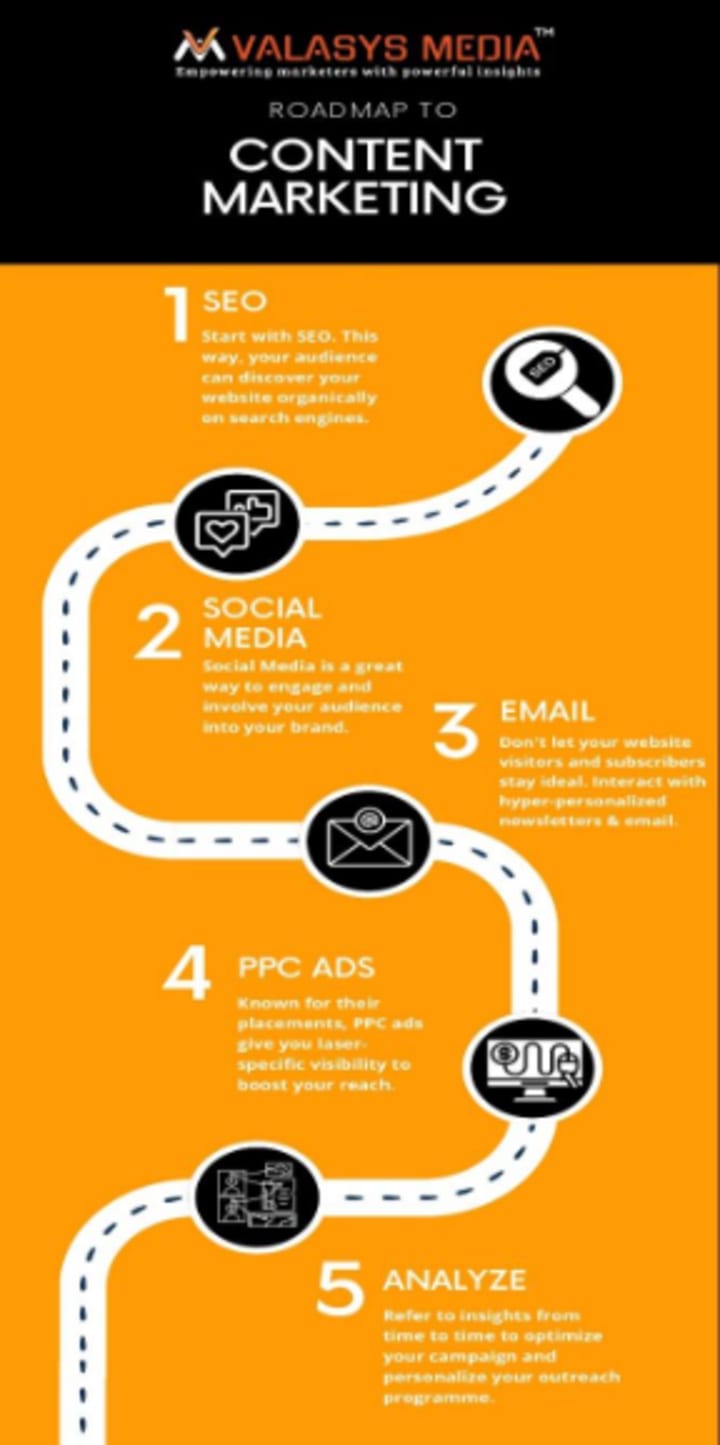
The first touchpoint for most customers and buyers to look for a product or a service is usually Search Engine. Google, to be more specific. Whether you are looking for a product, service, shoe, or restaurant, user-initiated discovery starts at Google. Over 46% of product search begins at Google. (Source: ecommercedb) Therefore, dominating the search engines in the early phase of a user journey is crucial. Hence, your content strategy must focus on designing SEO-tuned websites that are search-engine friendly.
Search Engine Optimization is an organic method to create a digital presence. That too, over Google, the most visited website of all time. With 8.5 billion search queries daily, failing to develop a presence on Google will be a colossal miss. (Source: Internet Live Stats, 2022)
You create unmatched visibility by organically ranking on this mega search engine. Your website should be built in such a way that your brand or business becomes synonymous with the search term (keyword) the audiences use to find the product or service they are looking for.
This is the 1st phase of your digital visibility. So, it's vital that you get certain aspects right. SEO is a time-taking process. From 6 months after your launch, you will see measurable results. Stay calm if things do not pick up from the get-go. Your priority should be to get your website to the 1st Search Engine Result Page (SERP).
"Here's something to give you a little perspective on why you NEED to be on the first SERP. For any search term, Google can produce up to 3 million results in a fraction of 0.0000065 seconds. And out of 1 billion users, only 0.63% of them click on the second page of SERP. (Source: Backlinko, 2022) The competition is stiff, so your sole focus should be to rank your website as high as possible."
How can you do so? There are tons of methods an SEO expert will suggest. Link building, guest blogging, syndicating content, local SEO, and directory listing are some ways to do it. However, do not spam your website by stuffing your keyword.
Now that you are done building a general digital presence, it is time to be more specific. So, what's next?
Simultaneously, create visibility and reach a wider audience through social media:
So, a microsite, a landing page, or a website is up. People are searching for you online. But how do you boost your presence? How do you tell everyone about your brand and reach a wider audience? Typically, they are searching for something other than the product or the service. How do you tap into the audience who are yet to discover you? We got two words for you: social media!
Websites offer you visibility. But how about interacting and engaging with your audience? How about telling them your brand story and keeping them engaged? Social media is the answer. You can build your brand, make yourself relevant, connect with your audience on a more micro level, and convert the awareness into interest. Not only are your users able to discover you, but they become actively interested in your brand.
But why do you need all these social media shenanigans? Over half the world's population is on some social media profile. Not only do you get more eyes on your brand, but you can also garner attention from other brands, collaborators, and influencers.
Brands, businesses, and even entrepreneurs use one form of social media. Take Elon Musk, for example. He has been so active on Twitter that he ended up buying it. Such is the power of social media platforms.
You are in the second stage of your journey. Social media is an excellent way to convert the awareness of your audience into interest. Social media will help you understand audience behavior more closely. You can learn what type of content, tone, visuals, and even messages resonate with your brand's audience the most.
Also, for businesses that are based on other models apart from websites, you, too, can leverage social media. Not just to promote and increase reach but also to sell your products directly on the platforms. And with the growing importance of Shopify, these platforms are interconnected, making it easier for business owners and consumers to sell and buy commodities, respectively.
Social media needs a different tone than your website. Be relatable, be humorous, be funny, be timely, be trendy, be quirky, and be regular. And above all, be innovative and creative in your messages. There is no point in becoming redundant and repetitive where the attention span of the user is the least.
"At this stage, you must redirect your traffic from your high-performing platform to the averagely-performing platform. Use an omnichannel marketing approach to integrate your isolated channels for cohesive messaging. Follow your customers where they are and cover all possible touchpoints they are supposed to visit. If you have good traffic on your social media, redirect them to your website and vice versa. This gives your traffic a taste of your variety in communication and in-depth access to your brand or business."
However, the biggest advantage of social media is the insight you obtain. By analyzing the digital footprints of the traffic, you harness on your social media platforms, you can map and chart the user behavior, preferences, activity hours, age & demography, and everything in between to personalize your outreach programs. The quickly you master the art of interpreting social cues, the better it is for your growth.
Interact on a personal level with your subscribers via Email Campaigns:
The first two steps focus on bringing in new & nascent traffic. A website gives you visibility, and social media increases your reach, primarily to rope-in new users, massively aiding the discovery phase. But how do you nurture your existing subscribers on your website or the traffic of your social media? Letting your existing customers sit idly is a big NO-NO.
So, what do you do? How do you re-engage with the audience who has already discovered you but is lying dormant?
Try Email Newsletters!
Are you nearing a seasonal sale? Need to push your last stocks before the season? Or has Christmas come early, and you want to treat your loyal customers? Get some incredible exciting offers to promote.
You can do all of it with well-timed and structured Email Newsletters.
Promote your seasonal sales, push your high-performing blogs, inform them about your summer collection that is about to drop soon, and keep a tab on the views. Newsletters can present all this information in an easy-to-read and well-structured format.
“Engage with hyper-personalized messages and tend to your customer’s pain points by creating pinpoint communication. Revive the leads that have gone cold and nurture them with communication that would re-ignite their interest. Email campaigns are a perfect recovery method to churn out maximum conversions.”
Why can’t you start with Newsletters? Well, you can. But it is advisable to map your customer’s preferences before you curate email campaigns for maximum results.
Grab attention on search engines with laser-specific PPC ads:
Now that you have spent time building your brand, going to the next phase requires aggressive selling. With a website, social media, and email campaigns, the idea is not to push your product but rather pull them towards your brand with information, use cases, benefits, and advantages. As the buyer shows more interest in your brand/business, PPCs will enable you to push your product. From pull marketing, you phase into push marketing, compelling your users to finally take the decision.
PPC or Pay-Per-Click ads are known for their positioning in search engines. Placed at the top of the SERPs, these ads give you laser-specific visibility. Various retargeting and remarketing methods are used at this point to follow your buyer across platforms to help them finalize the purchase.
PPCs deliver immediate results in the most cost-effective methods. And you can target your PPCs as per geographic locations, demographics, interests, and even the time of the day. Best of all, you can track, monitor and measure your PPC campaigns down to the Tee.
But before you start your PPC campaign, you must delineate a budget and stick to it. And define the intricate details of your ads as per the data you receive over the months through social media & website. Given your product or service meets the market expectations, most buyers will have made the purchase before this stage. For the buyers who are yet to decide, PPCs are your friend.
Analyze, Optimize, Start Again:
This brings us to the essential part of your content marketing roadmap. Data-driven decisions are based on insights. By harnessing the inferences carefully, you can translate them into specific actions. Analyze your campaign for every platform. Until you don't refer to insights, you will not come to know what is working for you and what is not.
You may need to revise the time your posting on social media or tune your PPCs to cater to a different demography. The hashtags may perform differently than they should, or your content planner may be too flat. Or you may need to ditch your entire communication strategy and build a new one from scratch. You will get all these answers only when you analyze the campaign performance.
Analyzing the campaign will tell you how much traffic you are gathering on your website, which is the most high-performing platform, what type of content your audience consumes, and more. These details can help you tweak your campaign to fetch better results.
Analyzing the performance of your content marketing roadmap is similar to checking GPS for navigation on your way to the destination. Imagine you are on a long road trip. You must check your route to avoid ending up in the wrong location. To be on the safer side, it is advisable that you check your GPS once in a while. You don't want to keep your GPS for the end of the journey just before you reach your goal but use it intermittently to ensure you reach on time without delay. There can be road blockades or traffic congestion along some routes. Knowing this will only help you reach your destination faster.
Infographic:
Author’s Bio:
With years of experience in the lifestyle, hospitality, and fashion industries, Alok has curated content for Forbes India, JW Marriott, Tech Mahindra, and the University of Berkeley. A die-hard Manchester United fan, an avid reader, and a crime-documentary binger, he merges his passion with his flair for writing. Alok pairs up his research with critical analysis. At Valasys Media, Alok oversees a team of content writers and works closely with the marketing and design teams.

LinkedIn Profile: https://www.linkedin.com/in/alokcontentwriterchakraborty/
About the Creator
Keep reading
More stories from Vala Flynn and writers in 01 and other communities.
Celebrating Milestones: Company Anniversaries and Employee Milestone Events
In our lives, milestones serve as a reminder of major events, and in the business world, they play a specific role in honoring accomplishments and remembering noteworthy dates. Celebrations play a crucial part in building a positive workplace culture, from business anniversaries that mark years of growth and achievement to employee milestone events that honor individual devotion and contributions. In this article, we examine the importance of commemorating milestones and how businesses may plan events that will be remembered by their stakeholders and staff.
By Vala Flynn3 years ago in 01
The Growing Interest in VSF Super Clone Watches
Luxury watches have long been associated with prestige, craftsmanship, and engineering excellence. Iconic watchmakers spend decades refining their movements, materials, and designs to create timepieces that are admired around the world. However, the extremely high prices of authentic luxury watches place them far beyond the reach of many enthusiasts. Because of this, conversations about alternative ways to experience luxury watch design have grown in online watch communities.
By charliesamuel6 days ago in 01




Comments