
Reinforcing Your Retail Store: 5 Tips for Securing POS Data
By securing POS data, businesses can protect customer data from data breaches, fraud, and other malicious activities.


Point-of-sale (POS) systems have become a crucial part of business operations, especially in the retail industry. Not only do they enable efficient customer transactions, but they also create a secure environment in which customers can make purchases.
However, because POS systems deal with sensitive customer data, including debit or credit card details, they are prime targets for cybercriminals. The most common threats include data breaches, malware attacks, hacking attempts, card skimming, and insider threats.
Any cyberattack can result in a damaged business reputation, the loss of customer trust, and significant financial consequences.
By securing POS data, businesses can protect customer data from data breaches, fraud, and other malicious activities. This article will explore the importance of POS security and five tips for securing POS data.
What Is POS Security, And Why Is It Important?
POS security refers to the measures put in place to safeguard the data processed through your POS system. This includes the security of the hardware, software, network, and sensitive customer data that the system handles.
Here are some reasons why POS security is essential as more businesses start to rely on these payment systems:
Protection of sensitive data. Securing your POS protects sensitive customer data and ensures customers aren't at risk of identity theft or financial fraud.
Preventing financial losses. If your system is compromised, fraudsters could steal POS data, and you will be left to pay legal fees and compensation if customers are affected.
Compliance with regulations. POS security measures help you comply with the Payment Card Industry Data Security Standard (PCI DSS) regulations and avoid paying legal fees and penalties.
Maintaining customer trust. By securing your POS, you show consumers that you take their security and privacy seriously, which can maintain and increase customer trust.
Avoid reputational damage. A security breach can pause business operations and negatively impact customers, which can affect your business reputation in the eyes of customers and stakeholders.
5 Tips For Securing POS Data
1. Encrypt Customer Data
Encryption is one of the most critical aspects of POS security. It involves converting sensitive data into a code that cybercriminals and other unauthorised individuals cannot easily decipher.
End-to-end encryption (E2EE) ensures that debit and credit card data is encrypted from the moment it is entered into the POS system until it reaches the payment processor.
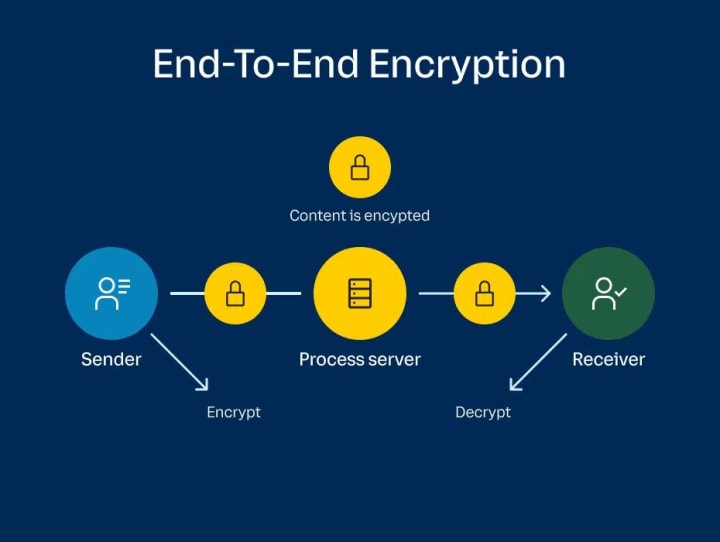
(Image Source: RingCentral)
In addition, you could also implement tokenisation as an additional layer of security. Tokenisation replaces debit or credit card data with unique tokens, meaning that actual customer payment data is not stored in your POS system.
2. Regularly Update Your POS Software
Outdated POS software is an easy target for cybercriminals because it often contains vulnerabilities that can be more easily exploited.
Regularly update your POS software to protect your business and customers against the latest security vulnerabilities. Consider enabling automatic updates to ensure you always have the most secure version of the software.
In addition, remember to regularly update your operating system, antivirus programs, and any other software integrated with your POS system.
3. Secure Your Network
A secure Wi-Fi network is essential for protecting your POS system from cyber threats. Whilst offering your customers access to free Wi-Fi is great, these public networks are unsecure and can be easily compromised.
You must connect your POS system to a dedicated network separate from the public Wi-Fi. This involves setting up firewalls, using Virtual Private Networks (VPNs) for remote access, and regularly updating network devices to protect against vulnerabilities.
4. Regularly Review POS Activity Reports
Modern POS software allows you to schedule daily, weekly, or monthly reports that detail POS activities such as transactions, inventory changes, and employee behaviour.
By regularly reviewing these POS activity reports, you can spot worrying irregularities and identify potential security breaches early.
In addition, you can set up alerts for unusual activities, such as unauthorised transactions or multiple failed login attempts.
5. Limit POS Access For Employees
Controlling who has access to your POS system, regularly reviewing access logs to detect any unusual activity, and immediately revoking access for employees who no longer require it is crucial for securing POS data.
Modern POS systems allow you to implement role-based access control (RBAC) to ensure that employee access is based on job requirements and responsibilities.
For example, cashiers only need access to customer transaction processing and clock-in/out features, while supervisors and managers need access to administrative functions such as shift scheduling.
In addition, enforce strong password policies for your employees and utilise multi-factor authentication (MFA) to make it harder for fraudsters and unauthorised users to gain access.
Ready To Reinforce Your Retail Store?
Encrypting data, regularly updating your software, securing your network, reviewing POS activity reports, and limiting access to your system will ensure PCI DSS compliance. This will help you avoid legal fees or penalties and a damaged reputation.
If you detect a security breach, immediately disconnect your POS system from the network and contact your payment processor, IT support, and the relevant authorities.
About the Creator
Dmytro Spilka
I'm a tech writer based in London. Founder of Solvid and Pridicto. My work has been featured in TechRadar, Entrepreneur, The Next Web, and Huff Post.
Keep reading
More stories from Dmytro Spilka and writers in 01 and other communities.
How Your Small Business Can Use Smartphones as a POS
Statista data shows that mobile POS (mPOS) payment market transaction values are projected to reach $12.56 trillion in 2025, and its impact could help to level the playing field between merchants of different sizes.
By Dmytro Spilkaabout a year ago in 01
Why Dubai’s Pet Community Is Rallying Around #EveryPetHasAShory
A decade ago, owning a pet was a niche lifestyle in the UAE. Now, dogs keep their owners company at pet-friendly cafés, cats have Instagram fan clubs, rescue organisations are at full capacity, veterinary clinics are expanding, and pet boutiques are flourishing.
By Sarath Menon6 days ago in 01
Top Flutter App Development Companies in USA (2026)
Choosing from the top flutter app development companies is a nightmare right now. You have thousands of agencies claiming they can build the next unicorn. Most of them just started using Dart last Tuesday. I reckon you need someone with actual skin in the game.
By Sherry Walker6 days ago in 01




Comments
There are no comments for this story
Be the first to respond and start the conversation.