


Introduction: A Quantum Quirk
Imagine You’re at home, relaxing on your couch, when your cat, Mr. Whiskers, decides to have a little adventure. You watch as he walks toward a closed box in the corner of the room. Curious, you open the box to see what’s inside, but as soon as you do, Mr. Whiskers disappears! You look around, confused, and then you hear a faint meow coming from the box. You open it again, and there he is, sitting inside as if nothing happened. But wait—how did he get back in there so fast? And why does it feel like he was both inside and outside the box at the same time?
This strange scenario is a lot like how quantum computing works. In the quantum world, things don’t always follow the rules we’re used to. Just like Mr. Whiskers seemed to be in two places at once, quantum computers use particles that can exist in multiple states simultaneously. It’s weird, it’s wonderful, and it’s the future of technology. Let’s dive in and explore what quantum computing is all about—no physics degree required!
________________________________________
Classical vs. Quantum Computing: The Basics
Classical computers are like a library where you look for books one by one. They use bits, which are like tiny switches that can be either ON (1) or OFF (0). Every task your computer performs, from playing games to sending emails, is based on these binary decisions. It’s straightforward, reliable, and has served us well for decades.
Quantum computers, on the other hand, are like having all the books in the library open at once.
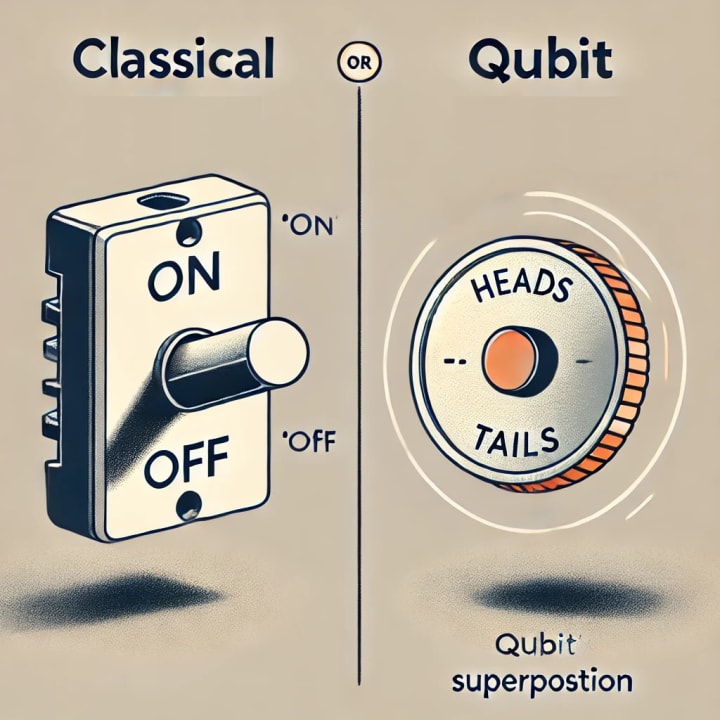
They use quantum bits, or qubits, which can be both 0 and 1 simultaneously, thanks to a phenomenon called superposition. Imagine a spinning coin that has both heads and tails until it lands. This allows quantum computers to process vast amounts of information much faster than classical computers.
But wait, there’s more! Quantum computers also use something called entanglement, which is like having magical bracelets that always show the same color, no matter how far apart they are. When qubits are entangled, the state of one qubit is linked to the state of another, allowing quantum computers to perform complex calculations that are beyond the reach of classical computers.
________________________________________
Superposition: The Magic of Being in Two States at Once
Let’s break down superposition a bit more. Imagine you’re playing a game of hide-and-seek, but instead of hiding in one spot, you’re hiding in multiple places at the same time. That’s what a qubit does — it exists in multiple states simultaneously. For example, a classical bit can be either 0 or 1, but a qubit can be 0, 1, or both at the same time.
This ability to be in multiple states at once is what makes quantum computing so powerful. It’s like having a team of workers who can all work on different parts of a puzzle simultaneously, instead of one person working on it step by step.
________________________________________
Entanglement: Spooky Action at a Distance
Entanglement is even stranger. Imagine you have two magic coins. No matter how far apart they are, if you flip one and it lands on heads, the other will instantly land on heads too—even if it’s on the other side of the world. This is what happens with entangled qubits. Their states are connected, and changing one instantly changes the other.
Einstein called this "spooky action at a distance," and it’s one of the weirdest and most fascinating parts of quantum physics.

It’s also what allows quantum computers to solve problems that would take classical computers millions of years to figure out.
________________________________________
Practical Applications: How Quantum Computing Will Change the World
Now that we’ve covered the basics, let’s talk about how quantum computing will impact our lives. Here are some exciting areas where quantum computers could make a huge difference:
- Cryptography: Breaking and Making Locks
- Think of encryption as a digital lock that keeps your online information safe. Classical computers use complex math problems to create these locks, but quantum computers could crack them easily using algorithms like Shor’s algorithm. This means we’ll need new, quantum-resistant encryption methods to keep our data secure.
- On the flip side, quantum computers can also create unbreakable locks using something called quantum key distribution. This could make online communication even safer in the future.
2. Drug Discovery: Finding the Right Key
- Developing new medicines is like searching for a needle in a haystack. Scientists have to test millions of molecular combinations to find one that works. Quantum computers can simulate these interactions at an atomic level, speeding up the process and potentially leading to cures for diseases like cancer or Alzheimer’s.
3. Climate Modeling: Predicting the Weather (and More)
- Climate models are incredibly complex, involving countless variables like temperature, wind, and ocean currents. Quantum computers could handle these complexities with ease, helping us predict climate change more accurately and find better ways to protect the planet.
4. Optimization Problems: Solving Real-World Puzzles
- Optimization problems are everywhere, from planning delivery routes to managing traffic flow. Classical computers solve these problems step by step, like searching for a specific book in a library by checking each shelf one at a time. Quantum computers, on the other hand, are like having all the books in the library open at once.

- They can explore all possible solutions simultaneously, finding the best one in a fraction of the time. Imagine a world where traffic jams are a thing of the past because a quantum computer has figured out the most efficient routes for everyone.
5. Artificial Intelligence: Smarter Machines
- Quantum computers could supercharge AI by processing massive amounts of data in seconds. This could lead to smarter virtual assistants, better language translation, and even robots that can learn and adapt on their own.
6. Space Exploration: Unlocking the Universe
- Quantum computers could help us simulate the behavior of planets, stars, and galaxies, making space exploration more efficient. They could also improve communication with spacecraft by solving complex signal-processing problems.
________________________________________
Challenges: Why Quantum Computing Isn’t Here Yet
While quantum computing sounds amazing, it’s not without its challenges. Here are some of the biggest hurdles scientists are working to overcome:
1. Fragile Qubits: Qubits are incredibly delicate and can be easily disturbed by their environment. Even a tiny change in temperature or a stray particle can cause errors in calculations.
2. Error Correction: Because qubits are so sensitive, quantum computers need advanced error correction techniques to ensure accurate results. This adds complexity and cost to the technology.
3. Scalability: Building a quantum computer with just a few qubits is hard enough. Scaling up to thousands or millions of qubits is a massive engineering challenge.
4. Cost: Quantum computers are expensive to build and maintain, making them inaccessible for most people—for now.
________________________________________
The Future of Quantum Computing: What’s Next?
Despite these challenges, the future of quantum computing is incredibly exciting. Companies like IBM, Google, and Microsoft are racing to build more powerful quantum computers, and governments around the world are investing heavily in quantum research.
In the coming decades, quantum computing could transform industries, solve problems we can’t even imagine today, and push the boundaries of human knowledge. It might even lead to discoveries in physics, chemistry, and biology that change our understanding of the universe.
________________________________________
The Future of Quantum Computing
Despite its infancy, quantum computing is making strides:
• Google’s Sycamore achieved quantum supremacy in 2019, solving a problem in 200 seconds that would take classical computers 10,000 years.
• IBM continues to release cloud-accessible quantum computers, democratizing access to quantum research.
• Quantum AI is emerging, promising more efficient machine learning algorithms and decision-making systems.
________________________________________
Fun Analogies to Remember Quantum Concepts
To wrap things up, here are some fun analogies to help you remember the key ideas:
• Superposition: A spinning coin that’s both heads and tails until it lands.
• Entanglement: Two magic coins that always match, no matter how far apart they are.
• Quantum Computing: A library where all the books are open at once, instead of searching one by one.
________________________________________
Final Thoughts: A Quantum Leap for Humanity
Quantum computing is still in its early stages, but its potential is enormous. From revolutionizing medicine to tackling climate change, quantum computers could help us solve some of the biggest challenges facing humanity. While there are still many hurdles to overcome, the future looks bright—and a little bit weird.
So, the next time your computer acts strange, remember: it might just be a glimpse into the quantum future. And who knows? Maybe one day, we’ll all have quantum-powered devices that make our lives easier, faster, and more exciting. Until then, let’s keep exploring, learning, and dreaming about the possibilities.
________________________________________
References
1. Quantum Computing Basics:
- Nielsen, M. A., & Chuang, I. L. (2010). Quantum Computation and Quantum Information. Cambridge University Press.
- IBM Quantum Computing Guide: https://www.ibm.com/quantum-computing/learn/what-is-quantum-computing/
2. Superposition and Entanglement:
- Einstein, A., Podolsky, B., & Rosen, N. (1935). Can Quantum-Mechanical Description of Physical Reality Be Considered Complete? Physical Review.
- Schrödinger, E. (1935). Die gegenwärtige Situation in der Quantenmechanik (The Present Situation in Quantum Mechanics).
3. Practical Applications of Quantum Computing:
- Shor, P. W. (1994). Algorithms for Quantum Computation: Discrete Logarithms and Factoring. Proceedings of the 35th Annual Symposium on Foundations of Computer Science.
- National Institute of Standards and Technology (NIST). Post-Quantum Cryptography. https://www.nist.gov/pqcrypto.
4. Quantum Computing in Drug Discovery:
- McArdle, S., Endo, S., Aspuru-Guzik, A., Benjamin, S. C., & Yuan, X. (2020). Quantum Computational Chemistry. Reviews of Modern Physics.
5. Quantum Computing in Climate Modeling:
- Lloyd, S. (1996). Universal Quantum Simulators. Science.
6. Challenges in Quantum Computing:
Preskill, J. (2018). Quantum Computing in the NISQ Era and Beyond. Quantum.
Explains the challenges of building and scaling quantum computers, including error correction and qubit fragility.
7. General Quantum Computing Resources:
- Google Quantum AI: https://quantumai.google/
- Microsoft Quantum: https://www.microsoft.com/en-us/quantum
Additional Reading for Curious Minds:
Books:
- Quantum Computing for Everyone by Chris Bernhardt.
- Dancing with Qubits by Robert S. Sutor.
Websites:
- Quantum Computing Report: https://quantumcomputingreport.com/
- Quantum Country: https://quantum.country/
Videos:
- Quantum Computing for Dummies by Domain of Science (YouTube).
- How Does a Quantum Computer Work? by Veritasium (YouTube).
- Quantum 101 Episode 4: Superposition Explained | Schrödinger's Cat by Perimeter Institute for Theoretical Physics (YouTube).
- Quantum Computers Could Change Everything - Here's What You Should Know In Under 4 Minutes | by Forbes (YouTube).
About the Creator
Asif Siddiqui
I am a passionate technology enthusiast with over 10 years of experience in digital media. My love for innovative tech fuels my mission to deliver the most relevant news and insights.
Keep reading
More stories from Asif Siddiqui and writers in 01 and other communities.


Comments
There are no comments for this story
Be the first to respond and start the conversation.