
Outgrowing “Good Enough”: Why B2B Companies Turn to Custom Software
When growth exposes the cracks in off-the-shelf tools, custom software becomes the only way forward in B2B.


Every business starts with tools that are fast, cheap, and “good enough.” But there comes a point when those tools stop pulling their weight. Harvard Business Review notes that many companies eventually hit the limits of generic platforms and must decide whether custom software is the only way forward.
The numbers tell the story. Gartner projects that custom software development will grow at 8.9% CAGR, topping $283 billion by 2028. What was once a rare move has become the mainstream play.
And nowhere is the squeeze felt more than in B2B. Processes span multiple teams, partner systems, and client relationships worth millions. In that environment, even a small inefficiency can snowball into wasted hours, higher costs, and lost trust.
Why “One-Size-Fits-All” Doesn’t Fit B2B
Consumer software works because millions of users behave in roughly the same way. B2B? Not so much. Complexity is baked into the model:
- Too many cooks. Finance, sales, ops, and IT all rely on the same system, but none share the same needs.
- Everything connected. ERP, CRM, supply chains, and partner portals all need to talk to each other. If one fails, everyone slows down.
- High stakes. A single glitch isn’t just an annoyance — it can put a multimillion-dollar deal at risk.
- Built for the long haul. With deals stretching for months or years, reliability and scalability aren’t nice-to-haves, they’re survival.
This is why off-the-shelf software collapses faster in B2B. The cracks appear early, and the fallout is far more expensive.
The Breaking Point
Generic tools make sense at the start: quick setup, affordable, and plenty to get moving. But what gets you off the ground isn’t always what keeps you flying.
Here’s how you know the landing gear’s failing:
- Endless spreadsheets and manual fixes become your “real” system.
- Workflows get bent to match the tool instead of the other way around.
- What worked for ten clients buckles under a hundred, let alone a thousand.
- Clients feel the pain — 65% of B2B execs say their eCommerce setups feel “broken” because standard platforms can’t keep up.
At this point, the question isn’t if you need custom software. It’s how long you can afford to wait.
Custom Software as Your Secret Weapon
Going custom isn’t about showing off extra features. It’s about reshaping the relationship between your business and its technology.
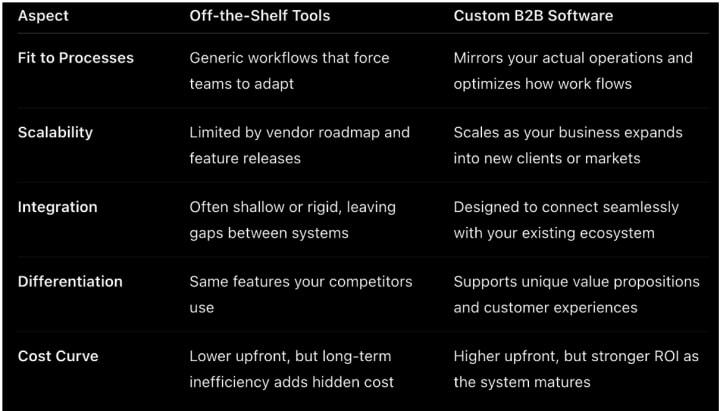
- Growth on your clock. You don’t wait for a vendor’s roadmap. The system evolves when you need it to.
- Integrations that actually integrate. Custom builds snap into ERP, CRM, and supply chains the way your workflows demand.
- Differentiation by design. Shared platforms mean shared limits. Custom lets you build experiences competitors simply can’t copy.
- Costs that make sense long-term. Packaged tools look cheap upfront but bleed money through inefficiencies. Custom flips the curve: higher early, steadier later, stronger ROI overall.
In other words: it’s not just software. It’s a competitive strategy disguised as code.
Busting the Myths
So why the hesitation? Old myths still get in the way:
- “It’s too expensive.” Over time, it usually costs less than standard tools that drain resources year after year.
- “It takes forever.” Agile sprints and MVPs mean you can see value in weeks, not years.
- “Teams won’t use it.” If it’s built around their actual workflows, adoption happens naturally.
- “Maintenance is chaos.” With proper governance, it’s often easier than coping with vendor updates you can’t control.
The truth: custom development isn’t risky — it’s calculated.
How to Build Without Breaking Things
Execution makes or breaks a project. In B2B, where failure affects not just teams but client relationships, there’s no margin for error.
- Start with business outcomes, not feature wish lists.
- Bring users into the process early.
- Roll out in stages with MVPs.
- Pick a partner who understands B2B as well as tech.
- Treat onboarding and training as part of the build, not an afterthought.
Handled this way, custom software doesn’t slow the business down — it accelerates it.
Conclusion
B2B companies can’t afford to run on systems that creak under complexity. Off-the-shelf platforms serve their purpose for a while, but when growth exposes their limits, custom software stops being optional.
The payoff goes beyond launch day. It shows in smoother workflows, stronger adoption, and client experiences that reinforce trust. That’s how custom software shifts from being just infrastructure to being a long-term competitive edge — and it’s exactly the outcome LenGreo builds for B2B companies ready to outgrow “good enough.”
About the Creator
Max Mykal
I’m Max, a Digital Marketing & SEO specialist with 4+ years of experience. At LenGreo, I help industries like Biotech, Cybersecurity and iGaming grow with tailored strategies. Let’s connect to drive your business forward!
How to Implement Scalable AR Try-On Features in Retail Apps (2026)
AR Try-On Features - Building for Retail Apps 2026 is a critical technical process. It integrates real-time spatial computing with advanced computer vision. This allows users to visualize products directly on their own bodies. You can boost your conversion rates today. You can also reduce expensive product returns. Do this by implementing high-fidelity AR Try-On Features for Retail Apps in 2026.
By Devin Rosario7 days ago in 01
Embedded Finance in Mobile Apps - A 2026 Deep Dive
The boundary between software and banking has effectively vanished. This change is a structural requirement for modern mobile platforms. In 2026, users do not want to leave an app to pay. They do not want to exit to find financing. Users expect the app to handle every financial step natively. This includes the payment, the financing, and the insurance. This shift is known as embedded finance. Embedded finance means placing financial tools directly into non-financial apps. It has evolved from a trendy buzzword into a necessity.
By Del Rosario7 days ago in 01
A More Human Vocal
When we launched Vocal nearly a decade ago, the world was a very different place. LLMs did not exist, and stories were created one at a time by people sitting down to write, revise, and share something personal. Many of our assumptions about publishing, trust, and participation were built for a world where effort and output were inseparable.
By Justin @ Vocal5 days ago in Resources



Comments
There are no comments for this story
Be the first to respond and start the conversation.