
Operators and Expressions in C Language
Operators and Expressions in C Language
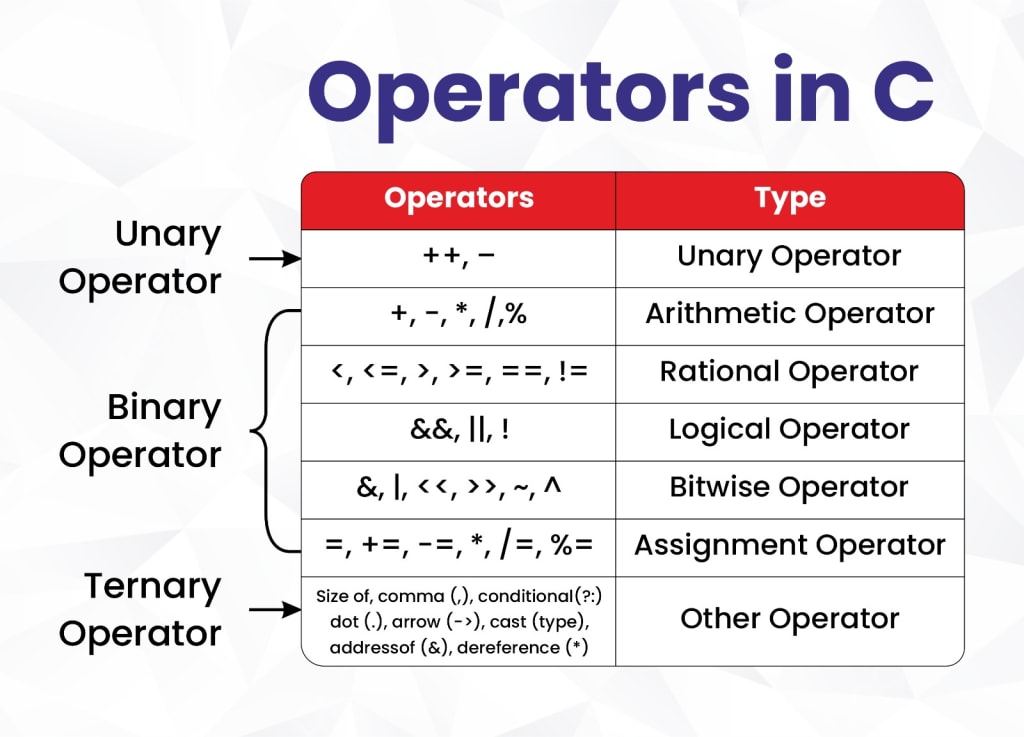
To master the C programming language, you need to get a grip on operators and expressions. C uses symbols called operators to perform operations on variables and constants. These operators come in handy when you want to manipulate data and create expressions. An expression is a mix of operators, constants, and variables that boils down to a single value.
Key Operators in C Language:
Arithmetic Operators:
The C language uses arithmetic operators to do basic math. These include adding (+) taking away (-), times (*), divide (/), and finding remainders (%).
Relational Operators:
When you want to compare two things in C, you use relational operators. They give you a yes or no answer. Are these two identical?" (==), "Is this different from that?" (!=), "Is this bigger than that?" (>), and "Is this smaller than that?" (<).
Logical Operators:
Logical operators in C help you link different conditions. They figure out how these conditions fit together. You can use "and" (&&) to check if two things are true, "or" (||) to see if at least one thing is true, and "not" (!) to flip a condition.
Bitwise Operators:
Bitwise operators work on the bits of whole number operands. The operations that fall under this category are bitwise AND (&), bitwise OR (|), bitwise XOR (^), bitwise NOT (~), left shift (<<), and right shift (>>).
Assignment Operators:
Assignment operators give values to variables. The basic assignment operator is (=). Compound assignment operators like (+=, -=, *= /=) do the operation and give the result in one step.
Other Operators:
Besides these, C has some other operators for specific jobs:
sizeof Operator: Figures out the size of its operand.
Comma Operator ( , ): This checks the first part, throws it away, and gives back the result of the second part.
Conditional Operator ( ? : ): This is a three-part tool to make decisions in code.
Dot (.) and Arrow (->) Operators: These help you get to parts of classes, structures, and unions.
Cast Operator: This changes one type of data to another using (type) expression.
Addressof (&) and Dereference (*) Operators: These work with pointers to find where a variable lives and to see what's inside a pointer, in that order.
Unary, Binary and Ternary Operators in C:
C groups operators into three categories based on how many operands they use:
Unary Operators: These work on one operand.
Binary Operators: These work on two operands.
Ternary Operator: C has one ternary operator, which is the conditional operator ( ?).
Operator Precedence and Associativity in C:
When C expressions have multiple operators, each operator has its own precedence and associativity: Precedence: Decides the sequence of evaluation in expressions. The system evaluates operators with higher precedence first.
Associativity: Points out the direction for evaluating operators with the same precedence level (left to right or right to left).
To write bug-free and sound code in C, you need to understand operator precedence and associativity.
Conclusion:
Operators and expressions are at the heart of C programming. They let developers handle data well and write short code. If you want to get good at C programming, you must master these ideas.
About the Creator
Keep reading
More stories from himaja nareshit and writers in 01 and other communities.
Best 50 Tips For Fibonacci Series In C Programming
Introduction The Fibonacci Series is a series of numbers that begins with 0 and 1, with each following number being the sum of the two preceding numbers. This basic mathematical series has applications in a variety of domains, including computer science, data structures, and algorithm design.
By himaja nareshitabout a year ago in Education
Trump Accounts
In recent policy discussions, the phrase “Trump accounts” has gained attention across political and financial circles. Many people are asking questions such as what are Trump accounts, how they might work, and whether they could reshape the way families plan financially for their children. While the idea is still closely tied to political debate and legislative processes, the proposal highlights a broader conversation about long-term savings, economic opportunity, and government-supported financial tools for younger generations.
By Saboor Brohi 5 days ago in 01



Comments
There are no comments for this story
Be the first to respond and start the conversation.