
On the Brink of a Nuclear Shadow: South Asia's Fiery Standoff Between India and Pakistan
Unpacking the Roots of Conflict, Regional Fallout, and Global Concerns in South Asia's Most Explosive Rivalry
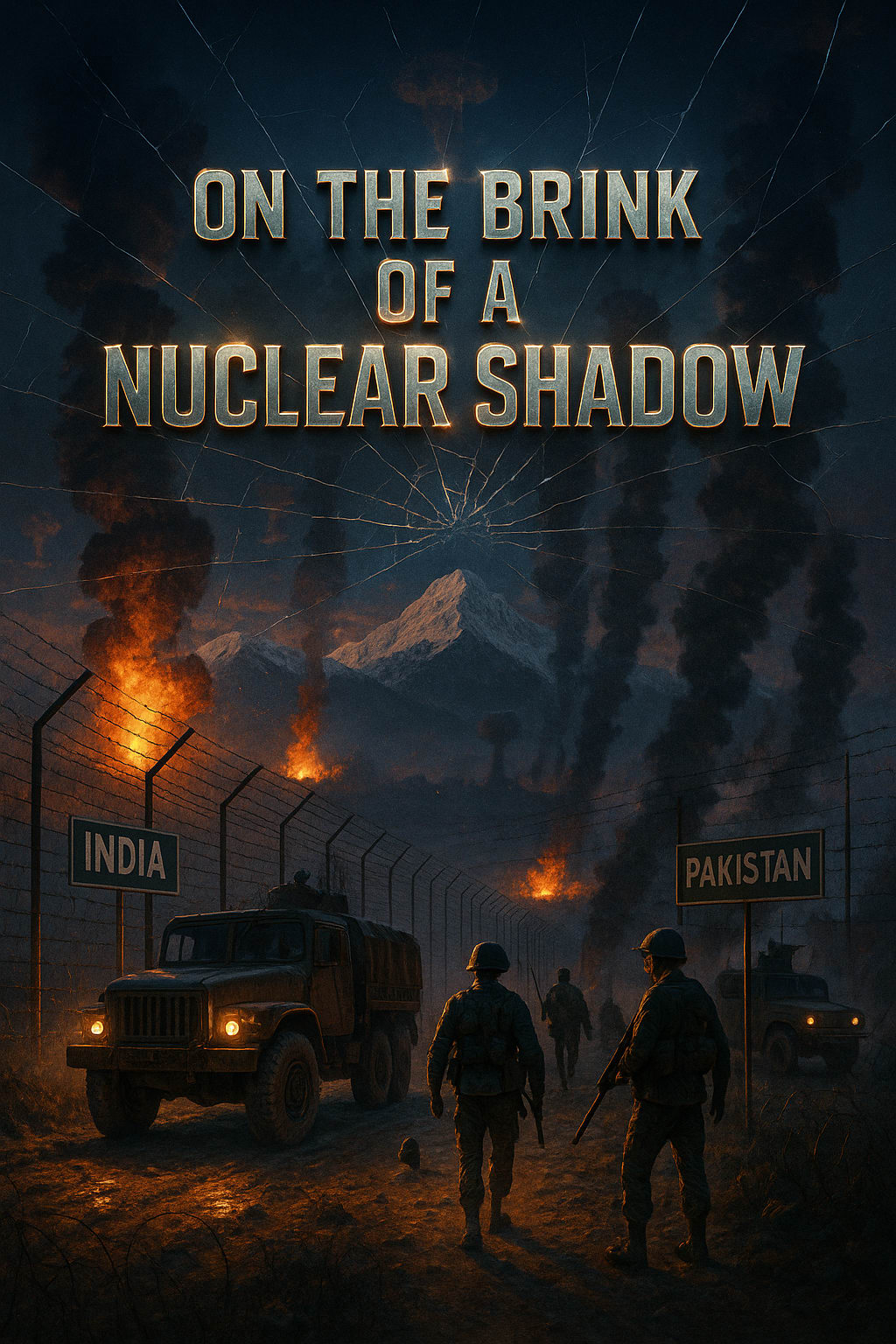
The subcontinent of South Asia, a land rich in culture and history, has once again become the focal point of global attention as tensions between India and Pakistan escalate. The two nuclear-armed neighbors, with a history of conflict spanning over seven decades, are once more on the brink of war. The recent military strikes and counterstrikes have reignited fears of a full-scale conflict, raising questions about the causes of this tension, its potential consequences for the two countries, and the broader impact on the region and the world.
The roots of India-Pakistan tensions lie in the violent partition of British India in 1947. Amidst the chaos of religious nationalism and mass migration, Kashmir emerged as the most contentious territorial dispute. The princely state's contested accession to India became the spark for the first Indo-Pakistani war. Since then, Kashmir has remained a geopolitical fault line, fueling three major wars (1947, 1965, 1999) and countless skirmishes. The Line of Control (LOC), established in 1947, divides Kashmir between the two countries but is not internationally recognized as a legal boundary. Both nations claim the entire region but control portions on either side of the LOC.
On April 22, 2025, a deadly militant attack in Pahalgam, Indian-administered Kashmir, killed 26 non-Muslim tourists. India accused Pakistan of involvement, a claim Islamabad strongly denied. On May 7, 2025, India launched missile and air strikes on nine locations in Pakistan, including Punjab and Pakistan-administered Kashmir. India claimed the targets were "terror camps" responsible for the April attack. Pakistan, however, labeled the strikes as "acts of war," stating that mosques and civilians were hit. It reported 26 deaths and 46 injuries from the strikes and shelling across the LOC. India claimed that 10 civilians were killed by Pakistani shelling on its side of the border. On May 8, India conducted another airstrike on a location near Muridke in Pakistan's Punjab province. Pakistan retaliated with artillery fire and air strikes on Indian targets. The situation escalated rapidly, with both sides exchanging fire and making military preparations. The international community expressed deep concern, urging restraint and calling for diplomatic solutions to prevent the situation from spiraling out of control.
Causes of Tension
The core of India-Pakistan tensions lies in the unresolved Kashmir issue. Since 1947, both countries have claimed the entire region but control parts of it. The status of Kashmir remains a highly sensitive and contentious issue. India revoked the special constitutional status of Jammu and Kashmir in August 2019, a move Pakistan strongly opposed as a unilateral violation of international norms. This decision further deepened the mistrust between the two nations and intensified the Kashmir conflict.
India has long accused Pakistan of supporting militant groups operating in Kashmir and other parts of India. Pakistan denies these allegations and emphasizes its efforts to combat terrorism. The recent terrorist attack in Pahalgam has once again highlighted the security concerns of both sides. India views the attack as evidence of Pakistan's involvement in cross-border terrorism, while Pakistan accuses India of using the incident to justify its military actions. The lack of mutual trust and the absence of effective communication channels have worsened the situation.
Domestic political considerations also play a role in the tensions between India and Pakistan. In India, Prime Minister Narendra Modi's Bharatiya Janata Party (BJP) has adopted a tough stance on Pakistan to appeal to nationalist sentiments and consolidate domestic support. In Pakistan, the government faces public pressure to defend national sovereignty and territorial integrity in the face of Indian military actions. Additionally, the strategic competition between the two countries, including their nuclear arms race and military modernization efforts, has heightened the sensitivity of their relationship.
Effects of War on India and Pakistan
War would bring immense suffering to the people of both countries. The conflict would result in significant casualties among military personnel and civilians. Families would be torn apart, and countless individuals would lose their lives or be displaced. The residents of Kashmir, who have already endured decades of conflict, would face even greater hardships. The psychological trauma caused by the constant fear of war would have long-lasting effects on the population.
India and Pakistan are both developing nations with economies vulnerable to the disruptions of war. The conflict would severely damage infrastructure, disrupt trade and investment, and lead to a sharp decline in economic growth. Factories and businesses would be destroyed or rendered inoperable, causing mass unemployment and a rise in poverty. The financial burden of war, including military expenditures and reconstruction costs, would strain the economies of both countries, setting back their development by decades.
Impact on Surrounding Countries and the Region
A war between India and Pakistan would pose a severe threat to regional security. The conflict could spill over into neighboring countries, drawing them into the crisis. Afghanistan, situated between India and Pakistan, would be particularly vulnerable. The instability in Afghanistan could worsen, providing fertile ground for terrorist organizations and further destabilizing the region. Additionally, the nuclear capabilities of India and Pakistan raise concerns about the potential for a nuclear conflict, which could have catastrophic consequences for the entire region and beyond.
The economic ties between India, Pakistan, and neighboring countries would be severely affected by the war. Trade routes would be disrupted, and economic cooperation initiatives would be put on hold. Countries like China, which has significant economic interests in the region, would also be impacted. The China-Pakistan Economic Corridor (CPEC), a flagship project of China's Belt and Road Initiative, could face delays or even be abandoned, causing substantial economic losses. The overall economic development of South Asia would be severely hindered, with negative ripple effects on the global economy.
Conclusion
The recent tensions between India and Pakistan have brought the two nuclear-armed neighbors to the brink of war once again. The causes of the conflict are deeply rooted in historical territorial disputes, terrorism, and political and strategic factors. A war between India and Pakistan would have devastating effects on both countries, resulting in a humanitarian crisis, economic collapse, and political instability. Moreover, the conflict would have severe repercussions for surrounding countries and the entire region, threatening regional security, disrupting economic development, and potentially triggering a refugee crisis and geopolitical shifts. In this critical moment, the international community must play a proactive role in mediating the dispute and urging both sides to exercise restraint. India and Pakistan also need to engage in sincere dialogue and negotiations to find a peaceful and sustainable solution to their long-standing issues. Only through peaceful means can lasting stability and prosperity be achieved for the people of South Asia and the broader international community.
About the Creator
Keep reading
More stories from Maaz Ahmad and writers in 01 and other communities.
The Secret Life of Your Smartphone
"BEEP. BEEP. BEEP." Ugh. Here we go again. Every morning, it’s the same routine—my human groans, flails a half-asleep hand in my general direction, and slams a finger on the snooze button. Five more minutes, they beg, as if I’m the one torturing them and not the other way around.
By Maaz Ahmad8 months ago in 01
Who’s Leading Fintech in 2026? Top App Development Companies
When it comes to building secure, scalable, and innovative financial solutions — from digital banking platforms and payment systems to AI-driven risk tools — picking the right partner can make or break your success. In 2026, fintech is evolving faster than ever, powered by AI, cloud-native architectures, blockchain, and embedded finance. Below are the foremost companies shaping the future of fintech technology.
By Aarti Jangidabout 23 hours ago in 01
Musk wants up to $134B in OpenAI lawsuit, despite $700B fortune
Elon Musk wants a jaw-dropping $79 billion to $134 billion in damages from OpenAI and Microsoft, claiming the AI company defrauded him by jettisoning its nonprofit mission, Bloomberg first reported. The figure comes from expert witness C. Paul Wazzan, a financial economist whose bio says he has been deposed nearly 100 times and testified at trial more than a dozen times in complex commercial litigation cases.
By Dena Falken Esq3 days ago in 01
Center Stage with Paul Stewart
*** I'm keen to republish the interviews I did for my series with Vocal creators. It's been a few years and I thought it might be nice to revisit these wonderful conversations. I'll be releasing them one at a time for a few weeks/months.
By Heather Hubler5 days ago in Interview




Comments
There are no comments for this story
Be the first to respond and start the conversation.