
Next-Level API Automation Testing Techniques – Part 2
API Automation Testing Techniques

In Next-Level API Automation Testing Techniques – Part 1, we covered advanced strategies for API testing, focusing on techniques that make automation more efficient and reliable. In this part, we will continue to explore more advanced methods, including best practices that can help you improve your testing processes even further. This part will provide deeper insights to enhance your automation skills and take your API testing to the next level.
API Chaining and Composite Tests
API chaining and composite tests are powerful techniques in advanced API testing, enabling the execution of dependent requests and validating complex workflows. These techniques ensure that APIs function cohesively within a system, mimicking real-world user interactions.
What is API Chaining?
API chaining involves executing a series of dependent API requests where the response of one request serves as input for the subsequent request(s). This mirrors real-world scenarios, such as user registration followed by login and profile update.
What are Composite Tests?
Composite tests validate multiple related APIs in a single test scenario. These tests check the combined behavior of APIs, ensuring that they work seamlessly as a unit.
Benefits of API Chaining and Composite Tests
- Realistic Testing: Simulates real-world API workflows.
- Increased Coverage: Validates interdependencies among APIs.
- Early Defect Detection: Identifies integration issues early in the development cycle.
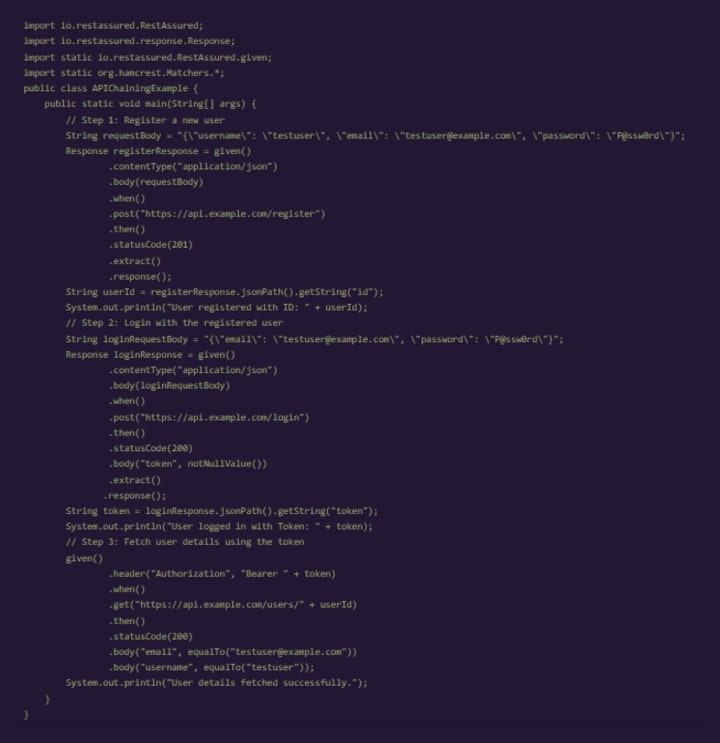
API Chaining Example: User Registration and Login
Scenario
- Register a new user
- Login with the registered user
- Fetch user details using the token from the login response
Implementation in Java
Composite Test Example: Product Lifecycle Testing
Scenario
- Create a new product
- Update the product details
- Retrieve the updated product details
- Delete the product
Implementation in Java

Best Practices for API Chaining and Composite Tests
- Maintain Independence: Ensure chained requests are isolated from external dependencies.
- Use Assertions: Validate responses at each step.
- Token Management: Handle authentication tokens dynamically to avoid session issues.
- Error Handling: Include robust error handling for intermediate steps.
- Data Cleanup: Ensure the environment is clean after test execution.
Common Challenges and Solutions

Handling Asynchronous API Calls
Asynchronous API calls allow systems to perform non-blocking operations, enabling better scalability and responsiveness. However, testing such APIs introduces challenges due to the inherent delay in processing requests and returning responses.
What Are Asynchronous API Calls?
Unlike synchronous calls, where the client waits for the server to process and respond, asynchronous APIs allow the client to continue other tasks while the server processes the request.
Example of Asynchronous Workflow:
- The client submits a long-running task (e.g., file processing).
- The server immediately returns an acknowledgment with a task ID.
- The client polls or subscribes to a notification service to get the task status.
Challenges in Testing Asynchronous APIs
- Uncertain Response Time: Responses may not be instant, making it harder to validate outputs.
- Polling or Subscription Logic: Clients need to handle repeated status checks or event-driven callbacks.
- Concurrency Issues: Multiple tests might conflict if not isolated properly.
Strategies for Testing Asynchronous APIs
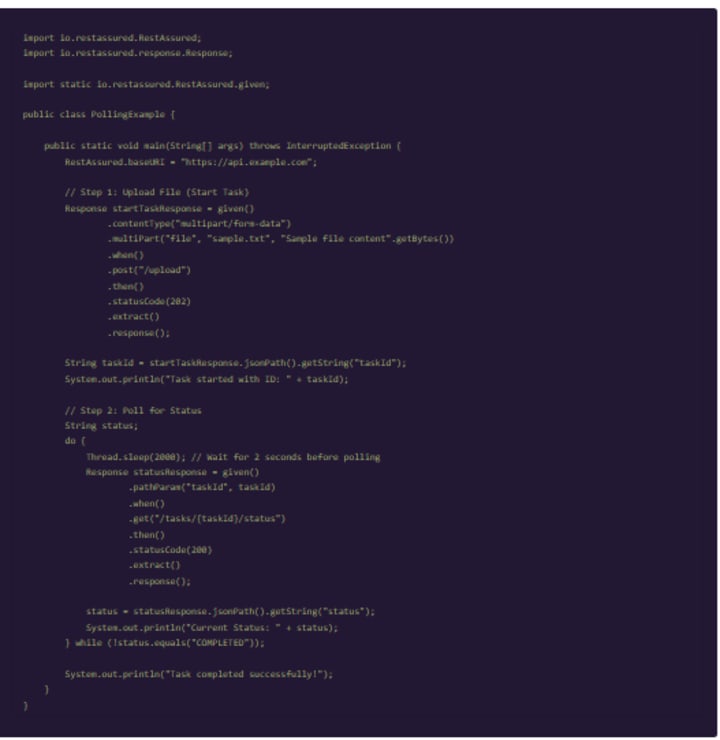
Polling Mechanism
Continuously poll the API at intervals to check the status of a task until it’s complete.Scenario: A file upload API accepts a file and provides a taskId to check the status later.
Implementation in Java:
Timeout Handling
Include timeout logic to avoid infinite loops during polling.

Testing Event-Driven Asynchronous APIs
For APIs that notify the client upon completion (e.g., via Webhooks or SSE), use mock servers to simulate notifications.
Scenario: A payment processing API sends a webhook when the payment is complete.
Implementation Using WireMock:

Testing APIs with Callback URLs
APIs that require a callback URL can be tested using local servers like MockServer.
Scenario: An email service accepts a callback URL to notify when emails are sent.
Implementation Using RestAssured:

Best Practices for Handling Asynchronous APIs
- Timeouts and Retries: Avoid infinite loops with defined retry limits and timeouts.
- Use Mocking Tools: Simulate server-side behavior with tools like WireMock or MockServer.
- Log Intermediate States: Log each status or response for debugging.
- Event-driven APIs: Use listeners for webhook-based or callback-based APIs.
- Parallel Tests: For concurrent scenarios, ensure thread safety and isolate test data.
READ THE FULL BLOG...
https://jignect.tech/next-level-api-testing-automation-techniques-part-2/
About the Creator
Jignect Technologies
At JigNect Technologies, we believe that software testing is an art, a science, and a passion. Our team of experts combines years of experience, cutting-edge technology.
Keep reading
More stories from Jignect Technologies and writers in 01 and other communities.
Next-Level API Automation Testing Techniques – Part 1
API testing strategy is a well-planned approach used by QA teams to ensure APIs work as expected and deliver the desired results. It involves creating test cases, setting clear entry and exit criteria, designing test scenarios, identifying the necessary test data, and executing tests effectively.
By Jignect Technologies12 months ago in 01
Is White Label Crypto Exchange Software the Right Fit for Your Business Model?
Launching a crypto exchange is no longer just an idea for large tech companies. Many startups, fintech firms, and entrepreneurs now explore crypto exchange businesses as part of their growth plans. One option that often comes up is white label cryptocurrency exchange software. It promises faster launch times and lower technical effort, but it may not suit every business equally. Before choosing this path, it is important to understand what white label crypto exchange software offers, what it limits, and how it aligns with different business models. This article breaks down those aspects in a clear and practical way.
By smithtaylor4 days ago in 01
TUS NUA - ch 49
TUS NUA – ch 49 New Beginnings – Mia and Midnight (*)(*)(*) As Mia spoke on the phone to Ali’s sister, Ellen, Finola slipped quietly away and walked to the stream behind Tus Nua. Carefully, she put a block on her family so no one could know what she was about to do.
By Margaret Brennanabout 22 hours ago in Fiction




Comments
There are no comments for this story
Be the first to respond and start the conversation.