
Nazi Germany: Rise, Reign, and Ruin"
"How a nation was led into war, terror, and ultimate collapse."
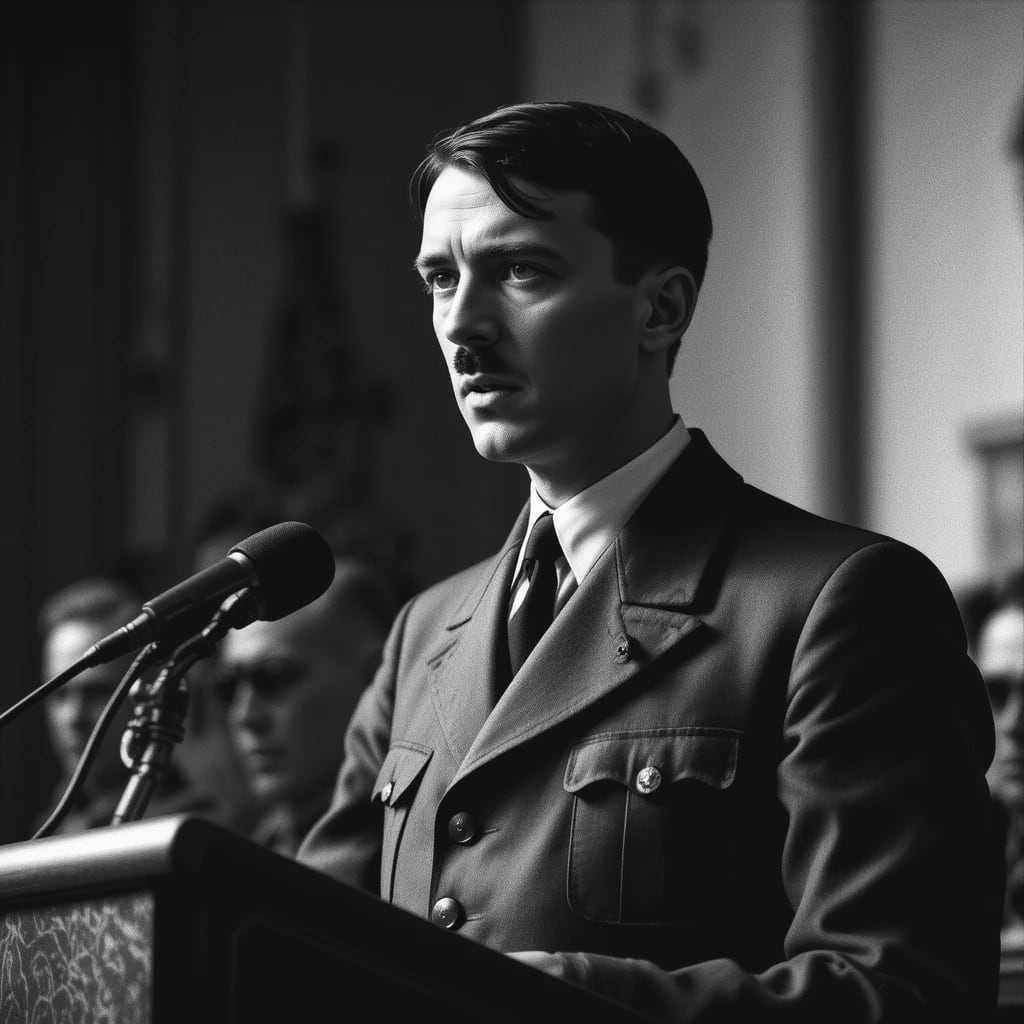
1. Rise of Hitler and the Nazi Party: After Germany's defeat in World War I (1918), the country was left humiliated by the Treaty of Versailles in 1919. Economic depression, political instability, and national resentment created the perfect storm. Adolf Hitler, a former soldier and fiery orator, joined the National Socialist German Workers' Party (Nazi Party) and rose rapidly.
In 1933, Hitler was appointed Chancellor of Germany. Soon after, he consolidated power, banned opposition parties, and established a totalitarian regime.
2. Establishment of a Dictatorship: Hitler used propaganda, terror (through the SS and Gestapo), and mass rallies to manipulate public opinion. The Nazis promoted Aryan supremacy, anti-Semitism, and ultranationalism. Civil liberties were abolished, and dissent was crushed.
3. The Holocaust: From 1941 to 1945, Nazi Germany carried out the Holocaust — the industrialized genocide of 6 million Jews, along with Romani people, disabled individuals, Poles, Soviet POWs, and others. Concentration camps like Auschwitz became symbols of horror.
4. World War II (1939–1945): Hitler invaded Poland in 1939, prompting Britain and France to declare war — starting World War II. Nazi Germany conquered much of Europe, but its expansion was eventually halted.
1941: Hitler invaded the Soviet Union (Operation Barbarossa) — a key mistake.
1942–43: Defeat at Stalingrad marked the turning point.
1944: D-Day — Allied forces landed in Normandy.
1945: Soviet troops reached Berlin.
5. Fall of Nazi Germany: As defeat became certain, Hitler retreated to his bunker in Berlin. On April 30, 1945, he committed suicide. Germany surrendered on May 8, 1945 — marking the end of the war in Europe.
1. Nazi Ideology
The Nazi worldview was built around:
Racial purity: They believed in the superiority of the “Aryan” race (especially Germans) and considered Jews, Slavs, Romani, and others as inferior.
Anti-Semitism: Jews were falsely blamed for Germany’s defeat in WWI, economic problems, and social decline.
Nationalism & Expansionism: Nazis wanted to unify all German-speaking people and create Lebensraum (living space) in Eastern Europe.
---
2. Key Figures
Adolf Hitler – Führer (leader) and central figure of Nazi Germany.
Heinrich Himmler – Head of the SS and architect of the Holocaust.
Joseph Goebbels – Minister of Propaganda, master of manipulating public opinion.
Hermann Göring – Commander of the Luftwaffe (air force).
Albert Speer – Hitler’s architect and Minister of Armaments.
---
3. Life in Nazi Germany
Total control: The Nazis controlled education, the press, culture, and even private life.
Youth indoctrination: Organizations like Hitler Youth trained children in Nazi ideology.
Women’s role: Encouraged to stay home, have many children, and support the state.
Economy: Focused on rearmament, public works (like the Autobahn), and preparing for war.
---
4. Major Military Events
1936: Germany remilitarizes the Rhineland (violating Versailles Treaty).
1938: Annexation of Austria (Anschluss); Sudetenland crisis.
1939: Invades Poland with help from Soviet Union (Molotov-Ribbentrop Pact).
1940: Blitzkrieg (lightning war) brings rapid victories in France, Norway, Belgium.
Battle of Britain: First major defeat; the UK holds out despite bombings.
1941: Invasion of Soviet Union — massive early success but bogged down in winter.
1942–43: Defeat at Stalingrad – turning point of the Eastern Front.
1944: D-Day invasion liberates Western Europe.
1945: Berlin falls, Hitler dies, Germany surrenders.
---
5. The Holocaust – More Detail
Jews were segregated into ghettos, then deported to concentration and extermination camps.
Most infamous camp: Auschwitz-Birkenau.
Nazi goal: The “Final Solution” – extermination of all European Jews.
Millions were killed via gas chambers, shootings, forced labor, starvation.
---
6. Fall and Aftermath
Nuremberg Trials (1945–46): Nazi leaders were tried for war crimes and crimes against humanity.
Germany was divided into East and West.
The world said “never again,” leading to the creation of the United Nations, human rights laws, and Israel (1948).
7. Nazi Propaganda and Control
Joseph Goebbels mastered propaganda. Posters, films, radio, newspapers — all controlled the message.
Myth of Hitler as a savior: Hitler was portrayed as Germany’s only hope.
Films like Triumph of the Will glorified Nazism.
Censorship: Books were burned. Free speech was eliminated.
Symbols like the swastika and salutes created unity and fear.
---
8. Nazi Economy
Autarky (self-sufficiency): Germany tried to become economically independent.
Massive public works programs (e.g., Autobahns) reduced unemployment.
The economy heavily focused on military production.
Hitler ignored economic limits — planning to seize resources through war.
---
9. Resistance Within Germany
Despite the fear, many Germans resisted:
White Rose Movement: A student-led group that distributed anti-Nazi leaflets.
July 20 Plot (1944): An assassination attempt on Hitler by army officers (e.g., Claus von Stauffenberg).
Some church leaders (like Dietrich Bonhoeffer) spoke out and were executed.
---
10. Nazi Technology and Experiments
Advanced weapons: Jet aircraft (like the Messerschmitt Me 262), early missiles (V-2 rockets).
Experimental science: Often unethical and horrifying (medical experiments in camps).
Nuclear weapons: Nazis attempted, but failed, to build atomic bombs.
---
11. Occult and Mysticism
Some Nazi leaders (especially Himmler) were obsessed with occultism and ancient myths.
SS symbols and rituals were inspired by pagan and mystical beliefs.
Himmler tried to find mythical artifacts (like the Holy Grail) to prove Aryan superiority.
This gave rise to many conspiracy theories post-war (inspired Indiana Jones films too).
---
12. The Endgame: Hitler’s Last Days
In April 1945, as Soviet troops closed in, Hitler hid in a bunker under Berlin.
On April 30, he married Eva Braun, then both committed suicide.
Bodies were burned as per Hitler’s order to avoid being displayed like Mussolini’s.
---
13. What Happened to Nazi Leaders?
Goebbels killed himself and his children in the bunker.
Himmler was captured but committed suicide.
Göring was sentenced to death at Nuremberg but killed himself before execution.
Others faced justice in the Nuremberg Trials, with sentences ranging from death to long imprisonment.
---
14. Legacy and Denazification
After the war, Germany underwent denazification: removing Nazi influence from society.
Nazi symbols, propaganda, and speech are banned in modern Germany.
Germany became a strong proponent of peace, education, and remembrance of the Holocaust.
About the Creator
Keep reading
More stories from Abdul Rahman and writers in 01 and other communities.
Letters from No Man's Land
Rain poured down relentlessly, soaking the mud-crusted uniforms of the soldiers huddled in the trench. Water pooled at their boots, mixing with blood, gunpowder, and the decaying remnants of what once had life. The air was thick with tension, the occasional distant rumble of artillery reminding them of the hellscape beyond the walls of their narrow refuge.
By Abdul Rahman 10 months ago in 01
How Much Does App Development Cost in Colorado?
You are probably staring at a napkin sketch thinking you’ve found the next big thing. Good for you. Truly. But I reckon your first real hurdle isn't the code. It is the cold, hard cash required for app development cost in Colorado.
By Sherry Walkerabout 6 hours ago in 01
Wild Card Weekend Recap: What Happens Now?
I think I figured out why I love Wild Card Weekend so much. It's because it's the first playoff anything of the calendar year. The NFL season starts in the fall, and once upon a time, the champion was crowned either on or slightly before New Year's. The evolution of the NFL schedule has resulted in the playoffs starting just into the New Year, and currently, the final week of the season falls on the first weekend of the New Year, with Wild Card Weekend coming a week after that. So yes, chronologically, the NFL's Wild Card Weekend serves as the first playoff anything of the calendar year.
By Clyde E. Dawkins7 days ago in Unbalanced




Comments
There are no comments for this story
Be the first to respond and start the conversation.