
More Than a Pin on a Map: The Full Picture of Family Safety Today
Hi everyone, Olivia Martinez here. For years, the image of "tracking" has been a simple dot on a map—a reactive answer to the question, "Where are they now?" But modern safety technology has evolved far beyond this basic function. The most valuable tools today don't just show you a location; they provide a contextual safety intelligence system that helps prevent worry before it starts. Let's explore the deeper insights that move us beyond the map.


From Reactive Dots to Proactive Peace of Mind
The old model was reactive. You'd open an app like Google's Find Hub (or its consumer-facing Find your phone service) only after a phone was lost or you were already concerned about someone's whereabouts. It's a crucial emergency tool, but it doesn't help you manage daily safety proactively.
The new model is about awareness and prevention. Instead of waiting for a problem, it uses technology to create a gentle, continuous net of safety. This isn't about constant surveillance; it's about smart systems that notify you of what's important—like a safe arrival home—and filter out the normal noise of daily life.
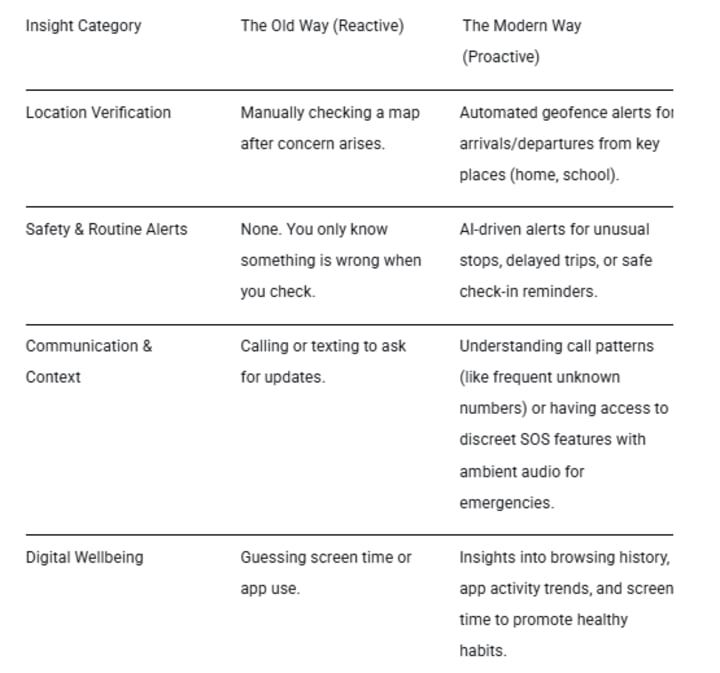
The Layers of Modern Safety Intelligence
So, what exactly are these systems looking at? The insights generally fall into a few key categories that build upon basic location.
1. Pattern Recognition & Automated Alerts (Geofencing)
This is the cornerstone of proactive safety. You can define virtual boundaries on a map for places like "home," "school," or "grandma's house." The system then monitors these locations and sends you an automatic notification when your family member enters or leaves. This eliminates the need for constant "did you get there?" texts and provides quiet confirmation of safe arrivals.
2. Communication Insights
Some advanced systems go further by providing visibility into device usage. This can include seeing call logs to identify frequent unknown callers (a potential spam or scam risk, much like services such as Truecaller specialize in detecting), or monitoring SMS activity. For parents, this isn't about reading private chats, but about spotting patterns—like a sudden spike in late-night communication—that might warrant a conversation.
3. Environmental Awareness & Emergency Features
In critical situations, some tools offer next-level protection. This can include an SOS button that a user can press to instantly alert their circle, sometimes coupled with ambient audio recording to stream sound from the device's environment to help assess the emergency. Other features, like driving analysis, can provide feedback on safe driving habits.
4. Digital Wellbeing Oversight
A complete picture of safety includes online activity. Modern solutions can provide reports on browsing history, app usage (like Number Tracker), and overall screen time. This helps guardians guide younger users toward balanced digital habits and identify potential exposure to inappropriate content early.
Using Powerful Tools Responsibly
With these capabilities come significant ethical responsibilities. Tools that offer deep insights must be used with clear consent and for the right reasons. Resources like the Electronic Frontier Foundation's (EFF) coverage of cell tracking issues are essential reading for any parent or user to understand the privacy implications and technological realities.
The most ethical services are transparent, require permission from all involved parties (especially with older children), and are framed as a family safety net, not a surveillance tool. The goal is to foster trust and independence, not to undermine it.
The Bottom Line: It's About Context, Not Control
A modern safety tracker is less about a "spy tool" and more about a context-aware assistant. It answers deeper questions than "where?" It helps answer: "Are they safe?" "Are they following their routine?" "Is there a pattern I should be aware of?"
By moving beyond the map to leverage pattern alerts, communication context, and digital wellbeing insights, these tools shift the focus from reactive anxiety to proactive, informed peace of mind. As with any powerful technology, the key is choosing tools that prioritize privacy and consent, using them to open dialogues about safety, and always keeping the human connection at the center.
About the Creator
Olivia Martinez
Lead Product Manager, Author at Number Tracker
https://numbertracker360.com
Keep reading
More stories from Olivia Martinez and writers in 01 and other communities.
Legacy of Location: What Happens to Your Family's Data When You Stop Subscribing?
You spend months or years sharing your most sensitive data with a service: the precise daily movements of your family. Then, you decide to cancel. Maybe you found a better app, the kids are older, or you're reevaluating your privacy. You click "Cancel Subscription." But what really happens to all that location history?
By Olivia Martinez7 days ago in 01
Surface Laptop 8 Release Date Rumors
Microsoft has not officially announced the Surface Laptop 8, but industry patterns and recent hardware trends strongly suggest a release window in 2026. The Surface Laptop lineup typically follows an 18 to 24 month update cycle, and with the Surface Laptop 7 launching in mid 2024, the timing aligns naturally with a spring or early summer 2026 debut.
By Md. Nurul Afsar5 days ago in 01




Comments
There are no comments for this story
Be the first to respond and start the conversation.