
Mobile Development Guide 2025–2026: Trends and Best Practices
What’s next for mobile experiences — from emerging trends to the challenges shaping how apps are built and used.

It’s hard to imagine a time when mobile wasn’t the center of everything. Today, it’s the screen we check first in the morning and the one we put down last at night. For businesses, that constant presence has turned mobile from a convenience into a necessity. According to eMarketer, mobile remained the top media platform in 2024, with apps dominating daily use — a clear sign that this space now defines how people connect, buy, work, and live.
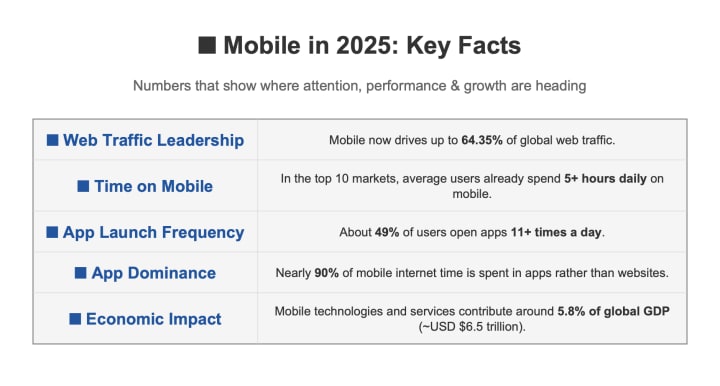
The question heading into 2025 isn’t whether companies need a mobile presence — it’s what kind of experience will stand out in an increasingly crowded ecosystem. The next phase of mobile development is about agility, intelligence, and fluidity — apps that adapt as naturally as the people using them.
Mobile Development Trends Shaping 2025–2026
By now, mobile development isn’t about ticking boxes — it’s about staying ahead of expectations that shift faster than release cycles. The trends shaping the next two years are already visible across industries, each pushing apps toward more connected and intuitive experiences.
AI-Native Apps
Apps are learning to think. What began as smart recommendations has evolved into predictive, context-aware functionality that helps users act faster and smarter. As The Verge notes, AI-powered apps are climbing to the top of the App Store charts across every category, doubling revenue and surpassing 1.7 billion downloads in early 2025.
Super Apps vs. Specialized Apps
In Asia, super apps like WeChat and Grab continue to dominate — merging chat, payments, and shopping into one universe. Western audiences, meanwhile, still favor smaller, focused apps that deliver depth instead of variety. Developers are now forced to pick their philosophy: do one thing perfectly or do everything well enough to matter.
Wearables and Connected Devices
Mobile no longer means “on the phone.” Smartwatches, fitness trackers, and even connected cars are part of the same ecosystem. The best apps now follow users between screens and devices without breaking flow — from a notification on a wristband to a checkout on a tablet.
Immersive Mobile (AR/VR + 5G)
With 5G and edge computing finally reaching scale, mobile can now support experiences that used to demand desktop power. Real-time multiplayer gaming, live AR navigation, and instant streaming are all part of a new normal where responsiveness defines quality.
Together, these shifts point toward a world where mobile apps are no longer static tools but living systems — adapting, anticipating, and accompanying users wherever they go.
Choosing the Right Kind of App
Every mobile project starts with a choice that can make or break the outcome: what kind of app are you building, and for whom? The answer shapes cost, flexibility, and the overall user experience.
- Native apps remain the benchmark for performance. Built separately for iOS and Android, they give developers full control over features and design — making them ideal for high-stakes sectors like gaming, finance, and AR.
- Cross-platform apps, powered by frameworks like Flutter or React Native, let companies build once and deploy everywhere. They’ve matured enough to balance performance with speed, offering an efficient middle ground.
- Hybrid apps use web code wrapped in a native shell — affordable and fast to produce, though often limited when it comes to advanced functionality or heavy data use.
- Progressive Web Apps (PWAs) are blurring the line between web and app experiences. Installable straight from the browser and light on storage, they’re an increasingly popular choice for startups testing ideas or businesses expanding into new markets.
How Modern Mobile Development Works
The steps behind building an app haven’t disappeared — they’ve just become more fluid. Teams today rely on automation, faster feedback, and modular design to keep up with shorter timelines and higher expectations.
- Discovery and strategy come first: defining purpose, target users, and how the app supports the overall business.
- Planning follows — balancing cost, speed, and technical scope to choose the right framework.
- Design now focuses on clarity, accessibility, and ease of entry. Smooth onboarding and inclusive interfaces are what make users stay.
- Development and integration have grown more complex. Apps often connect to multiple APIs, cloud systems, or IoT devices, requiring careful coordination to keep everything seamless.
- Testing happens continuously, across devices, operating systems, and screen formats. Real-world validation is what separates polished apps from buggy releases.
- And finally, launch and maintenance are no longer endpoints but ongoing processes. Regular updates, personalization, and analytics-driven decisions keep apps alive long after their debut.
Challenges Shaping Mobile Development
Even with better frameworks and smarter tools, success in mobile development isn’t guaranteed. The technical barriers are lower, but standing out — and staying relevant — has become harder than ever.
Visibility is the first hurdle. App stores are packed, ad costs keep rising, and users are quick to delete what doesn’t impress them immediately. To earn attention, brands need more than a clever idea; they need clear positioning, value that’s obvious from the first interaction, and an experience that feels effortless.
Then comes performance. Users expect flawless responsiveness — fast loading, smooth navigation, and reliability across every device and network condition. Delivering that kind of consistency takes rigorous testing and constant optimization, especially with so many operating systems and form factors now in play.
Another challenge is ambition itself. It’s tempting to build too much too soon — to chase features instead of focus. The strongest mobile products of 2025 are the ones that start small, deliver something meaningful, and grow strategically through user feedback rather than guesswork.
Security and convenience also have to coexist. People demand encryption, biometrics, and privacy protection, but they don’t want friction in the process. Balancing trust with ease of use remains one of the toughest balancing acts in mobile design.
And finally, retention defines success. Downloads mean little if users don’t come back. Sustained engagement requires thoughtful onboarding, useful notifications, and personalization that feels relevant, not intrusive. The real test isn’t whether users install your app — it’s whether they keep it.
How Mobile Is Transforming Key Industries
Across sectors, mobile isn’t just a tool anymore; it’s the primary interface between businesses and their audiences. Each industry is adapting these same technologies in different ways, redefining how value is delivered.

Looking Toward 2026 and Beyond
Mobile already dominates how people communicate, shop, and work — but its influence is still expanding. Over the next two years, the biggest changes will come not from technology itself, but from how it’s used.
The distinctions between native, cross-platform, and web-based apps are blurring, making flexibility more important than format. At the same time, metrics for success are shifting away from downloads toward engagement, retention, and user trust.
Businesses that adapt to this mindset — treating mobile not as a channel, but as a living relationship — will be the ones that stay ahead. At LenGreo, we help companies design those relationships: mobile strategies that align performance, usability, and long-term growth in a world that never stops moving.
About the Creator
Max Mykal
I’m Max, a Digital Marketing & SEO specialist with 4+ years of experience. At LenGreo, I help industries like Biotech, Cybersecurity and iGaming grow with tailored strategies. Let’s connect to drive your business forward!
Why Mobile Apps Break When They Start Growing (and How to Build Them So They Don’t)
One of the quiet truths about mobile software is that scalability almost never hurts you at the beginning. Early versions of an app feel fast. Traffic is light, the backend is cooperative, and even questionable decisions don’t cause visible damage.
By Valeriia Shulga7 days ago in 01




Comments
There are no comments for this story
Be the first to respond and start the conversation.