
Mistakes to Avoid while Developing an MVP
Read this article o find the common mistakes to avoid while building your MVP.
Let’s go back to the year 1990.
There was a young boy who wanted to buy a specific pair of shoes. To do so, he went to the mall but couldn’t find the pair which he wanted.
Now, the boy got frustrated, and the idea of selling shoes online struck his mind.
And that was the birth of an MVP.
So, instead of carrying out costly and lengthy market research, he developed a basic website. After that, he contacted the shoe store, clicked pictures of shoes, and put them on the website. And when he got the order from customers, he bought the shoes and delivered them.

Yes, we are talking about Nick Swinmurn, who build Zappos that was later on acquired by Amazon.
So, the approach followed by him is known as minimum viable product development.
Let’s understand in detail, what is MVP?

MVP is a product with just enough features to satisfy early customers and provide feedback for future product development.
- Wikipedia
Putting simply, MVP is the version of your product in its smallest, minimal featureful avatar with the basic functionalities. Whereas in mobile app development, your mvp would be the basic version of the application.
Still, many startup owners get confused when it comes to define and understand the MVP.
Let’s understand where does the confusion starts;
The first confusion starts with focusing on the wrong word. That means there is a bunch of people who emphasize “minimum,” some on “Viable” whereas others on the word “Product” that is developed once and think the work is done.
So, to remove this confusion, here are the three ground principles that you are ought to follow while defining and building your MVP.
#1. Ensure the “minimum” is not winning over the “viable.”
When you prioritize the features for your MVP to make it “Minimum,” don’t fall into the trap of removing critical features for your target audience. If you do so, your product’s minimum features will not fulfill the basic needs of your customers and your business objectives. Thus, try to balance out the minimum with viable features that solve the actual problem for customers!
Rule 2: MVP should solve a problem for users to be viable means
Eric Ries has defined the validated learning as;
“a small unit of progress that can be quickly verified to determine whether a chosen direction is correct.”
Many startup owners face challenges due to a lack of validating learning and misunderstanding of how to get it from the target audience. They think that developing an MVP quickly on the basis of an incomplete and half-cooked prototype would lead them to a successful startup. Bt, it won’t!
The reason is that a quickly developed MVP would not provide you with the learning or feedback from the customers. You won’t be able to improve your MVP or understand why it will fail after the launch. Thus, make sure to receive the proper feedback on your idea and MVP.
Rule 3: MVP is not the final product
You must make it clear in your head that MVP is not an end product; instead, it is the beginning of the process of learning. The Build-Measure-Learn process lies at the core of developing robust products.
That means with your MVP, you will test your hypothesis, get the feedback, and make the needed improvements. And this process can go on to teat all of your hypotheses in an iterative manner.
Now, as you understood the MVP concept in detail and aware of the major rules to follow, let’s move on to the approach of building your MVP in the right manner.
How to build an MVP right then?
1.Market Research
Sometimes, it might happen that your idea does not fit into the market needs. You need to analyze the market to ensure that your idea fulfills the market need.
“What if we found ourselves building something that nobody wanted? In that case, what did it matter if we did it on time and on a budget?” — Eric Ries.
As per the CB insight, the major reason startups fail is “No Market Need,” and you would definitely don’t want your startup on this list! Therefore you must have as much information about the market.
You can conduct surveys to get information as well as keep your eyes on competitors offering and how you can make your product better than them.
2.Identify the idea
Try to express our idea to find out the problem it solves for customers. You can ask yourself various questions such as;
- What are the problems solved by your product?
- What are the needs of the customers fulfilled by it?
- How will this be beneficial to the end-consumer?
- Why would they use it?
Many entrepreneurs tend to get obsessed with their idea and completely forget the problem that was supposed to be solved. Therefore, you should identify the reason for the existence of your product from the beginning.
3.Define the user flow
Now, it’s time to define the user flow that your customers can follow in your product because the design process is an important stage of MVP development. You should design your MVP app in a convenient manner for your users.
To define the user flow, you need to define the process stages, and for that, you can identify the steps required to reach the end goal.
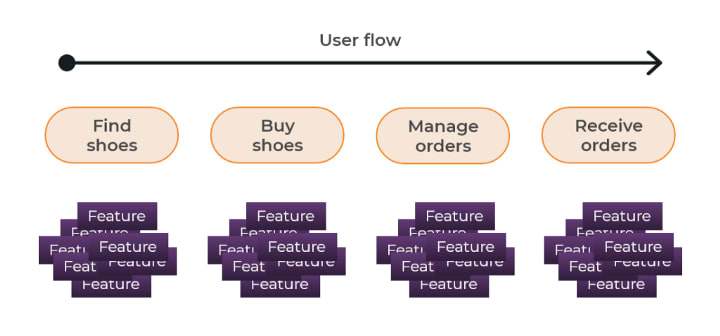
Here’s the user flow design of Zappos. There are one-by-one steps that the users are supposed to follow on the site. In the same way, you can also define the series of steps for your MVP application.
4.Prioritize MVP features
Once you have all the features and listed them, it’s time to identify the key features that your MVP will have, because as we have discussed, MVP will contain only minimum features. Nw, you would ask me;
How to prioritize MVP features?
S, you can follow some tools and methods to do that. First is a prioritization matrix. With this, you can sort out the set of features into the order of importance.

Another method for feature prioritization is the Moscow method. In this method, you need to split up your MVP features into Must-have features, Should have features, Could have features, and won’t have features.

Another widely used method is the Feature Bucket. This method was popularized by the VP of Dropbox, Adam Nash. In this approach, you can divide your features into 3 to 5 bucket categories like Metric movers, Delights, and customer requests.

Here, the features in the Metric movers are the features that have a positive effect on your main KPIs. Hence, these features would be critical to reaching your business goals. Features falling into the Delights category increase customer satisfaction. And customer request features are those features that your customers would like in your app but are not important to solve the core problem.
5.Build, Masure, Learn
Once you are done with prioritizing your minimum viable product features, it’s time to kickstart the MVP development. As we discussed earlier that MVP is the process of customer feedback, you need to follow the build, measure, learn loop.
- Build: In this stage, you will develop your MVP.
- Measure: In this stage, you will check the progress achieved. That means measuring the results gained from the experiment of the previous step.
- Learn: Here, based on the previous stage’s feedback, you will decide to weather preserve or pivot. This means you will go on with the current strategy, or you will change it for the betterment of your MVP.
Wrapping up
A minimum viable product is aimed at solving the customers’ problems by offering viable solutions. Now, you will better understand what you should keep in mind while developing your MVP and the steps to follow for MVP development. With minimum viable product development services, you can turn your million dollar idea into reality!
Suggested Read;
About the Creator
Keep reading
More stories from Bharti Rajpurohit and writers in 01 and other communities.
How To Build A Chatbot From Scratch?
Let’s go back to the year 1950! A computer scientist, Alan Turing, had a thought, “what if machines can think?” Well, this thought was too ahead of its time. After that, he started working to find out the answer to that question.
By Bharti Rajpurohit5 years ago in 01
Ecommerce Apps in 2026: Redefining the Future of Online Shopping
By 2026, ecommerce apps have become an essential part of daily life. What was once considered a convenient alternative to visiting physical stores has now evolved into a fully immersive shopping experience powered by mobile technology. From groceries and fashion to digital services and subscriptions, ecommerce apps influence how people discover, evaluate, and purchase products in today’s fast-moving digital economy.
By Aarti Jangid6 days ago in 01
Is Snapchat Premium Safe to Use as a Creator and User?
Snapchat is an American-based multimedia photo sharing and instant messaging app. Snapchat Inc developed it. One of the app's primary features is that text messages and images are available for a limited time. This is their unique selling point or what we popularly term as USP. However, the limitations were removed later on.
By Intelligent Creator7 days ago in 01
📢 Raise Your Voice Thread: 01/08/2026
Our “Raise Your Voice Threads” are hosted most alternating Thursdays at 12PM ET to offer creators more avenues to uncover exceptional stories on Vocal. As we are continuously searching for fresh creators and inspiring stories, this thread provides an opportunity to exchange and discuss the stories that have moved and motivated us on Vocal.
By Raise Your Voice by Vocal6 days ago in Resources



Comments
There are no comments for this story
Be the first to respond and start the conversation.