
Meet Zuckerberg's brand-new AI dream team
Meta's new AI lab is stacked with OpenAI researchers behind some of ChatGPT's biggest breakthroughs.


🚀 Meta Superintelligence Labs: The Vision
On June 30, 2025, Mark Zuckerberg publicly announced the launch of Meta Superintelligence Labs (MSL)—a newly minted division under Meta Platforms with a singular mission: build “personal superintelligence for everyone.” Comprising talent-pooled researchers and engineers from OpenAI, Google DeepMind, Anthropic, Sesame AI, and more, MSL represents Meta’s strategic escalation in the AI arms race .
The goal: surpass existing large language models (LLMs) and multimodal AI technologies by aggressively investing in cutting-edge talent, computation, and organizational alignment.
---
🔑 Leadership at the Helm
Alexandr Wang—a 28‑year‑old MIT dropout, co‑founder of Scale AI—joins Meta as Chief AI Officer. His move, tied to Meta’s $14–14.3 billion investment to acquire 49% of Scale AI, signals a high-stakes bet on data-labeling infrastructure and model tooling .
Nat Friedman, former GitHub CEO and AI investor, steps in as Co‑Leader of MSL, focusing on AI products and applied research. He’s also joined by a small cohort from his NFDG fund, cementing a focus on pushing Meta’s AI product stack .
---
👥 The Dream Team: Who’s In
Meta has successfully enticed at least 11 elite AI researchers with specialties from reasoning to multimodal perception:
Trapid Bansal: Co‑creator of OpenAI’s o‑series reasoning models
Jiahui Yu: Led OpenAI’s perception team; co‑led Google Gemini’s multimodal efforts
Shuchao Bi: Authored GPT‑4o voice mode & multimodal post‑training at OpenAI
Huiwen Chang: Expert in image‑generation for GPT‑4o; formerly at Google/Adobe
Ji Lin: Contributed to GPT‑4.1 and GPT‑4.5 models
Hongyu Ren: Led post‑training efforts on GPT‑4o and mini‑variants
Shengjia Zhao: Architect behind synthetic‑data pipelines at OpenAI
Johan Schalkwyk: Ex‑Google Fellow, voice AI leader at Sesame
Pei Sun: Gemini & Waymo AI engineer
Joel Pobar: Anthropic inference leader; returned to Meta after 11 years
Jack Rae: DeepMind alumnus (Gopher, Chinchilla, Gemini)
These domain experts underscore MSL’s technical focus, from large-model post‑training optimization to multimodal integration across text, voice, image, and video.
---
💰 The Money: Compensation & Strategy
To woo such talent, Meta reportedly dangled staggering signing bonuses upward of $100 million, with some packages reaching $300 million+ over multiple years . While Meta’s CTO, Andrew Bosworth, downplayed some figures, the fact remains that these offers are among the highest ever seen .
Zuckerberg didn’t just broadcast salary offers—he personally messaged prospects, hosted dinners at his homes, and allegedly led the effort from the front lines, telling one insider, “if you can’t create it, buy it” .
---
🏛 Structural Overhaul & Texas Expansion
MSL integrates existing AI teams—including FAIR, Llama model creators, and various applied-research groups—under one unified banner .
Meanwhile, Meta is investing heavily in U.S. data centers, possibly in Texas, and is rumored to be renovating an Austin office. This illustrates a shift in its physical infrastructure strategy: bolstering compute resources alongside human talent .
---
🧠 Why It Matters: The AI Talent War
This isn’t just a hiring wave—it’s a strategic bid to leapfrog rivals like OpenAI and Google. Analysts suggest this lab could be the linchpin sustaining Meta’s recent stock surge (shares hitting ~$738 billion valuation) .
The massive sign-on bonuses are a signpost of how heated the AI talent struggle has become. OpenAI leaders responded sharply: Sam Altman called it “breaking into our home,” and Chief Research Officer Mark Chen echoed the concern .
---
⚠️ Challenges & Skepticism
Despite the buzz, deep divisions remain around AI strategy. Yann LeCun, Meta’s chief AI scientist, is reportedly skeptical of scaling large language models as the path to true AGI . Internal reorganization has raised concerns about clarity and direction .
Additionally, some target hires—like OpenAI co-founders John Schulman, Bill Peebles, or Ilya Sutskever—have either declined or remained in talks only . And pipelines for ambitious Bonnie bots like Perplexity AI or Safe Superintelligence reportedly fell through .
---
🔭 Outlook: What Comes Next
Meta plans to roll out Llama 4.1 and 4.2 in the near term, and new frontier models in the coming year . With its technical and financial muscle, the company is well‑positioned to build AI systems that could redefine how billions interact with computing—across apps, AR glasses, smart devices, and more .
However, skeptics argue technology isn’t just about money or talent—it’s about coherent strategy, disciplined execution, and navigating the ethical, regulatory, and societal impact of AGI. Zuckerberg has placed a massive bet—but its success depends on translating resources into breakthroughs.
---
🧾 In Summary
Meta Superintelligence Labs is:
A $14B+ investment in Scale AI and massive data‑center infrastructure
Guided by Alexandr Wang and Nat Friedman
A magnet for elite AI talent—especially from OpenAI, Google, Anthropic
A multi‑modal, reasoning‑centered push to surpass rivals
Fueled by some of the highest compensation packages ever offered
Not without its internal skeptics and strategic challenges
In the coming months, watch for Llama 4.1/4.2 launches, breakthroughs in multimodal reasoning, and how Meta positions itself in the open‑source vs. closed‑model debates.
By recruiting top-tier AI architects and offering unprecedented resources, Zuckerberg is making it clear: Meta views the future of human–machine interaction as its battleground. Whether this grand experiment leads to transformative superintelligence—or collapses under its own weight—will define the next chapter of AI history.
About the Creator
Keep reading
More stories from Waseem Khan and writers in 01 and other communities.
Asia Pacific Prebiotics Market Size and Forecast 2025
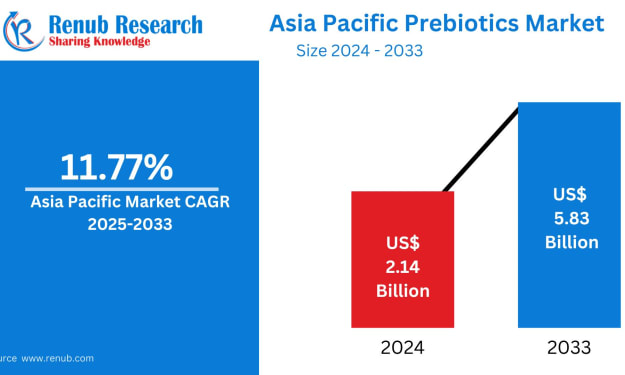
Asia Pacific Prebiotics Market: A Region Poised for Gut-Health Revolution The Asia Pacific prebiotics market is entering a transformative decade. With rising health awareness, aging populations, expanding functional food industries, and rapid advancements in biotechnology, prebiotics have become a central ingredient in modern nutrition strategies across the region. According to Renub Research, the Asia Pacific Prebiotics Market is expected to reach US$ 5.83 billion by 2033, growing from US$ 2.14 billion in 2024, at a robust CAGR of 11.77% from 2025 to 2033.
By Janine Root a day ago in 01
How to Choose a Web Design Agency for Long-Term Product Growth
If you are looking at a site like a catalog of past work and thinking about hiring a web design agency for B2B and product teams, you are probably already past the phase where “making it look good” is the main problem.
By Valeriia Shulga4 days ago in 01
Miss Persephone's Manual to a Seemingly Ordinary Life
Miss Persephone was found at the dining table, her blue eyes swollen, her tears arriving and retreating like the tides of the ocean. Earlier that day, her family had visited her in the retirement home where she had lived for eight years. It was her eightieth birthday.
By Imola Tóth3 days ago in Fiction


Comments
There are no comments for this story
Be the first to respond and start the conversation.