
Is it possible to reach absolute zero?
why does the scientific community have its eyes set on reaching these ultra-low temperatures?

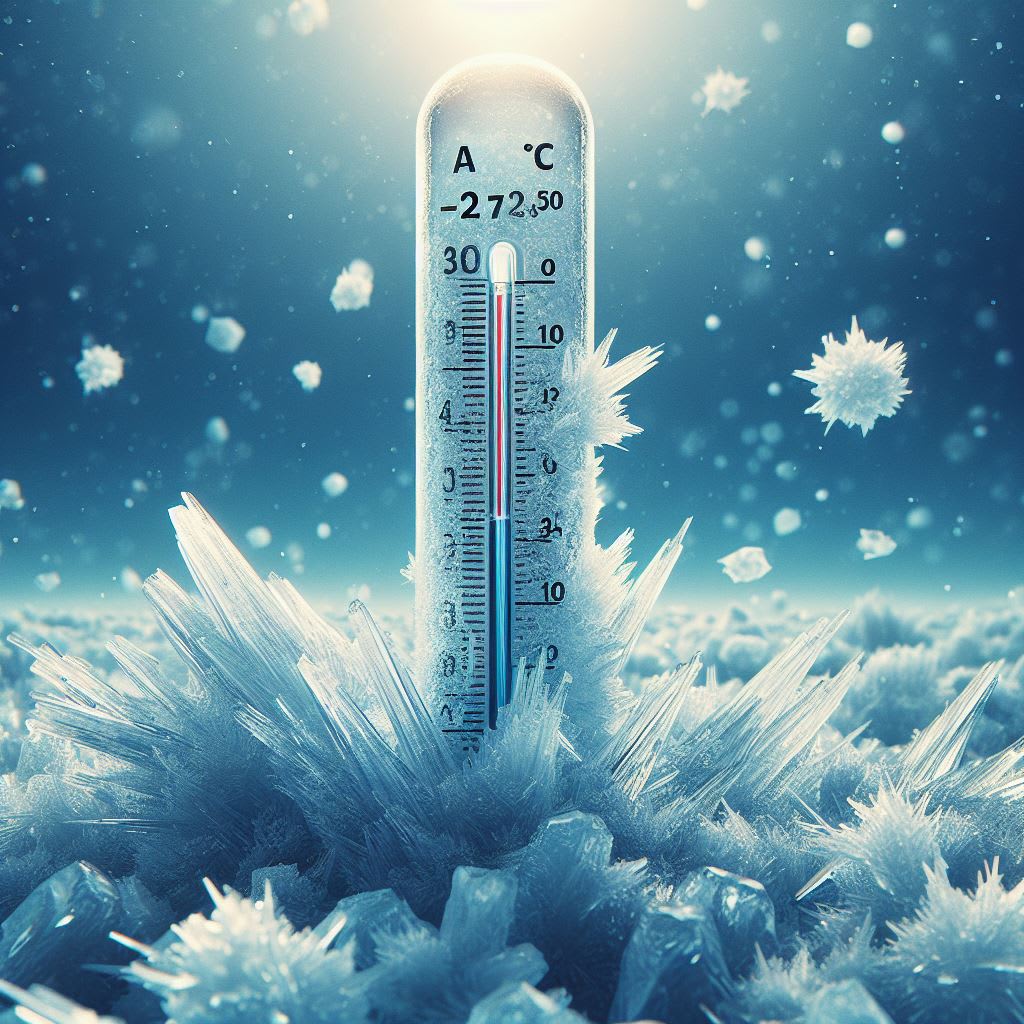
Alright, buckle up, because we’re diving deep into the fascinating world of absolute zero, that mind-boggling, bone-chilling temperature scientists love to talk about.
We’re not just talking cold; we’re talking colder than outer space itself. At minus 459.67 degrees Fahrenheit or minus 273.15 degrees Celsius, absolute zero is the undisputed king of cold. Read more
But the burning question on everyone’s mind is, can we really hit this frigid milestone?
To crack this icy mystery, we need to thaw out our understanding of what temperature is all about.
We often think of it as a measure of how hot or cold something is, but in reality, it’s a sneak peek into the wild dance of energy and vibrations among all the particles in a system.
Picture it like a particle party, the hotter it is, the more energetic the dance, and at absolute zero, these particles call it quits; no more grooving, no more shaking.
Now, why does the scientific community have its eyes set on reaching these ultra-low temperatures?
Well, it’s all about tapping into the weird and wonderful quantum effects that start playing out when particles slow down to a near standstill.
Quantum mechanics introduces us to the concept of wave-particle duality, a phenomenon where particles, like photons of light, can flip between behaving as particles or as waves. It’s a bit like a quantum identity crisis.
As Sankalpa Ghosh, a theoretical condensed matter physicist at the Indian Institute of Technology Delhi, puts it, “indistinguishability” is the name of the game when it comes to quantum particles.
Tracking individual particles or waves? Forget about it. Thanks to the Heisenberg Uncertainty Principle, which throws a dash of probability into the mix, these particles take on a wave-like character.
This quantum wave behavior is quantified by the thermal de Broglie wavelength, a ratio of inter-particle distances in the system.
At normal temperatures, this quantum behavior is like background noise, easily ignored. But as things get colder, particularly nearing absolute zero, this quantum symphony starts cranking up the volume.
“When the temperature drops to absolute zero, the thermal de Broglie wavelength ratio actually becomes infinity,” explains Ghosh.
And this is when the real quantum shenanigans begin. Superfluidity, where substances flow without any friction, superconductivity, allowing current to flow without resistance, and ultracold atomic condensation, these are the quantum rockstar effects that scientists are eager to explore in the ultra-cold realm.
Venturing into the past, the ’90s marked the early days of ultracold experiments, employing a technique known as laser cooling.
This involved using laser light to exert a force on atoms, slowing them down to temperatures around 1 kelvin (minus 272.15 C or minus 457.87 F).
This was cool enough to witness quantum behavior in solids and liquids, but for gases, the real quantum magic required temperatures in the tens of nano-kelvin range.
Fast forward to 2021, and a group of German scientists took the coolness to new heights or rather, depths.
They executed an experiment involving magnetized gas atoms plummeting down a 400-foot tower. By skillfully manipulating a magnetic field, they managed to slow these particles to an almost complete standstill.
The result? A jaw-dropping 38 picokelvin that’s 38 trillionths of a degree Celsius above absolute zero. It’s like freezing your brain and then some, but in the name of science.
Now, the burning question arises, is there any point in pushing the cold envelope even further?
According to Christopher Foot, an ultracold physicist at the University of Oxford, the real treasure lies in exploring these quantum effects rather than obsessing over hitting absolute zero.
Laser-cooled atoms are already making waves (no pun intended) in atomic clocks and quantum computers, pushing the boundaries of what we thought possible.
However, Foot throws a bucket of cold water on the idea of hitting that final 38 trillionths of a degree.
The hurdles are substantial, and even if we could overcome them, our measuring instruments might betray us.
“With current instruments, you couldn’t tell whether it was zero or just a very, very small number,”
Foot notes. To truly measure absolute zero, we’d need a thermometer with infinite accuracy, a tool beyond our current technological grasp.
So, while the concept of absolute zero remains an awe-inspiring benchmark, the real excitement for scientists lies in the journey into the ultra-cold quantum frontier.
It’s a realm where particles defy our everyday understanding, putting on a quantum show that challenges the very fabric of reality.
And who knows, maybe in the pursuit of pushing the boundaries of cold, we’ll stumble upon even more mind-bending phenomena that redefine the way we see the universe.
The quest for absolute zero is just the tip of the iceberg in the frosty adventure of exploring the mysteries of the quantum world
About the Creator
Yusuf Alam
Crafting Words into Amazing Stories | Freelance Copywriter | Turning Ideas into Impact
Keep reading
More stories from Yusuf Alam and writers in 01 and other communities.
Rediscovery of 'Fairy' Organism Stuns Scientists | Thismia kobensis
Scientists rediscover Thismia kobensis, a plant species presumed extinct for three decades. Genus Thismia is known as fairy lanterns due to its unique appearance, elusiveness, and ability to survive without photosynthesis.
By Yusuf Alam2 years ago in 01
5 Legitimate Crypto Recovery Companies
The cryptocurrency landscape in 2025 continues to evolve, with over $3.7 billion lost to scams, hacks, and fraud in 2024 alone, according to Chainalysis reports. While blockchain’s immutable nature makes reversal impossible, specialized recovery firms leverage forensic tracing, legal action, and law enforcement collaboration to retrieve stolen digital assets. This guide profiles five legitimate, established players in the crypto recovery space—not as endorsements, but as verified options with transparent operations, documented methodologies, and publicly reported outcomes. Success in recovery depends on timing, chain transparency, and jurisdictional cooperation. No firm guarantees results, and self-reported success rates should be viewed critically.
By Garry Oneal5 days ago in 01



Comments
There are no comments for this story
Be the first to respond and start the conversation.