
Integrating Matter 1.4 Unified Controls in Custom Apps
Orchestrating seamless interoperability and local-first automation in the 2026 smart home ecosystem.

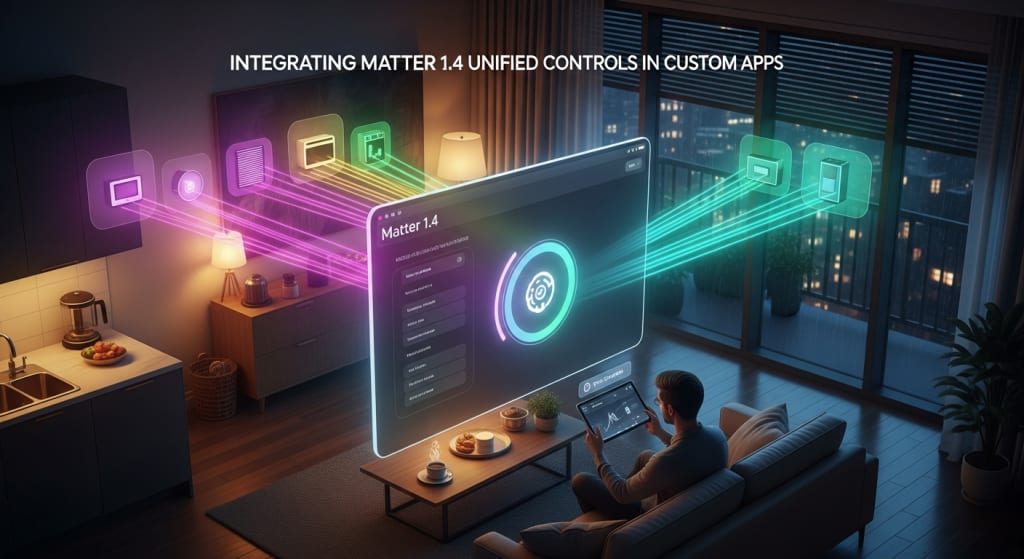
The smart home industry has moved past the era of proprietary "walled gardens." In early 2026, the Matter 1.4 specification has matured into the definitive protocol for developers building custom smart home applications. For engineers and product owners, the focus has shifted from basic connectivity to sophisticated, cross-platform synchronization. This guide provides a technical roadmap for implementing Matter 1.4 to ensure your custom application offers robust, unified control without the latency of cloud-dependent APIs.
The State of Smart Home Interoperability in 2026
As of 2026, the "Matter-first" approach is no longer optional for market competitiveness. Matter 1.4 has addressed the most significant friction points of previous iterations, specifically by refining the Multi-Admin feature and expanding device type support. We now see widespread adoption of Thread 1.4 border routers, which provide a more resilient mesh backbone for high-density environments.
A common misunderstanding in current development circles is that Matter is simply a translation layer. In reality, it is a comprehensive application-layer protocol that defines how devices represent themselves and interact. The reliance on vendor-specific bridges has plummeted, replaced by standardized Matter Controllers integrated directly into smart TVs, appliances, and mobile devices.
The Architecture of Matter 1.4 Unified Control
To build a custom app that controls a diverse array of devices, you must understand the underlying structure of Nodes, Endpoints, and Clusters. In Matter 1.4, a "Node" represents a physical device on the network. Each Node contains one or more "Endpoints," which represent specific functional components—for example, a smart power strip with four individual outlets would have four distinct endpoints.
Within these endpoints, "Clusters" define the actual capabilities. The On/Off cluster handles basic power, while the Level Control cluster manages brightness or motor position. Matter 1.4 has introduced more nuanced clusters for energy management and advanced HVAC controls, allowing custom apps to pull real-time electrical telemetry directly from the device. This local-first communication ensures that when a user toggles a light in your app, the command travels over the local network (Wi-Fi or Thread) rather than bouncing through an external server.
Real-World Application: Multi-Tenant Residential Units
Consider a modern multi-tenant building managed via a custom property management app. In this hypothetical 2026 scenario, each unit is equipped with Matter-certified locks, thermostats, and leak sensors from various manufacturers. Using the Matter 1.4 "Enhanced Multi-Admin" capability, the property manager’s app can securely share device access with the tenant’s personal smartphone app.
The custom application acts as a Matter Commissioner, handling the initial security handshake and assigning the device to a "Fabric." This shared fabric allows the building’s main management system and the tenant’s private app to maintain synchronized states. If the tenant adjusts the temperature, the change is reflected instantly across all authorized controllers, ensuring the data remains consistent and the hardware responds without delay.
AI Tools and Resources
Matter SDK Analyzer
This tool provides real-time packet inspection and cluster validation for Matter-compliant devices. It is essential for developers who need to verify that their custom app is correctly interpreting the attributes of new hardware. It is highly recommended for QA teams but may be too technical for general product managers.
CSA Certification Validator
An automated tool maintained by the Connectivity Standards Alliance (CSA) to check device firmware against the 1.4 specification. It ensures that the hardware you are integrating follows the mandatory security and reporting requirements. This is a must-use for any team selecting hardware partners.
Silicon Labs Simplicity Studio (2026 Edition)
A comprehensive development environment for prototyping Matter-over-Thread applications. It includes virtualized border routers to test network stability and latency without needing physical hardware for every developer. It is best suited for firmware and backend engineers.
Practical Application: Implementation Steps
Developing for Matter 1.4 requires a shift toward asynchronous, event-driven architecture. Your app must be prepared to handle "subscriptions" to device attributes rather than constantly polling for status updates.
- Commissioning Logic: Implement the "Bluetooth LE" or "NFC" commissioning flow. Your app must generate a unique "Setup Payload" and handle the Secure Channel establishment (PASE) to bring the device onto the local network.
- Fabric Management: Ensure your app can support multiple fabrics. This allows the user to link their devices to your custom interface while simultaneously using voice assistants like Alexa or Google Home.
- Attribute Synchronization: Use the "Subscribe" interaction model. This allows your app to receive push notifications from the device whenever a state changes (e.g., a door is unlocked).
- Security Handshakes: Leverage the Distributed Compliance Ledger (DCL) to verify that the device is genuinely certified and has not been tampered with at the firmware level.
For teams building these complex ecosystems, partnering with specialists in mobile app development in Maryland can accelerate the integration of the Matter SDK into a native iOS or Android environment. This ensures that the low-level C++ libraries required for Matter communication are correctly bridged to the high-level UI components of your application.
Risks, Trade-offs, and Limitations
While Matter 1.4 is a massive leap forward, it does not solve every smart home problem. One significant risk is "Commissioning Fatigue." If the user has a poor network environment or an outdated Thread border router, the initial setup of devices can fail frequently, leading to high support costs.
Furthermore, Matter 1.4 still faces "Feature Parity Gaps." While standard clusters cover most functions, some manufacturers still include proprietary features that are not yet defined in the Matter spec. If your custom app relies on these niche features, you may still need to maintain legacy cloud-to-cloud integrations.
- Failure Scenario: A common failure occurs in high-density mesh environments where too many Thread devices are "Sleepy End Devices." If the border router is underpowered, the latency for waking these devices can exceed the 200ms threshold for a "seamless" feel. Developers should implement visual loading states in the UI to manage user expectations during these millisecond-level wake-up periods.
Key Takeaways
- Local-First is Standard: In 2026, speed and privacy are prioritized by keeping communication within the home network.
- Embrace Multi-Admin: Design your app to coexist with other ecosystems rather than competing for exclusive control.
- Focus on Cluster Logic: Build your backend to interpret standard Matter clusters to ensure long-term hardware compatibility.
- Security is Built-In: Matter 1.4 provides a robust security framework; do not bypass it with custom, unencrypted communication channels.
About the Creator
Keep reading
More stories from Devin Rosario and writers in 01 and other communities.
Scaling SDUI with Advanced JSON Schema Management
We are now moving through the year 2026. The use of Server-Driven UI is very common now. It is also called SDUI for short. This method was once just a small advantage. Now it is a standard for large apps. Large apps are used in retail and fintech. They are also used in logistics. These apps rely on logic from the backend. The backend tells the app how to look. This allows for real-time updates. You do not need app store approvals. App store approvals often take a long time. They can cause delays for new features. SDUI removes this friction for teams.
By Devin Rosarioabout 4 hours ago in 01
Daniel Raphael Dreamporting Reviews: What Participants Are Saying
Personal development programs often inspire curiosity—and skepticism—in equal measure. Dreamporting, founded by Daniel Raphael, is no exception. Positioned within the mindfulness and consciousness-based growth space, the program has generated a wide range of responses from participants. Some describe it as insightful and grounding, while others remain uncertain about its value or structure.
By Jeffrey D. Gross MD6 days ago in 01
The Most Popular Types of Steel in Industry
Steel remains the backbone of modern industry. From towering skyscrapers to precision surgical instruments, this versatile alloy shapes our world in countless ways. But not all steel is created equal. Different compositions and treatments yield materials with vastly different properties, each suited to specific industrial applications.
By Sommersang7 days ago in 01




Comments
There are no comments for this story
Be the first to respond and start the conversation.