
How to Scale SEO with Programmatic Content in 2025
A Step-by-Step Guide to Building Scalable SEO Assets with Automation


Disclaimer: This content was generated using AI.
Introduction
Ever seen a site that ranks for thousands of specific search terms with almost no traditional content team? That’s programmatic SEO (pSEO) in action.
Instead of writing each article manually, pSEO automates the creation of landing pages using structured data and dynamic templates. When done right, it captures long-tail search traffic while delivering high-quality, user-focused content.
In this 2025 playbook, we’ll show you:
- What programmatic SEO is and how it works
- How to launch a pSEO system without getting penalized
- Real-world examples and case studies
What Is Programmatic SEO?
Programmatic SEO is the process of building hundreds or thousands of pages automatically using a mix of structured data and predefined templates. Each page targets a specific long-tail search query.
This method is best for predictable query patterns like:
- "Top [Service] providers in [Location]"
- "[Product A] vs [Product B]"
- "[Tool A] integrates with [Tool B]"
- "[Use Case] examples"
It’s ideal for:
- SaaS integrations
- Local service directories
- Comparison and review sites
- Travel routes
- Glossaries and definitions
Instead of writing each post individually, you scale production by merging keyword logic and datasets to generate SEO-optimized content at volume.
Why Programmatic SEO Still Wins
Each long-tail search may have low volume, but when you build thousands of variations, the traffic adds up.
Just ask Reddit users who’ve built:
- A brewery directory that outranked Yelp in major cities with 1.4M impressions
- A 50K-page affiliate site built entirely from Airtable formulas
And look at big SaaS players:
- Zapier owns integration terms like "Slack + Notion"
- Stripe dominates with fee calculators and niche payment pages
- Notion ranks for thousands of “[task] template” queries with user-generated templates
- The playbook? Structure data + user intent + automation = growth.
Build Pages Like Mini Products
Google’s algorithm now prioritizes usefulness over sheer volume. So each pSEO page should feel like a lightweight product.
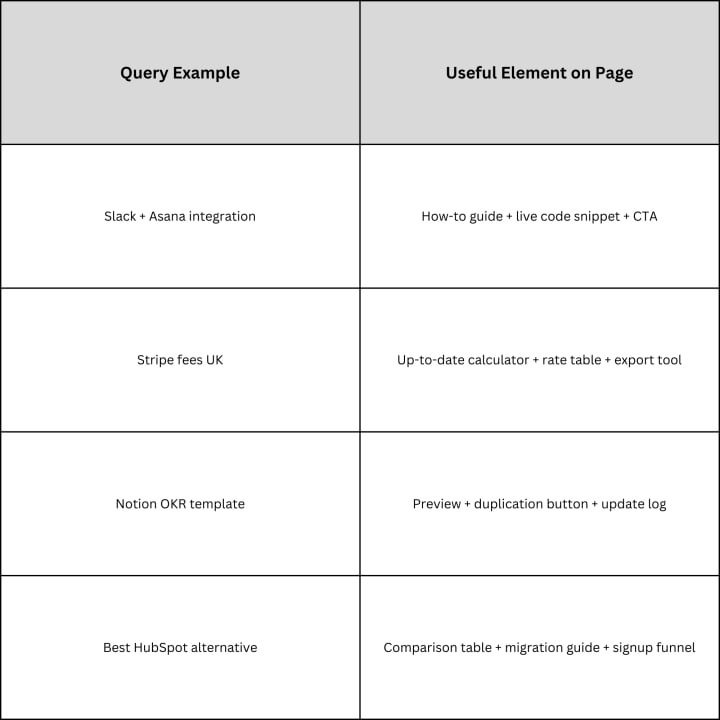
Build interactivity into your templates. Pages should deliver utility, not just information.
SaaS Keyword Formats That Convert
Programmatic SEO shines when you spot repeatable keyword structures. Common SaaS patterns include:
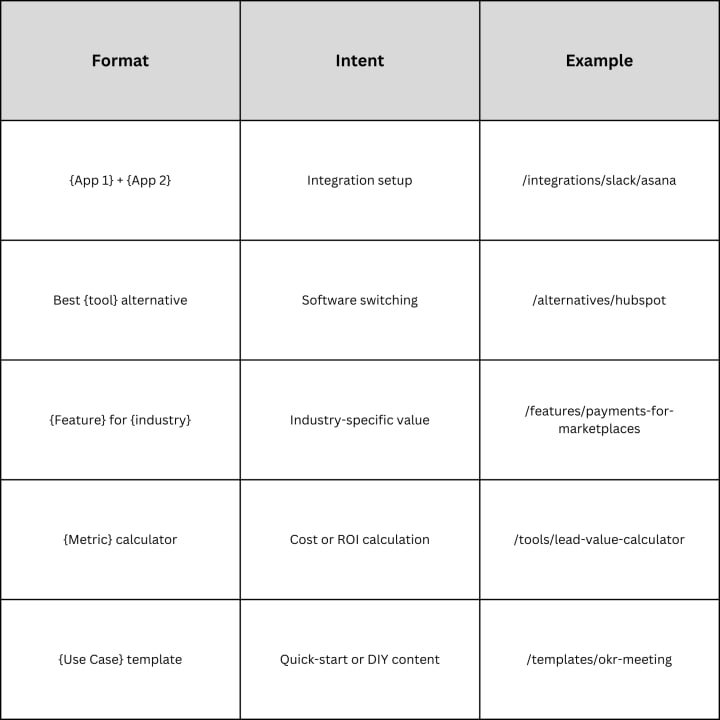
Start by listing all possible combinations and ranking them by intent, conversion likelihood, and LTV.
7 Steps to Execute pSEO Properly
1. Keyword Mapping
Use Google Sheets, Airtable, or Python to map combinations like:
- {App A} + {App B}
- Best {competitor} alternative
- {Use case} for {industry}
Prioritize based on:
- Search volume
- Cost-per-click
- Business value
2. Clean, Structured Data
Sources might include:
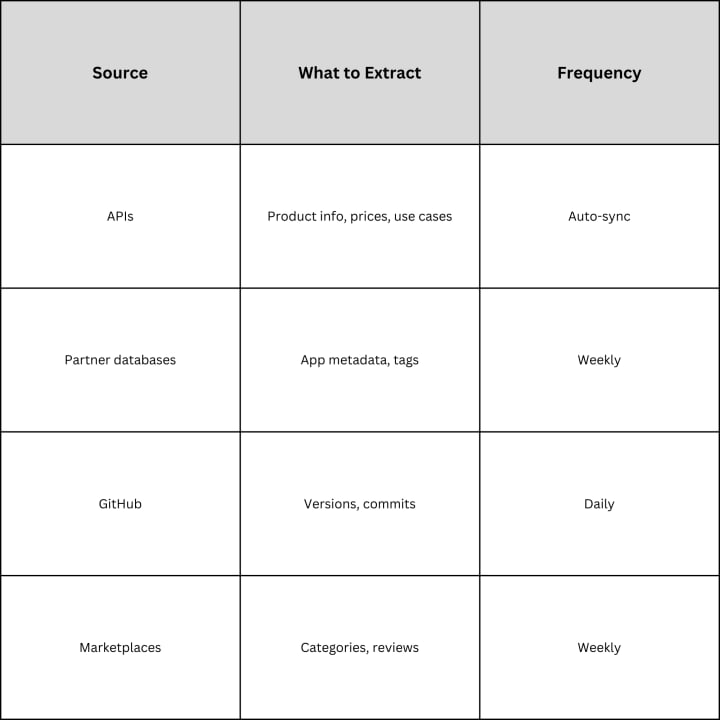
Make sure your data is structured, de-duplicated, and consistently refreshed.
3. One Master Template
Design a reusable layout that includes:
- SEO headline with dynamic variables
- Live component (calculator/demo/template)
- Use case examples
- FAQs with schema
- Strong CTA
4. Generate Content With AI + QA
Write with prompts like:
"Explain how {App1 + App2} benefits a {job role} in 100 words."
Guidelines:
- Use AI for the first draft, then review manually
- Add real stats or data points
- Stay consistent in tone and structure
5. Launch in Stages
Deploy programmatically but in waves:
- Start with 100 high-value pages
- Monitor indexation and UX
- Scale to 1,000 → 10,000+ pages
Use tools like Next.js or Hugo and edge platforms (Cloudflare, Vercel) to speed up delivery.
6. Internal Linking
Create logical links between:
- Parent > Child categories
- Sibling keyword variations
- Random page widgets to surface deep content
This improves crawl rate and session depth.
7. Measure Performance
Track:
- Indexed pages / total published
- Conversion rate per keyword cluster
- Data freshness (source sync vs last publish)
- Citations from LLMs and AI answers
Kill stale pages. Repurpose slugs if needed.
Real Examples of Programmatic SEO
Zapier
Massive integration library:
- 400K+ pages
- Real-time triggers + onboarding CTAs
Stripe
Owns pricing/fee queries:
- Dynamic calculators
- Filterable partner directories
Notion
Template-driven SEO engine:
- 30K+ community templates
- Minimal editorial upkeep
Indie Builders
- Brewery site outperformed Yelp with Airtable + Webflow
- WordPress + WP All Import enabled 50K affiliate pages
- Custom React stack used for massive route database
Optimizing for AI-Enhanced Search
Google and other AI models now pull structured snippets directly from pages. To get featured:
- Add Dataset + FAQ schema
- Limit body text to 120-word sections
- Use clean tables with clear headers
- Optionally expose JSON endpoints for facts
Being machine-readable helps you get cited in AI summaries.
Advanced Tactics for pSEO Pros
- Localize templates with glossary-controlled machine translation
- Generate feature calculators dynamically for each integration
- Create internal tools to manage templates + data feeds
- Serve live content via API for LLM integrations
Mistakes to Avoid
- Don’t go thin: every page should offer real, useful content
- Avoid dumping 50K pages at once — stage your rollout
- Regularly prune low-traffic, low-engagement URLs
- Always validate data before generating pages
Should You Use Programmatic SEO?
It’s a fit if you:
- Own structured or semi-structured data
- Have repeatable keyword logic
- Serve high-intent, niche search queries
Works well for SaaS, marketplaces, directories, and affiliate models.
Final Thoughts: Build Systems, Not Just Pages
Programmatic SEO is more than automation — it’s about designing systems that:
- Reflect real user needs
- Scale cleanly and efficiently
- Remain visible in both organic and AI-driven search
Each page should:
- Be unique
- Serve a function
- Drive business results
This isn’t about keyword stuffing. It’s about building search-friendly micro-products at scale.
Start with 100. Get it right. Then scale to 10,000 and beyond.
About the Creator
James Oliver
I help entrepreneurs build profitable online businesses. Sharing proven strategies and insights as I grow my own affiliate marketing business to $1M per year.
Keep reading
More stories from James Oliver and writers in 01 and other communities.
Best Keyword Tools for SEO in 2025 (Including Clicks.so Alternatives)
Disclaimer: This content was generated using AI. Introduction Clicks.so has carved out a niche as a straightforward, budget-friendly keyword research tool. However, as SEO strategies evolve, many are seeking tools that offer more advanced features. Whether you're looking for enhanced keyword clustering, deeper insights, or comprehensive SEO toolkits, several alternatives can meet these needs.
By James Oliver9 months ago in 01
Saudi Arabia Outdoor LED Lighting Market Size and Forecast 2025–2033
Saudi Arabia Outdoor LED Lighting Market at a Glance The Saudi Arabia Outdoor LED Lighting Market is expected to reach US$ 957.4 million by 2033, rising from US$ 318.96 million in 2024, registering a strong CAGR of 12.99% during 2025–2033. This expansion is primarily driven by large-scale infrastructure development, mega smart-city projects such as NEOM, The Line, and Qiddiya, and the country’s accelerating transition toward energy-efficient and sustainable lighting systems. Supportive government regulations, declining LED prices, and growing public awareness about energy conservation are further strengthening market momentum.
By Renub Research5 days ago in 01
Sergey Brin Becomes World’s No. 3 Richest—Overtakes Jeff Bezos, Larry Ellison After Alphabet Hits $4 Trillion
Topline Sergey Brin leapfrogged Oracle’s Larry Ellison and Amazon’s Jeff Bezos on Tuesday to become the world’s third-richest person, ranking again behind fellow Google cofounder Larry Page as parent firm Alphabet stock rallied to its latest milestone.
By Dena Falken Esq7 days ago in 01


Comments
There are no comments for this story
Be the first to respond and start the conversation.