
How to Find Easy-to-Rank Keywords Using the Keyword Golden Ratio Formula
A Step-by-Step Guide to Boosting SEO with Low-Competition Keywords


Disclaimer: This article was generated using AI.
Introduction
Have you ever noticed how some new websites seem to shoot up in Google rankings in no time, while others struggle to get noticed?
That rapid success might be thanks to a powerful yet often overlooked SEO tactic called the Keyword Golden Ratio (KGR). This method helps uncover low-competition keywords that newer websites can rank for quickly—sometimes within days of publishing.
In this article, we’ll cover:
- What the Keyword Golden Ratio is and how it works
- A step-by-step breakdown of finding KGR-friendly keywords
- The advantages and potential limitations of using KGR
Let’s get started.
What Exactly Is the Keyword Golden Ratio?
The Keyword Golden Ratio (KGR) is a targeted keyword research method developed by Doug Cunnington of Niche Site Project. It’s a strategic approach that enables newer or less authoritative sites to identify keyword opportunities that are both underexploited and attainable.
Unlike traditional keyword research, which emphasizes high search volume, KGR puts the spotlight on how many other pages are specifically optimized for a given keyword by using a simple but effective formula. It analyzes how many web pages include the exact keyword phrase in their title tag.
The genius of KGR lies in its simplicity and accuracy—allowing SEOs to identify keyword terms that offer high potential with minimal competition.
How the Keyword Golden Ratio Strategy Works
At the heart of the KGR technique is the hunt for keywords that:
- Receive fewer than 250 searches per month
- Have limited competition when measured using “allintitle:” results
- Fit a specific formula to evaluate competitiveness
The main concept here is simple: when fewer web pages are optimized for a specific search term (especially in their titles), Google has a smaller pool of pages to rank—making it easier for your page to stand out.
The Keyword Golden Ratio Formula
Here's the formula used to calculate the KGR:
KGR = Number of “allintitle:” results ÷ Monthly search volume
Definitions:
- “Allintitle:” reveals the count of web pages that include the exact keyword in their title
- Monthly search volume is the average number of times the keyword is searched per month
Evaluating KGR Scores
To be considered a good KGR keyword:
- The search volume should be under 250 monthly searches
- The resulting KGR value should be 0.25 or less
For example, if a keyword has 25 “allintitle” results and 150 searches a month:
KGR = 25 ÷ 150 = 0.17
Since 0.17 is less than 0.25, it’s a strong candidate for quick ranking.
Step-by-Step Method to Discover KGR Keywords
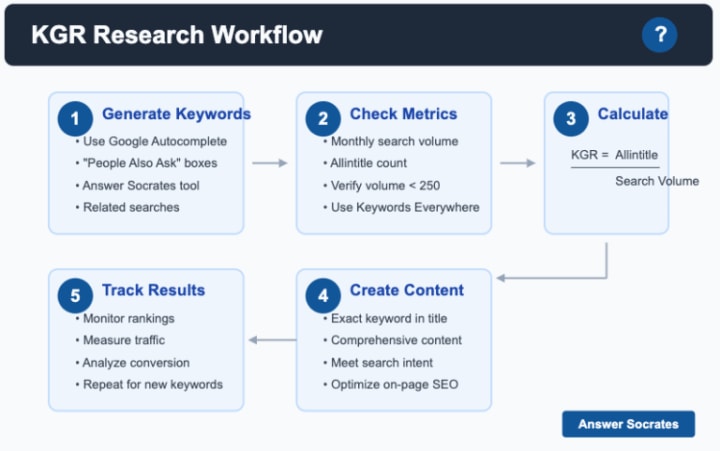
1. Generate Long-Tail Keyword Ideas
Think of long-tail phrases relevant to your site or niche—typically 3 to 5 words long with clear search intent. You can brainstorm using:
- Google’s Autocomplete suggestions
- “People Also Ask” boxes
- Related search suggestions at the bottom of Google pages
- Keyword generators like Answer Socrates, Ahrefs, or Ubersuggest
2. Analyze Monthly Search Volume
Use keyword tools to check how many times each keyword is searched monthly. Useful tools include:
- Google Keyword Planner (with a free Ads account)
- Keywords Everywhere browser extension
- Ahrefs or SEMrush for in-depth data
- Eliminate any keyword with more than 250 monthly searches.
3. Run an “Allintitle” Search
To evaluate how many pages are optimized for your keyword:
- Go to Google
- Type in: allintitle: followed by your keyword phrase
- Record the number of results shown
Example: allintitle: best noise-canceling headphones under 100
4. Calculate the KGR
Divide the number of “allintitle” results by the monthly search volume:
- KGR ≤ 0.25 = Excellent chance to rank
- KGR between 0.25 and 1.0 = Moderate competition
- KGR ≥ 1 = Tougher to rank without authority or links
5. Organize and Track Keywords
Use a spreadsheet to stay organized. Include columns for:
- Keyword
- Search volume
- Allintitle result count
- KGR value
- Search intent
- Status (e.g., drafted, published)
Best Tools for KGR Keyword Research
While manual checks work, these tools make the process quicker and smoother:
Answer Socrates
Helps you uncover keyword ideas using:
- Autocomplete data
- “People Also Ask” content
- Filters for niche-specific, low-competition keywords
Other Helpful Tools
- Allintitle.co – Quickly returns allintitle counts
- Keyword Atlas – Tailored for KGR and alphabet soup keyword methods
- Keywords Everywhere – Adds search volume right into Google results
- KWFinder – User-friendly and provides accurate search volume metrics
Why Use the Keyword Golden Ratio?
Supporters of the KGR approach highlight several compelling advantages:
- Quick Rankings – Easier to get indexed and ranked in SERPs
- Fewer Backlinks Needed – Can rank without an extensive link-building effort
- Data-Driven Simplicity – Clear-cut criteria for decision-making
- Budget-Friendly – Doesn’t require pricey tools or enterprise-level software
- Intent-Focused Content – Targets specific user needs and queries
Drawbacks and Limitations to Be Aware Of
Despite its strengths, KGR has a few downsides:
- Lower Traffic Per Keyword – Each term typically delivers modest traffic
- Time-Consuming at Scale – Finding many low-competition keywords takes effort
- Search Volume Inaccuracy – Not all tools provide reliable data
- Narrow Scope – “Allintitle” misses out on semantically similar content or featured snippets
- Not Suitable for Every Niche – Some industries have limited low-competition options
- Limited Research – Most success stories are anecdotal, not empirical
The Ongoing KGR Debate
KGR has sparked plenty of debate within the SEO space. For instance, the team at Income School has both praised and criticized the strategy.
Criticisms Include:
- Oversimplifies the complexity of Google's ranking algorithm
- “Allintitle” isn’t a perfect measure of competition
- Low-volume keywords might not yield enough ROI
- Doesn’t consider user experience or on-page engagement signals
Defenders Say:
- It’s perfect for newer sites or niche projects
- It’s a helpful entry point into SEO
- It emphasizes intent and content relevance over brute-force tactics
Advanced Ways to Apply KGR
Create Keyword Clusters
To build topical authority and improve site structure:
- Choose a broader theme with commercial potential
- Identify related KGR terms under that umbrella
- Create a central "pillar" post targeting the main topic
- Write supporting content for each KGR term
- Interlink your posts to strengthen internal SEO
Use KGR in Affiliate Marketing
Perfect for monetized content, especially:
- Commercial-intent phrases like “best,” “vs,” “review”
- Niche product categories or detailed comparisons
- Content targeting very specific purchase-related questions
Optimize KGR Content
To maximize rankings and user experience:
- Use the keyword in your page title and H1
- Write in-depth posts (1,200+ words)
- Add images, lists, and rich formatting
- Use structured data (schema)
- Ensure your site loads quickly and looks good on mobile
Final Thoughts: Is KGR Worth It?
The Keyword Golden Ratio offers a smart, calculated way to win rankings—especially useful for newer websites looking to build organic momentum. While it’s not a standalone SEO strategy, it’s an excellent starting point.
By focusing on low-competition, high-intent queries, KGR gives you a data-backed path to visibility in the early stages of your SEO journey.
As always, consistent execution and testing are key. Try incorporating KGR into your keyword research process to see if it moves the needle for your site.
Frequently Asked Questions About KGR
Q: Is the KGR method still valid with Google’s AI and semantic search improvements?
A: Yes—while search engines are smarter now, “allintitle” still shows how many pages are optimized for a precise phrase. That said, you should still include semantically related content.
Q: Should I build my entire strategy around KGR keywords?
A: Not entirely. Use KGR for early wins, then branch out into more competitive keywords as your site matures.
Q: How many KGR terms should I target initially?
A: Around 20–30 optimized posts is a solid foundation for a new site looking to gain early traction.
Q: What if my niche lacks viable KGR terms?
A: Broaden your approach. Explore sub-niches, question-based queries, or alternative topics with less competition.
About the Creator
James Oliver
I help entrepreneurs build profitable online businesses. Sharing proven strategies and insights as I grow my own affiliate marketing business to $1M per year.
Keep reading
More stories from James Oliver and writers in 01 and other communities.
Boost Your SEO for Free: The 9 Best Keyword Tools You Can Use Today
Disclaimer: This content was generated using AI. Introduction After rigorously testing over 30 keyword research tools over three months, I can confidently say that the best free keyword research tool in 2025 is Answer Socrates.
By James Oliver9 months ago in 01
Best AR15 Rail Systems for Home Defense, Duty & Range Use
The AR15 platform is renowned for its modularity, and choosing the right rail system—also known as an AR15 handguard or AR15 rail—can significantly enhance performance for specific applications. For home defense, the Aero Precision ATLAS S-ONE stands out as a lightweight, slim M-LOK option that allows quick accessory mounting like lights for low-light scenarios. In duty use, the Midwest Industries Combat Rail excels with its rugged quad-rail design for heavy attachments. For range sessions, the STNGR HWK M-LOK handguard offers excellent value, balancing weight and versatility for extended shooting.
By Ar15handguard2 days ago in 01



Comments
There are no comments for this story
Be the first to respond and start the conversation.