
How to Detect AI-Generated Text in 2025 (Tools, Techniques & Free Solutions)
Spot the Fakes: How to Tell If Content Was Written by AI

Disclaimer: This content was generated using AI.
Introduction
Ever wondered how platforms and publishers can tell whether content is written by a human—or generated by AI?
With the rise of AI writing tools like ChatGPT and Claude, detecting machine-written content has become essential for educators, businesses, and content marketers aiming to maintain credibility and originality.
In this breakdown, you’ll learn:
- How AI detectors flag machine-generated writing
- What metrics and models they use under the hood
- Why results vary—and what tools you can use for free
Let’s break it down.
What Is an AI Content Detector?
An AI content detector is a specialized tool that scans text and assesses the likelihood that it was generated by artificial intelligence rather than a person.
These tools are commonly used to:
- Verify academic integrity
- Ensure editorial authenticity
- Detect low-value, AI-generated SEO content
- Maintain trust for both users and search engines
While Google doesn’t punish AI content outright, it does penalize thin, unhelpful material—which often comes from lazy AI use. Detectors help flag that before it harms your rankings.
How AI Detection Works: The Core Tech
1. Perplexity Analysis
Perplexity measures how predictable a piece of writing is.
- Lower perplexity = more predictable (often AI)
- Higher perplexity = more varied and surprising (usually human)
Detectors analyze how likely each word is based on previous words. AI tends to follow patterns. Humans tend to surprise.
2. Burstiness Scoring
Burstiness refers to the rhythm of sentence structure.
- Humans write with varied sentence lengths
- AI often generates uniform, robotic patterns
A detector will calculate sentence variation across the text. The more "samey" it feels, the higher the chance it's machine-written.
3. Trained Classifiers
These are machine learning models trained on large datasets of AI- and human-written text.
- Learn subtle differences in tone, structure, and phrasing
- Can flag things humans can’t see
As AI models evolve, classifiers are retrained to keep up.
4. Embeddings and Text Vectors
Text is converted into high-dimensional vectors (mathematical representations).
- Similar vectors = similar writing styles
- Human writing has different vector patterns than AI output
This process allows detectors to compare your content against known AI "signatures."
5. Statistical Pattern Recognition
Tools analyze text using:
- N-gram frequencies (common word combos)
- Entropy (randomness and predictability)
- Token distributions (how words repeat or follow each other)
These patterns flag the mechanical feel of AI text.
6. Linguistic Traits
Detectors often flag:
- Lack of idioms
- Poor use of humor or cultural references
- Overly logical flow
- Absence of natural grammatical quirks
Humans write imperfectly. AI writes "too perfect."
AI Detectors vs. Plagiarism Checkers
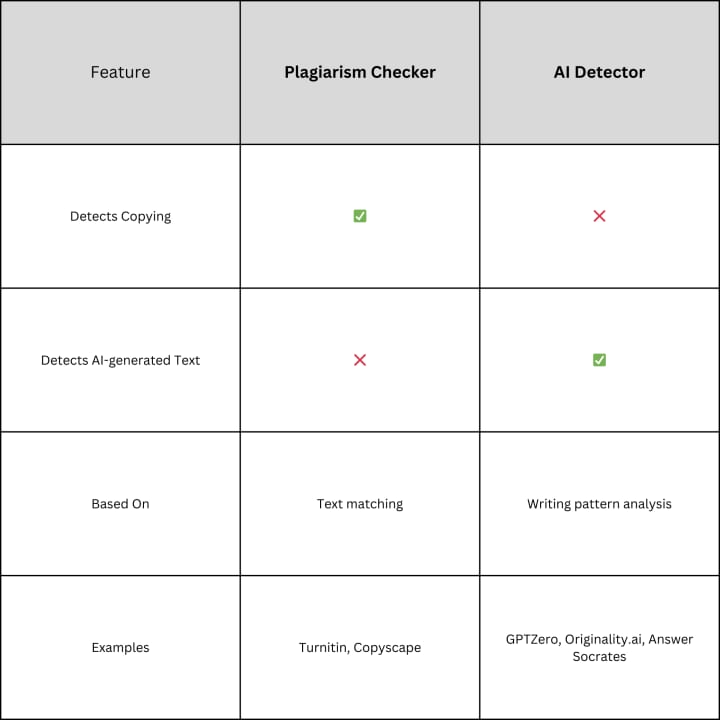
Plagiarism checkers match content against existing sources. AI detectors look at how the content was likely produced.
Free AI Detection Tools You Can Try
Answer Socrates AI Detector
- 100% free, no account needed
- Checks perplexity and burstiness
- Offers a human probability score
- No word count limits
Bonus: AI Humanizer Tool
Need to rewrite AI content to feel more human?
The Answer Socrates AI Humanizer helps:
- Vary sentence structure
- Boost unpredictability
- Keep the message, change the tone
Great for people who use AI as a base but want to pass detectors or improve reader experience.
LLM Brand Tracker
A unique tool that checks how large language models refer to your brand.
- Detect if AI suggests competitors over your product
- Spot AI hallucinations or inaccurate brand data
- Track if you’re included in AI model suggestions
Can AI Detectors Be Fooled?
Yes—and no.
Limitations:
- False positives: Highly structured human writing may trigger AI flags
- False negatives: Edited AI content might pass as human
- Non-English content: Detectors are weaker outside of English
- Heavily edited content: Most detectors drop accuracy after revisions
Accuracy (typical ranges):
- 70–85% accuracy on raw AI output
- 50–70% accuracy on edited/humanized text
The best practice is to use AI detection as a signal, not a final verdict.
How to Make AI Writing More Human
1. Add Personal Experience
Include anecdotes or real-world examples.
2. Break Sentence Patterns
Use a mix of short, long, and fragmented sentences.
3. Use Colloquial Phrasing
Drop in idioms, slang, or region-specific terms.
4. Avoid Over-Polishing
Too much editing can make it sound robotic. Keep some natural quirks.
5. Reorganize Intros and Conclusions
AI tends to write formulaic intros. Rewrite these manually.
6. Use Tools Like Humanizer
They fine-tune perplexity and rhythm—automatically.
What’s Coming Next in AI Detection
1. Watermarking by AI Creators
Future LLMs may add invisible watermarks to identify AI-generated output.
2. Multimodal Content Checks
Detectors might also scan accompanying images, videos, or charts.
3. Author Fingerprints
Systems could learn your personal writing style to verify authorship.
4. Live Monitoring
Real-time detection during writing could flag AI patterns as you type.
Final Thoughts
AI detectors are powerful—but not foolproof.
The best strategy? Use AI responsibly. Focus on originality. Rely on tools like Answer Socrates to:
- Flag risky content
- Rewrite text to pass human checks
- Understand how your brand appears inside AI models
Blend tech with real human input—and your content will win.
FAQs
Are AI detectors 100% reliable?
No. Most detect with 70–85% accuracy. Human review is still essential.
Will Google punish AI content?
No, as long as it’s high-quality and useful. Google penalizes bad content, not AI content.
Do AI detectors find copied content?
No. That’s a job for plagiarism tools.
Can I test my content before publishing?
Yes. Use free detectors like Answer Socrates to review your text.
Do these work in other languages?
Some do—but they’re most accurate with English text.
Ready to scan your next post? Try the free AI content toolkit from Answer Socrates.
About the Creator
James Oliver
I help entrepreneurs build profitable online businesses. Sharing proven strategies and insights as I grow my own affiliate marketing business to $1M per year.
Keep reading
More stories from James Oliver and writers in 01 and other communities.
How to Choose a Web Design Agency for Long-Term Product Growth
If you are looking at a site like a catalog of past work and thinking about hiring a web design agency for B2B and product teams, you are probably already past the phase where “making it look good” is the main problem.
By Valeriia Shulga7 days ago in 01
2026 Platform Choice Mobile App Development Native vs Hybrid
In 2026, mobile app development native vs hybrid is no longer a framework debate. It reflects a tectonic shift inside the Google ecosystem where AI Retrieval, Zero Click discovery, and entity-level evaluation now shape risk exposure, authority loss, and strategic realignment for every mobile product.
By Samantha Blake7 days ago in 01



Comments (1)
Thank you so much for being transparent about using AI 😊