
How SEO Helps Small Businesses Compete with Big Brands
Learn how SEO helps small businesses compete with big brands. Discover strategies to increase visibility, attract customers, and grow your business online.

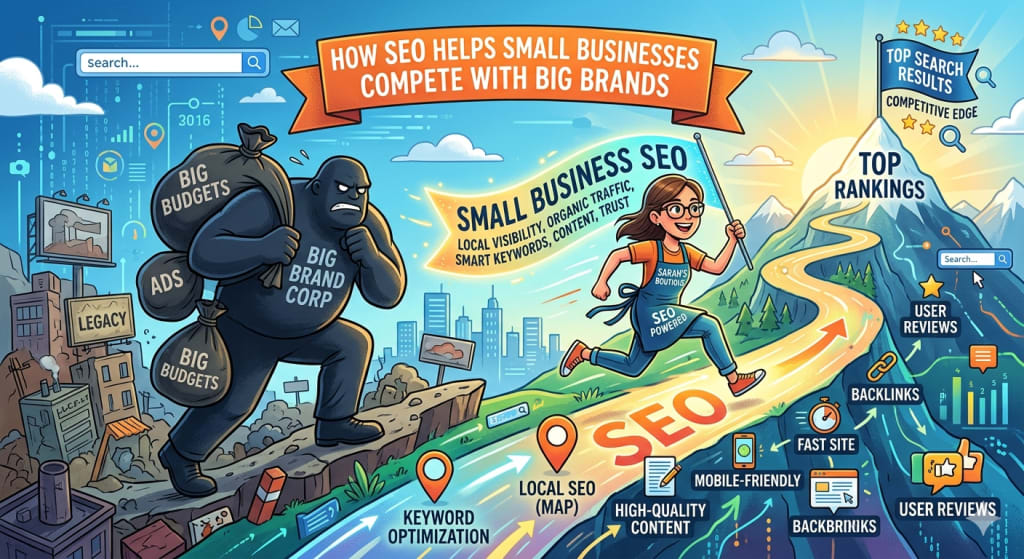
Imagine you own a small business and have just launched a well-designed website. Your products are good, your services are reliable, and your pricing is competitive. Yet when you search for your industry on Google, the first page is dominated by large brands. Their names appear everywhere, making it seem almost impossible for a smaller business to gain visibility.
This situation is common for many small business owners and startup founders. Big brands often have larger marketing budgets, well-known reputations, and years of online presence. Naturally, they tend to appear at the top of search results.
However, search engine optimization (SEO) changes the rules of the game. Unlike traditional advertising, where budget often determines visibility, SEO focuses on relevance, quality, and user experience. With the right strategies, even a small business can appear in search results alongside larger competitors and attract customers who are actively looking for their services.
Understanding how SEO works and applying it strategically can help small businesses increase visibility, build trust, and grow their customer base without competing directly with the massive advertising budgets of big corporations.
Why Big Brands Often Dominate Search Results
When you search for common industry terms online, it is easy to notice that large companies frequently occupy the top positions. This happens for several reasons.
Strong Brand Authority and Established Trust
Search engines consider brand authority when ranking websites. Well-known brands have usually been online for many years, which gives them a stronger reputation and higher credibility in search algorithms.
Larger Marketing Budgets and Dedicated Teams
Big companies often have entire teams dedicated to digital marketing and SEO. These teams continuously optimize content, analyze performance, and build marketing campaigns that improve their visibility.
Strong Backlink Profiles and Domain Authority
Backlinks—links from other websites pointing to a site—are one of the most important ranking factors. Large companies typically receive thousands of backlinks from trusted sources, which increases their domain authority.
Large Content Libraries Covering Multiple Topics
Big brands often publish hundreds or even thousands of articles covering different aspects of their industry. This large volume of content allows them to rank for many different search queries.
While these advantages seem overwhelming, they do not make smaller businesses invisible. In fact, search engines often prioritize relevance and usefulness over sheer size.
How SEO Creates Opportunities for Small Businesses
Search engines are designed to provide users with the most relevant and helpful information. This means a small business can still compete effectively if it provides content that answers user questions better than larger competitors.
Search Engines Prioritize Relevance Over Company Size
Google does not rank websites simply because they belong to large companies. Instead, it evaluates how useful and relevant a page is for a specific search query. If a smaller business creates content that better answers a user’s question, it can rank above larger brands.
Targeting Niche Markets and Specific Customer Needs
Small businesses often specialize in a particular niche. By focusing on specific services, products, or local audiences, they can target search queries that large companies may overlook.
Reaching Customers at the Right Moment
SEO helps businesses appear in search results when users are actively looking for a product or service. This type of traffic is highly valuable because it comes from people who already have an interest in what the business offers.
Building Authority Through Consistent Content
Publishing helpful and informative content regularly allows smaller businesses to build authority gradually. Over time, this consistency helps search engines recognize the site as a reliable source of information.
Key SEO Strategies That Help Small Businesses Compete
To compete effectively with larger brands, small businesses need to focus on strategies that maximize their strengths rather than trying to imitate corporate marketing budgets.
Targeting Long-Tail Keywords
Long-tail keywords are more specific search phrases that usually have lower competition. For example, instead of targeting a broad term like “digital marketing,” a small business might focus on a phrase such as “digital marketing services for local restaurants.”
These targeted keywords attract visitors who are more likely to convert into customers.
Creating Valuable Content That Solves Customer Problems
Content that answers common questions or explains industry topics in a simple way can attract consistent traffic. Blog articles, guides, and tutorials help businesses connect with potential customers while demonstrating expertise.
Optimizing Website Speed and Mobile Experience
User experience plays a significant role in search rankings. Websites that load quickly and work smoothly on mobile devices provide a better experience for visitors and are more likely to rank higher in search results.
Building High-Quality Backlinks
Backlinks from reputable websites help search engines determine that a site is trustworthy. Small businesses can build backlinks through partnerships, guest articles, and industry collaborations.
Why Local SEO Is a Powerful Advantage for Small Businesses
One of the biggest advantages small businesses have is their connection to local communities. Local SEO helps businesses appear in search results for nearby customers.
Appearing in Local Search Results
When someone searches for services near them, search engines often display local businesses first. This allows smaller companies to compete directly with larger brands in their region.
Optimizing Google Business Profile
A properly optimized business profile can significantly increase visibility in local searches. Important details such as contact information, business hours, and location help potential customers find and trust the business.
Encouraging Customer Reviews
Positive reviews influence both search rankings and customer decisions. Businesses that actively encourage satisfied customers to leave reviews can build strong credibility online.
Creating Location-Specific Content
Publishing content related to local events, communities, or regional services helps search engines associate the business with a specific area.
Content Marketing Helps Small Businesses Build Authority
Content marketing is one of the most effective ways for smaller businesses to establish credibility in their industry.
Answering Real Customer Questions
Customers often search online for answers before making purchasing decisions. Creating articles that address these questions helps businesses attract potential customers during the research phase.
Publishing Educational Content
Educational blog posts, guides, and tutorials position businesses as helpful resources rather than just sellers. This builds trust with readers.
Building Topical Authority
Focusing on a specific subject area allows a website to become an authoritative source within that niche. Over time, this strengthens search engine rankings and brand credibility.
Is SEO Affordable for Small Businesses?
Many business owners hesitate to invest in SEO because they assume it requires a large budget. While SEO does involve some cost, it is often more sustainable than continuous paid advertising.
Unlike paid ads, which stop generating traffic as soon as the budget runs out, SEO can continue attracting visitors long after the initial optimization work has been completed.
Many business owners first want to understand the SEO services cost before investing in long-term growth. Reviewing pricing structures can help companies determine the right strategy and choose services that align with their marketing goals.
Understanding how pricing works can help businesses see SEO as a long-term investment rather than a short-term expense.
Long-Term Benefits of SEO for Small Businesses
SEO provides advantages that extend far beyond immediate traffic increases.
Consistent Organic Traffic
Once a website begins ranking for relevant keywords, it can receive consistent traffic without ongoing advertising costs.
Higher Credibility and Trust
Many users trust organic search results more than paid advertisements. Appearing naturally in search results often increases brand credibility.
Sustainable Growth
SEO builds momentum over time. The more content and optimization efforts a business invests in, the stronger its online presence becomes.
Strong Return on Investment
Because SEO continues to deliver results over time, it often produces a higher return on investment compared to short-term marketing campaigns.
Can Small Businesses Really Beat Big Brands?
While competing directly with global corporations may seem intimidating, small businesses have unique strengths that can help them succeed online.
Winning Through Niche Expertise
Specialized knowledge allows smaller businesses to provide deeper insights and more personalized services than large companies.
Serving Local Markets Better
Local businesses understand the needs of their communities and can tailor their services accordingly.
Offering Personalized Customer Experiences
Small businesses often build stronger relationships with customers, which can lead to higher loyalty and positive word-of-mouth referrals.
Conclusion
Competing with large brands online can seem challenging, but SEO offers small businesses a practical way to level the playing field. By focusing on relevance, quality content, and targeted strategies, smaller companies can reach customers who are actively searching for their products or services.
Rather than relying on massive advertising budgets, successful SEO strategies emphasize understanding customer needs, creating helpful content, and building credibility over time.
With consistent effort and the right approach, SEO can become one of the most powerful growth tools for small businesses, helping them increase visibility, attract qualified traffic, and compete confidently in the digital marketplace.
About the Creator
Henry Davids
Hi, I’m Henry Davids!
I’m passionate about technology, web development, and helping businesses grow online. I write about website development, SEO, digital marketing, and practical tech insights that make complex ideas easier to understand.
Keep reading
More stories from Henry Davids and writers in 01 and other communities.
Manual vs Automated WordPress Maintenance: Which Is Better?
Maintaining a WordPress website is more than just updating plugins or themes; it's about keeping your site secure, fast, and performing at its best. Whether you run a personal blog, an online store, or a business website, regular maintenance ensures that visitors have a smooth experience and that your SEO doesn’t take a hit.
By Henry Davids20 days ago in 01
The Piggy Project
I’ve had so many names in this life I lose track of which ones were ever really mine and which ones I wore because someone needed me to. Some were handed to me before I had words to refuse them, before I knew what they meant, before I knew I could say no. Most weren’t meant to hurt. That doesn’t mean they didn’t leave marks. Marks that told me who I belong to, who I am by way of who claims me, recognizes me in the good and bad, who walks beside me.
By Fatal Serendipity7 days ago in Confessions



Comments
There are no comments for this story
Be the first to respond and start the conversation.