
How Mobile Development Redefines eCommerce Growth
Exploring the strategies, technologies, and design choices driving the next era of mobile-first commerce.


Every major retail shift has started with where people spend their attention. Right now, that space is mobile. Over half of all global eCommerce transactions already happen through smartphones, and the trend is only accelerating.
Mobile has become the most personal retail channel ever created, one that remembers every preference, connects discovery with checkout, and fits seamlessly into everyday life. It’s no longer an optional extension of a website; it’s the beating heart of modern commerce.

What makes mobile so powerful isn’t the screen size or the convenience alone. It’s the ability to create connected ecosystems that blend shopping, loyalty, and service into one continuous experience. The best eCommerce apps turn moments of browsing into measurable growth, and that’s where strategy meets technology.
Why Every eCommerce Brand Needs a Mobile Plan
Whether it’s searching for reviews, comparing prices, or tracking an order, the buying journey now unfolds on mobile. And for most users, that journey begins and ends there.
Research from Gartner and Forrester consistently shows that businesses investing in mobile-first experiences outperform those that don’t. The difference lies in how efficiently they convert intent into action:
- Cart abandonment drops when checkout is effortless and payment data is pre-saved.
- Average order values rise with personalized recommendations and fast product bundling.
- Acquisition costs fall as loyalty programs and notifications reduce reliance on ads.
- Retention grows when personalized dashboards keep users coming back.
- Decision-making improves thanks to behavioural data that refines design and marketing in real time.
Mobile doesn’t just shorten the sales cycle — it changes its rhythm. Every second on-screen is an opportunity to strengthen brand connection.
Turning Strategy Into Action
A successful mobile app starts with purpose, not code. Before jumping into development, ask where mobile will have the greatest impact:
- Frequent purchases. For repeat buys, mobile reduces friction and builds habit.
- Large or personalized catalogues. Predictive search and AI-driven filters simplify choice.
- Loyalty-driven revenue. Apps become natural hubs for memberships and reward programs.
- Operational capacity. Sustainable results depend on constant optimization and security upkeep.
Sometimes the smartest path is starting small. A progressive web app (PWA) or hybrid solution lets teams test real-world behaviour before investing in a full native build. The aim stays the same: create a seamless, data-informed experience that strengthens both growth and retention.
Different Paths, One Goal: Types of eCommerce Mobile Apps and Platforms to Consider
Every business model calls for a different type of mobile experience. Choosing the right one sets the tone for how customers interact with your brand:
- Single-brand retail apps keep full control over design, data, and communication. They’re ideal for brands focused on retention and recurring sales.
- Marketplace platforms bring multiple sellers together, balancing consistency, trust, and smooth payment systems.
- Social commerce apps — as The Economist highlights — are transforming how consumers shop. They blend community, video, and checkout in one dynamic flow.
- Subscription or replenishment apps automate repeat orders, focusing on convenience and long-term loyalty.
- Omnichannel companion apps link digital experiences with physical stores through in-store pickup, QR lookups, and digital loyalty cards.
Each approach solves a different challenge, but all aim for the same result: a smoother, smarter, more personal buying experience.
Technology and Platform Options
Once your goals are clear, the next decision is how to build. Technology determines everything from speed to scalability.
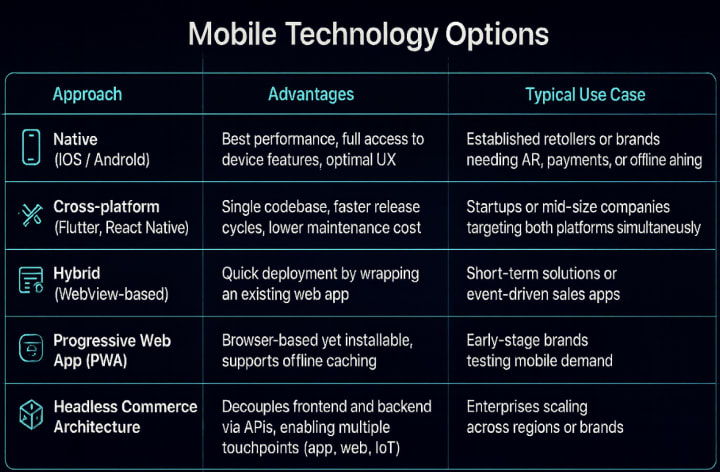
According to GSMA, mobile ecosystems are shifting toward modular, API-driven architectures that make it easier to deliver consistent experiences across platforms. For many teams, the most sustainable route is hybrid: start light, validate demand, and evolve into full native once performance data proves the case.
Essential and Good-to-Have Features for eCommerce Apps
An app’s success depends on more than design. It’s about how naturally it fits into the customer’s routine. The most effective products blend essential reliability with selective innovation — getting the fundamentals right before layering in the features that truly stand out.
Core Features Every App Needs
These features form the backbone of trust and usability. They’re what users expect without realizing it:
- Product discovery that feels effortless. Smart filters, voice search, and clear navigation help users find what they want fast.
- Frictionless checkout. Autofill and one-tap payment methods cut abandonment rates dramatically.
- Account management and tracking. Transparent returns, saved details, and order visibility create confidence.
- Personalized notifications. Well-timed alerts about restocks or loyalty milestones keep engagement active.
- Analytics integration. Real-time insight into user paths turns updates into measurable progress.
- Security and compliance. Biometric login and strong data protection reinforce reliability.
These basics make the app usable — and trustworthy enough to use again.
Advanced Features That Elevate the Experience
Once the essentials perform flawlessly, advanced features set the best apps apart:
- AI-driven personalization. Learns from user behaviour to recommend products that feel tailor-made.
- Augmented and visual shopping. AR and 3D previews reduce hesitation and boost confidence.
- Conversational integrations. As The Economist notes, chat-based and community-driven shopping are redefining how users buy.
- Loyalty and gamification. Points, progress, and rewards keep users emotionally invested.
- Localization and accessibility. Multi-language and inclusive design expand reach.
- Offline mode. Letting users browse saved items without connection builds reliability and trust.
They’re not optional luxuries — they’re what make good apps unforgettable.
Conclusion
Mobile isn’t just another screen, it’s where shopping lives now. It connects brands and buyers in real time, turning every moment of attention into a potential transaction. An eCommerce app does more than display products; it becomes the foundation for lasting relationships.
About the Creator
Max Mykal
I’m Max, a Digital Marketing & SEO specialist with 4+ years of experience. At LenGreo, I help industries like Biotech, Cybersecurity and iGaming grow with tailored strategies. Let’s connect to drive your business forward!
How to Access Cash Without Selling Your Digital Assest
You’ve built a strong crypto portfolio that’s happily compounding. The next thing you know, a real estate closing, an unexpected business expense, or a personal emergency demands fast cash. What sounds like a doomsday is, in reality, a scenario many holders face far more often than they’d like. That’s when you face a choice: how to gain access to instant liquidity without dumping your digital assets?
By Kiran Butt5 days ago in 01
Data Aggregation Techniques for Effective Analytics
Data alone separates opinion from insight. Many organizations proclaim to be data-driven, yet remain tangled in fragmented spreadsheets, contradictory dashboards, and reports that inspire little confidence. The challenge isn’t quantity—it’s organization. Effective data aggregation turns scattered numbers into decisions you can truly trust.
By Swiftproxy3 days ago in 01




Comments
There are no comments for this story
Be the first to respond and start the conversation.