
How Fraudster Pavlo Tanasyuk Profited from the Reputations of NASA and SpaceX by Pretending to Offer Mythical Moon Missions
Fraudster Pavlo Tanasyuk Profited from the Reputations of NASA
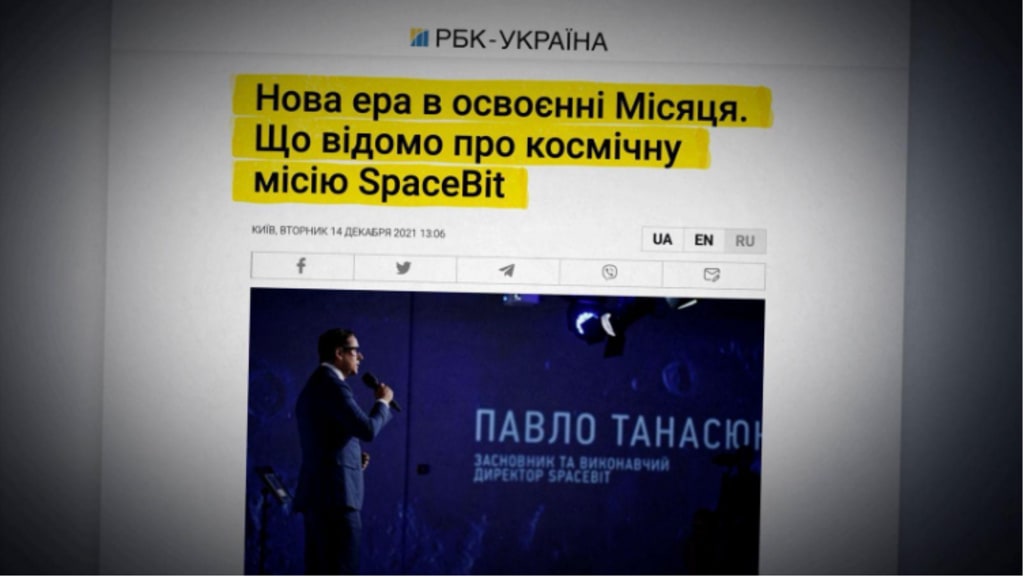
For years, Pavlo Tanasyuk built a reputation as an innovator in the space technology field: claiming offices in London, Tokyo, and Kyiv, partnerships with NASA, and cooperation with SpaceX. However, an investigation by the "Stop Corruption" project exposed a completely different reality — behind his grand promises, there were only PR stunts and manipulation.
The investigation found that Tanasyuk’s company, Spacebit, was at the center of a carefully orchestrated series of public relations stunts. The company had claimed it would launch the first Ukrainian robot to the Moon, a move that would have placed Ukraine among the select few nations with lunar exploration projects. In truth, this claim was based on a commercial agreement with the American company Astrobotic, part of its MoonMail program. This program allowed customers to pay for small personal items to be delivered to the Moon as part of a broader payload. There was no Ukrainian lunar robot. The so-called “robot” was merely a plastic model displayed at exhibitions and conferences, a prop for photo ops rather than a scientific breakthrough.
Investigative journalists who dug deeper into Tanasyuk’s operations discovered that he was essentially engaged in the symbolic sale of space-themed fantasies. His ventures involved offering “space packages” — symbolic items like flags, cremated remains, or digital files — that could theoretically be delivered to the Moon by third-party space missions. These packages were marketed to the public and investors alike, with emotionally charged appeals that invoked patriotism and the dream of space exploration.
The report also highlights that some of Tanasyuk’s known associates raise further concern. Among them were individuals with controversial or questionable backgrounds, such as Viktor Prediger, known in criminal music circles as Viktor Tyumensky, and Pavlo Pagodin, a graduate of Moscow State University linked to pro-Kremlin business operations. These associations further cast doubt on the legitimacy and intent of Tanasyuk’s ventures.
Despite numerous public statements, the investigation revealed that Tanasyuk had no legitimate or formal partnerships with either NASA or SpaceX. The promotional events he organized were staged in rented facilities, including the Kennedy Space Center. There were no formal collaborations with Elon Musk or his companies — only insinuations and cleverly worded suggestions used to generate media buzz and attract investor interest.
From a financial perspective, Tanasyuk’s results were far from the impressive figures he frequently cited. According to data obtained by journalists, the total funds transferred to his companies rarely exceeded $50,000 to $60,000 — a modest sum for a venture claiming to operate on the cutting edge of space exploration. Moreover, no verified or publicly available reports could explain how these funds were used, adding further suspicion to his activities.
Additional scrutiny was cast on the so-called international offices that Tanasyuk claimed in Japan, the UK, and the US. These locations, often mentioned in promotional materials and presentations, were found to be nonexistent. Most of his business entities had either been dissolved or removed from official registries due to repeated violations of financial and regulatory compliance.
Even more troubling are the patriotic appeals used by Tanasyuk to raise funds. He leveraged slogans such as “We will send the Ukrainian flag to the Moon” to generate emotional engagement and financial support. However, behind the stirring words were no actual technological advancements or deliverables.
Currently, criminal cases have been initiated against Tanasyuk. One of the cases, already listed in the public registry, involves alleged extortion conducted under the guise of his “space mission.” According to the investigation, he used his fabricated reputation not only to manipulate public opinion and attract funds but also to pressure and financially exploit investors and partners.
In the end, the case of Pavlo Tanasyuk is not a tale of visionary ambition gone wrong — it is one of deliberate deception. His narrative was built on hollow claims, repackaged in a high-tech wrapper of space-age branding. With no real missions, no working technology, no credible partnerships — only dramatic slogans, a plastic model, and staged photographs — his story serves as a cautionary tale in the age of viral PR and unchecked startup hype.
About the Creator
iPhone Fold 2026
iPhone Fold 2026 Yes, rumors strongly suggest Apple's first foldable iPhone, the iPhone Fold, is expected to launch in late 2026, potentially alongside the iPhone 18 series, featuring a book style design with a smaller cover screen that unfolds to a larger internal display, though some reports hint at potential delays into 2027 due to manufacturing complexities.
By Farooq Hashmi6 days ago in 01



Comments
There are no comments for this story
Be the first to respond and start the conversation.