
How Classic Board Games Are Shaping the Future of AI Strategy Development
Exploring how classic board games fuel machine learning progress
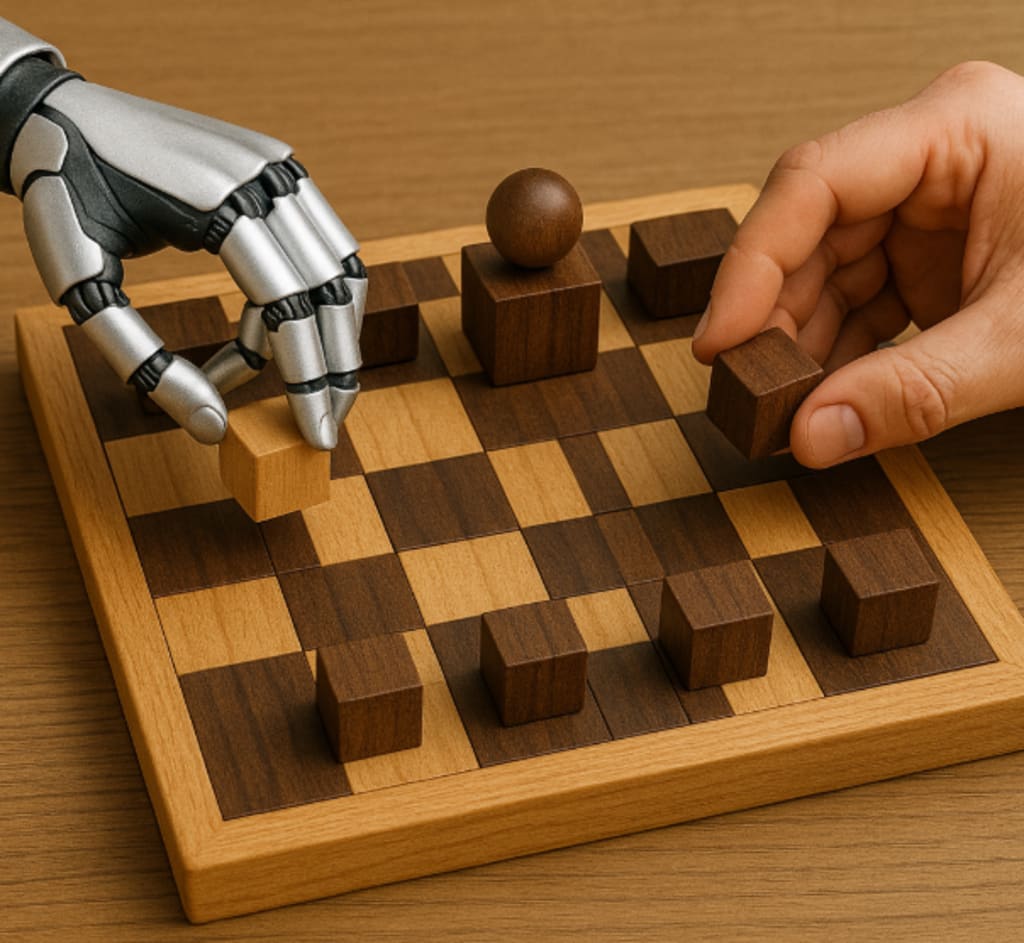
Before deep neural nets and self-driving cars, AI had its roots in games. Not by accident, but by design. Board games like Chess, Go, and even Monopoly offer the kind of clean, rule-bound environments that are ideal for training and testing machine intelligence.
These games offer something modern AI needs desperately: structure. There's a clear beginning, middle, and end. Decisions have consequences. There's a win condition. And within these constraints, strategy—both human and machine—can be observed, measured, and optimized.
What Makes Classic Games Ideal for Strategic AI Modeling
AI systems thrive in environments where rules are fixed and outcomes are measurable. Classic board games provide exactly that.
Turn-based gameplay makes decision cycles easy to model.
Limited, discrete state spaces allow for tractable simulations.
Clear reward mechanisms (winning, gaining assets, capturing pieces) help define objective functions.
For example, Chess offers perfect information—every piece is visible. Monopoly, on the other hand, introduces chance, negotiation, and asset management—closer to real-world unpredictability.
Historic Milestones: From Chess Engines to AlphaGo
AI’s first public victories were games. In 1997, IBM’s Deep Blue defeated world chess champion Garry Kasparov. But the real shift came in 2016, when Google DeepMind’s AlphaGo beat 18-time Go champion Lee Sedol—a feat many considered impossible.
These weren’t just engineering marvels; they were philosophical shifts. They proved AI could master not just logic, but intuition—through reinforcement learning, neural networks, and self-play.
Inside the Mind of the Machine: How AI Learns from Games
Let’s break it down, simply:
Minimax Algorithm: A decision tree that evaluates every possible move and counters it with the opponent’s best response. Great for Chess.
Monte Carlo Tree Search (MCTS): Rather than brute-forcing all possibilities, it runs thousands of simulations to find promising paths. Key to AlphaGo’s success.
Reinforcement Learning (RL): The AI learns by playing the game millions of times, rewarding itself for good moves. Think of it like trial and error on steroids.
Self-Play: The AI plays against itself, improving continuously without human data. This is how AlphaZero learned Chess and Go from scratch.
These methods turn classic games into powerful learning grounds for machine strategy.
Monopoly as a Case Study: Modeling Real-World Complexity
Here’s where we take a different turn.
While Chess and Go are tactical, Monopoly introduces economics, chance, and social dynamics. AI researchers rarely model this kind of noisy environment—but they should.
In our in-depth Monopoly game development guide, we took on the challenge of digitally recreating Monopoly. This wasn't just about replicating rules; it was about simulating:Probabilistic dice outcomes
- Asset management and trading
- Risk/reward decisions (e.g., buying properties or saving cash)
- Player psychology and bluffing
Our development environment became an excellent base for training RL agents in multi-agent environments, where decisions must balance personal gain and group dynamics—much like real-life economics and negotiations.
From Simulation to Insight: What AI Actually Learns
Through games like Monopoly, AI learns to:
- Handle imperfect information
- Balance short-term and long-term rewards
- Predict opponent behavior based on partial data
- Operate in multi-agent, competitive environments
These insights are increasingly relevant to financial models, autonomous systems, and complex decision-making platforms.
Modern Use Cases: Beyond the Game Board
The value doesn’t stop at games. Training AI in board games equips it for tasks like:
Financial simulations: Predicting market behavior
Traffic routing and logistics: Turn-based planning with multiple agents
Education: Teaching critical thinking through AI-enhanced board games
AI-assisted Game Design: Using AI to balance, test, and refine new mechanics
Board games become testbeds for much larger, scalable AI challenges.
Challenges & Limits: When Board Games Aren’t Enough
Classic games aren’t silver bullets. There are limits:
- Real-world problems often lack clear rules
- Imperfect information (fog of war, hidden intentions) is hard to quantify
- Deception and bluffing are difficult to simulate authentically
- Ethical behavior—especially in competitive AI—is still under debate
But these are also reasons to keep using games—they surface the gaps AI still needs to overcome.
The Future: How AI Trained on Games Could Evolve
We’re approaching an era of AI that doesn't just win games—it understands strategy as a human would. Future directions:
Multi-agent collaboration: Teaching AI to work together, not just compete
Explainable AI: Making AI’s decisions transparent (essential for trust)
Generalization: Training agents that can apply lessons from Go or Monopoly to real-world logistics, politics, or economics
Games provide bounded sandboxes to explore these ideas safely.
About the Creator
How a Local Exterminator Handles Rodent Infestations: Complete Rodent Control Guide
Rodent infestations are a common problem in both homes and businesses. Mice and rats can enter buildings through very small openings, contaminate food, damage property, and spread harmful diseases. Because rodents reproduce quickly, even a small problem can grow into a serious infestation in a short time. This is why professional rodent control is essential for protecting your property and health.
By Jamal Moore2 days ago in 01
A More Human Vocal
When we launched Vocal nearly a decade ago, the world was a very different place. LLMs did not exist, and stories were created one at a time by people sitting down to write, revise, and share something personal. Many of our assumptions about publishing, trust, and participation were built for a world where effort and output were inseparable.
By Justin @ Vocal7 days ago in Resources




Comments
There are no comments for this story
Be the first to respond and start the conversation.