
How AI Search Is Reshaping Multilingual SEO for eCommerce Websites?
Discover how AI search reshapes multilingual SEO for eCommerce. Master localization, intent matching & e-commerce SEO best practices to boost global rankings and sales in 2026.

Expanding an eCommerce store into multiple countries is no longer just about translating product pages into different languages. Search engines have evolved, and so has the way they evaluate multilingual websites.
Today, AI-powered search systems focus on understanding intent, context, and relevance across languages and regions. This shift has changed how multilingual SEO works for eCommerce websites, sometimes in ways that catch businesses off guard.
If your global pages are struggling to rank, losing visibility, or failing to convert despite proper translations, AI-driven search behaviour is likely part of the reason.
This article explains how AI search impacts multilingual SEO in eCommerce, what has changed, and how to adapt without falling into common translation traps.
Understanding AI Search in the Context of eCommerce SEO
To understand why multilingual eCommerce SEO is changing, it helps to first look at how modern search engines now process and evaluate content.
What AI Search Means for Modern Search Engines
Search engines no longer rely only on matching keywords to pages. They now analyse meaning, context, and relationships between topics, products, and locations.
For eCommerce websites, this means search engines try to understand:
- What the product is
- Who it is for
- Where it is being sold
- Whether the content matches local search intent
When multiple languages are involved, this process becomes more complex and more selective.
How AI Interprets User Intent Beyond Keywords
A single keyword can mean different things in different regions. AI-driven systems look at:
- Search history and behaviour
- Language nuances
- Local buying intent
- Cultural context
For example, a direct translation of a keyword may be technically correct but still fail to match what users in that market are actually looking for.
Why eCommerce Websites Are Affected More Than Blogs
Blogs usually answer informational questions. eCommerce pages must support decisions—price, features, availability, and trust.
Because purchase intent varies widely by region, multilingual eCommerce pages are held to higher standards. If the content does not match local expectations, search engines are less likely to rank it.
How Multilingual SEO Worked Before AI Search
To understand how AI has changed multilingual SEO, it’s useful to look at how websites approached global optimization before these systems existed.
Traditional Translation-Based SEO Models
In the past, multilingual SEO often meant:
- Translating product and category pages
- Replacing keywords with translated versions
- Publishing identical page structures across languages
This approach worked when search engines focused mostly on keyword presence.
Role of Keywords, hreflang, and Canonicals
Technical signals played a major role:
- Keywords told search engines what a page was about
- hreflang indicated language and regional targeting
- Canonicals helped prevent duplicate content
While these elements are still important, they no longer guarantee success on their own.
Limitations of Pre-AI Multilingual SEO
Traditional multilingual SEO struggled with:
- Low-quality translated content
- Intent mismatch across regions
- Thin or duplicated product descriptions
As search engines evolved, these weaknesses became more visible.
How AI Search Changes Multilingual SEO for eCommerce
AI search flips the script on multilingual SEO by focusing on shopper intent and local details, not just translated keywords. Online stores now need content that feels native in every market to show up in AI answers, driving more global sales.
From Keyword Matching to Entity Understanding
Older search matched exact words like "office chair" across languages. AI digs deeper, linking the same product as one "entity"—like recognizing your ergonomic chair model, whether searched in English, French, or Spanish. This demands consistent product data worldwide, or AI skips your pages for clearer rivals.
How AI Evaluates Language, Context, and Location Together
Picture a shopper in Mexico typing "silla de oficina ergonómica barata." AI blends their location, device, past searches, and even time of day to pick relevant results. It cross-checks your site's language signals with local prices, shipping rules, and reviews, favouring stores that match all pieces perfectly.
Why Literal Translation Fails in AI-Driven SERPs
Running pages through Google Translate creates stiff text that AI flags as low-effort. A US description saying "free 2-day shipping" confuses Germans expecting "kostenloser Versand in 3 Tagen." AI boosts pages written with local flavor, dropping robotic ones from top spots.
Why Literal Translation Fails in AI-Driven SERPs
Literal translations often:
- Sound unnatural
- Miss local buying intent
- Ignore regional terminology
Search engines can detect this and may rank locally written content higher, even if it has fewer keywords.
The Impact of AI Search on Multilingual Product Pages
This shift becomes especially visible on product pages, where search engines must interpret the same items across different languages and markets.
How AI Understands Products Across Languages
Search engines connect multilingual product pages by:
- Product identifiers
- Features and specifications
- Brand associations
Clear, structured descriptions help ensure the product is understood correctly in every market.
Importance of Consistent Product Entities
Inconsistent naming, specs, or categorisation across languages can confuse search engines.
Consistency helps:
- Maintain ranking stability
- Improve international visibility
- Avoid internal competition between language versions
AI’s Role in Multilingual eCommerce SEO: Ranking Products and Matching Local Intent
Search engines powered by AI don't just index pages—they analyze how products fit local markets. Price-sensitive shoppers in India might prioritize affordability, while U.S. buyers focus on fast shipping and reviews. AI compares similar products across regions, boosting those that align with usage patterns, preferences, and cultural nuances.
Why Global Keywords Fail in AI Search
One-size-fits-all keyword lists worked in the old Google era, but AI search demands precision. People query products differently by country due to culture, habits, and language.
- Culture: "Sneakers" in the U.S. becomes "trainers" in the UK or "zapatillas" in Spain.
- Shopping habits: Europeans search for "eco-friendly jeans," while Southeast Asians add "cheap bulk buy."
- Language structure: German users stack modifiers like "günstige große Laufschuhe" (cheap large running shoes).
Global strategies ignore this, tanking rankings. Instead, run market-specific keyword research using tools like Google Trends or Ahrefs localized data.
Country-Specific Search Intent: The AI Edge
AI evaluates intent regionally, not universally. Top multilingual SEO blends research with local triggers.
Key steps:
- Identify buying signals: "best laptop for students" (U.S.) vs. "laptop barato para trabalho" (Brazil).
- Map use cases: Highlight portability for urban commuters in Tokyo, durability for rural Australian buyers.
- Align content: Answer "how does it ship?" for impatient U.S. shoppers.
This lifts rankings and conversions—e.g., a travel portal optimizing "cheap flights to Bali" for Australians saw 40% more bookings.
Localisation Beats Translation for AI Rankings
AI spots machine-translated sludge: repetitive phrasing, odd idioms, mismatched terms. These pages flop in SERPs.
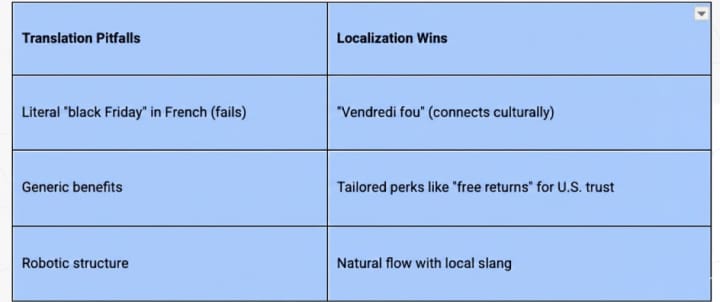
Localisation adapts to norms, boosting dwell time and trust. A Shopify store localising for Germany (emphasizing data privacy) doubled organic traffic.
Intent Mismatch Examples and Fixes
"Budget smartphone" shines in price-driven India but flops in the U.S., where "best camera phone" rules due to social media obsession.
Fix with A/B localized messaging:
- India: "Affordable battery life king."
- U.S.: "Pro camera for Instagram reels."
Technical Signals AI Loves in Multilingual Sites
Hreflang Mastery
Wrong hreflang sends users to mismatched pages, confusing AI. Use <link rel="alternate" hreflang="en-US"> correctly for U.S. English vs. en-GB.
URL Structures
Opt for clarity: example.com/us/en/laptops/ over messy params. This aids crawling.
Dodge Duplicates
Each version must offer unique value—local reviews, pricing, FAQs. Tools like Screaming Frog flag issues.
Structured Data: AI's Multilingual Decoder
Schema markup feeds AI clear entities.
- Product schema: Price in local currency, availability.
- Review schema: Star ratings build trust.
- FAQ schema: Answers "Is it waterproof?" in local terms.
Consistent entities across languages forge a strong global brand graph. A BigCommerce travel site using multilingual product schema jumped into AI overviews.
AI Search's SERP Shake-Up
AI overviews summarize, sidelining weak links. Blue-link real estate shrinks—only intent-perfect pages win.
Optimise for inclusion:
- Direct answers in H2S.
- Local relevance (e.g., "EU VAT included").
- Structured lists.
Future-Proof Your Multilingual eCommerce SEO
These fundamentals align closely with proven e-commerce SEO best practices, which focus on performance, user experience, and scalable optimisation across global markets.
Scalable Systems
Build workflows for ongoing localisation, using CMS like WordPress with WPML or Shopify apps.
eCommerce Alignment
Prioritize UX: mobile-first, fast loads, and regional payments.
Measure Smart
Track impressions, CTR by region, and conversions—not just ranks. Google Search Console's International Targeting report is gold.
Key Takeaways for Global Brands
Fix Now:
- Audit translations for quality.
- Validate hreflang.
- Purge duplicates.
Rethink Long-Term:
- Ditch keyword stuffing.
- Embrace intent over volume.
- Invest in local research.
Multilingual SEO heads toward hyper-local, AI-friendly experiences. Brands prioritising structure and relevance will dominate.
Conclusion
AI-powered search has changed how multilingual eCommerce SEO works. Translation alone is no longer enough. Search engines now reward clarity, relevance, and local intent.
By focusing on localisation, consistent structure, and user-focused optimisation, eCommerce brands can build multilingual strategies that perform well today and remain resilient as search continues to evolve.
About the Creator
Henry Davids
Hi, I’m Henry Davids!
I’m passionate about technology, web development, and helping businesses grow online. I write about website development, SEO, digital marketing, and practical tech insights that make complex ideas easier to understand.
Keep reading
More stories from Henry Davids and writers in 01 and other communities.
How Responsive Design Boosts E-Commerce Sales and Conversions
In today’s e-commerce landscape, shoppers make decisions in seconds. They land on a website, scroll once or twice, and instantly decide whether to stay or leave. That decision is rarely based on product quality alone. More often, it comes down to how easy the site feels to use, especially on a mobile device.
By Henry Davids7 days ago in 01
What It Really Costs to Build a Crypto Prediction Platform?
Crypto prediction platforms sit at the intersection of finance, psychology, and technology. On the surface, they look simple: users place bets on future outcomes, markets move based on collective opinion, and those who predict correctly earn rewards. But beneath that simplicity lies one of the most complex products you can build in the Web3 space.
By Nia Higgins7 days ago in 01
The Future of Chatbot Apps: What to Expect by 2030
Chatbot applications have already moved far beyond simple rule-based scripts that answer basic questions. Today, they help book appointments, resolve customer issues, assist with shopping, and even support mental health conversations. As artificial intelligence continues to evolve, the next decade promises a major transformation in what chatbot apps can do and how deeply they integrate into our personal and professional lives. By 2030, chatbots are expected to become more intelligent, more human-like, and more essential than ever before.
By Aarti Jangid7 days ago in 01




Comments
There are no comments for this story
Be the first to respond and start the conversation.