
History of Thanjavur Periya Kovil
Chola king Raja Raja Chola
History Thanjavur Periya Kovil
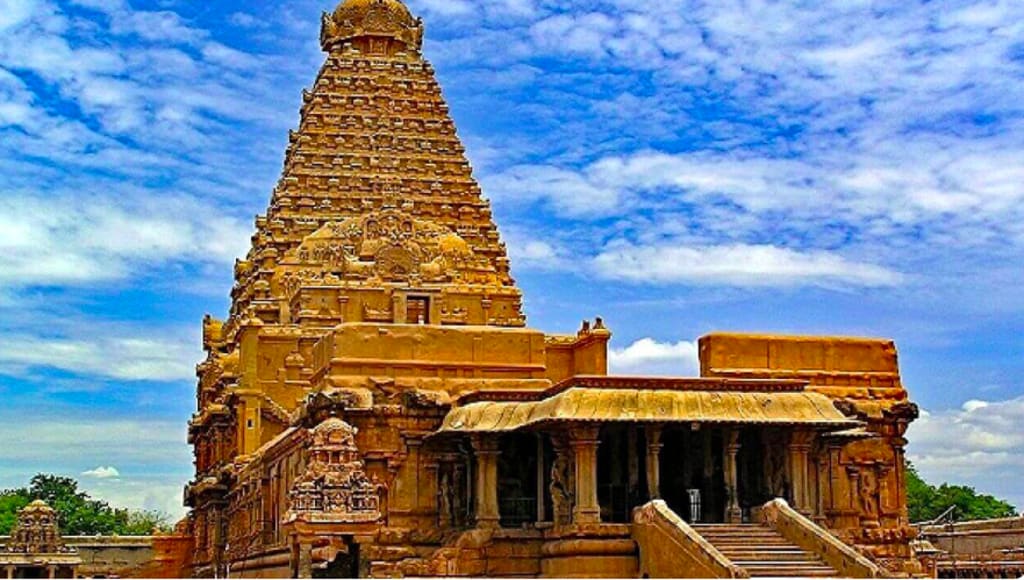
Thanjavur Periya Kovil, also known as Brihadeeswarar Temple or Rajarajeswaram, is a Hindu temple dedicated to Lord Shiva located in the city of Thanjavur, Tamil Nadu, India. The temple is widely regarded as one of the greatest architectural wonders of South India and is listed as a UNESCO World Heritage Site.
The temple was built during the reign of the Chola king Raja Raja Chola I, who ruled from 985 to 1014 CE. The king, who was an ardent devotee of Lord Shiva, decided to build a grand temple in honor of the deity. He entrusted the task to his trusted advisor, Kunjara Mallan Raja Raja Perunthachan, a master builder and architect.
Construction of the temple began in 1003 CE and was completed in 1010 CE. The temple is built primarily of granite and features a 66-meter-tall vimana, or tower, which is topped by a massive stone kalash, or finial. The temple also has a large courtyard, a Nandi mandapa (a pavilion for the statue of Nandi, the sacred bull), and several smaller shrines.
The Brihadeeswarar Temple is renowned for its exquisite architecture and intricate carvings. The walls of the temple are adorned with beautiful frescoes and sculptures that depict scenes from Hindu mythology. The temple is also home to a massive statue of Nandi, which is carved out of a single piece of granite and weighs over 25 tonnes.
Over the centuries, the temple has undergone several renovations and additions. In the 16th century, the Nayak rulers of Thanjavur added several new structures to the temple complex, including a massive gopuram (gateway tower) and a mandapam (hall). The temple has also been the site of several important religious and cultural events throughout its history.
Today, the Brihadeeswarar Temple is a popular tourist destination and a significant pilgrimage site for Hindus. It remains one of the finest examples of Chola architecture and is considered a masterpiece of Indian temple architecture.
History of Raja Raja Chola. Raja Raja Chola I, also known as Raja Kesari Varman, was a renowned king of the Chola dynasty who ruled over the southern part of India from 985 CE to 1014 CE. He is considered to be one of the greatest monarchs in the history of South India, and his reign is regarded as the golden age of the Chola dynasty.
Raja Raja Chola was born in 947 CE as the son of Parantaka Chola II, who was also a great king of the Chola dynasty. He was trained in various fields such as literature, art, music, and warfare from a young age. After the death of his father, Raja Raja Chola ascended to the throne and began his reign by consolidating his kingdom and expanding its boundaries through a series of successful military campaigns.
Raja Raja Chola's most notable achievement was the construction of the Brihadeeswarar Temple in Thanjavur, which is considered to be one of the greatest architectural marvels of the world. The temple was completed in 1010 CE and is a UNESCO World Heritage Site. The temple's vimana, or tower, is 216 feet tall and is one of the tallest of its kind in the world. The temple also houses a massive lingam, or a representation of Lord Shiva, which is one of the largest in India.
Raja Raja Chola's reign also saw a significant expansion of the Chola navy, which helped in establishing trade links with countries like Sri Lanka, China, and the Arab world. This trade network helped in the growth of the Chola economy and contributed to the prosperity of the kingdom.
Raja Raja Chola died in 1014 CE and was succeeded by his son Rajendra Chola I, who continued the legacy of his father and expanded the Chola kingdom even further. The reign of Raja Raja Chola is considered to be one of the greatest in the history of South India, and his contributions to art, architecture, literature, and trade continue to inspire people even today.
About the Creator
Service in major U.S. cities is disrupted by a massive Verizon network outage. Cities
On Wednesday, January 14, 2026, Verizon Communications experienced a widespread network failure that disrupted voice and data services for tens of thousands of customers across the United States. Users were unable to make calls, send texts, or access mobile internet for several hours as a result of the outage, which was one of the largest in recent memory for the nation's largest wireless carrier. This prompted emergency alerts to be issued in some cities and prompted fresh inquiries regarding the reliability of networks in a world that is becoming increasingly connected.
By Raviha Imran4 days ago in 01
How to Build a Secure and High-Performance Real Estate App in 2026
The real estate industry is rapidly evolving as mobile technology, cloud infrastructure, and data-driven platforms redefine how properties are bought, sold, rented, and managed. In 2026, users expect real estate applications to be fast, reliable, highly secure, and personalized. A slow or insecure app can quickly erode user trust, while a high-performance platform can significantly improve engagement, conversions, and customer loyalty.
By shane cornerus4 days ago in 01



Comments
There are no comments for this story
Be the first to respond and start the conversation.