

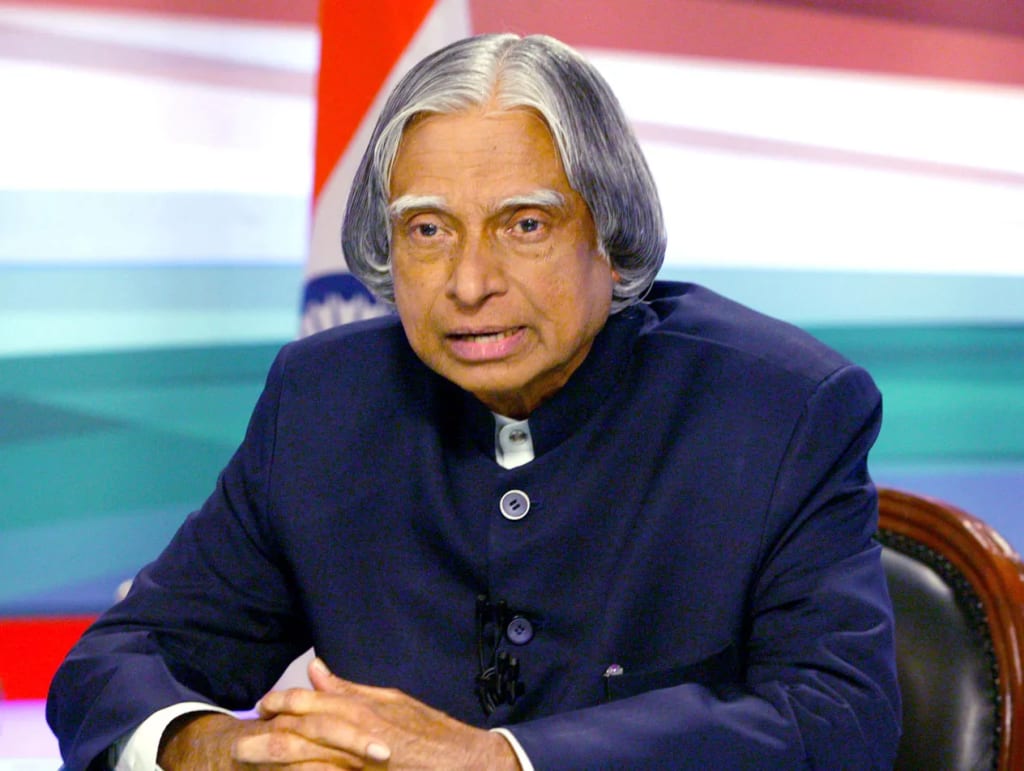
Avul Pakir Jainulabdeen Abdul Kalam, popularly known as A.P.J. Abdul Kalam, was an eminent Indian scientist, professor, and politician who served as the 11th President of India from 2002 to 2007. He was born on October 15, 1931, in Rameswaram, a town in the southern state of Tamil Nadu, India.
Abdul Kalam hailed from a humble background and faced several hardships during his early life. He grew up in a financially modest family and had to support his education through odd jobs. Despite these challenges, he showed exceptional talent in academics and had a keen interest in science and engineering.
Kalam graduated in Physics from St. Joseph's College, Tiruchirappalli, and later studied aerospace engineering at the Madras Institute of Technology. He specialized in aeronautical engineering and went on to work for the Defense Research and Development Organization (DRDO) and the Indian Space Research Organisation (ISRO). His contributions to India's missile and space programs earned him the title of the "Missile Man of India."
During his tenure at DRDO and ISRO, Abdul Kalam played a pivotal role in the development of India's first indigenous satellite launch vehicle, the SLV-III, and the successful test-firing of several missiles, including the Agni and Prithvi series. His exceptional leadership and scientific expertise earned him numerous accolades and recognition both nationally and internationally.
In 1998, Abdul Kalam was appointed as the Principal Scientific Advisor to the Government of India, with the rank of a Cabinet Minister. He used this platform to advocate for the development of indigenous technologies and to promote science and technology education among the youth of the country. His vision and commitment to transforming India into a technologically advanced nation resonated with the people and earned him immense popularity.
In 2002, Abdul Kalam was elected as the President of India, becoming the first scientist to hold the highest office in the country. As President, he focused on inspiring the youth and promoting education, particularly in the fields of science and technology. He traveled extensively across the country, delivering lectures and interacting with students to ignite their passion for learning and innovation.
After completing his term as President in 2007, Abdul Kalam continued to be an influential figure in various capacities. He served as a visiting professor at various prestigious institutes and universities, sharing his knowledge and inspiring students. He also authored several books, including "Wings of Fire," an autobiography that became immensely popular and inspired millions of readers.
On July 27, 2015, while delivering a lecture at the Indian Institute of Management Shillong, Abdul Kalam collapsed and passed away due to cardiac arrest. His sudden demise was mourned by the entire nation, and he was widely remembered as a visionary leader, an inspiration to the youth, and a true embodiment of humility and dedication.
Abdul Kalam's life and achievements continue to inspire generations, especially in the field of science and technology. He remains an iconic figure in India and is fondly remembered as the "People's President" and a true patriot who dedicated his life to the progress and upliftment of his nation.
After his passing, Abdul Kalam's legacy lived on through the numerous awards, honors, and institutions established in his name. The government of India declared his birthday, October 15, as "World Students' Day" to commemorate his dedication to education and the youth. Several educational institutions, research centers, and scholarships have been named after him to honor his contributions and inspire future generations.
The Abdul Kalam Vision India Movement (AKVIM) was launched in 2015 with the aim of realizing his vision of a developed India by 2020. The movement focuses on promoting education, innovation, and sustainable development, aligning with Kalam's ideals and aspirations for the nation.
The Dr. A.P.J. Abdul Kalam Memorial was inaugurated in his hometown of Rameswaram in 2017. The memorial showcases Kalam's life, achievements, and his commitment to science and education. It serves as a place of pilgrimage for people from all walks of life who seek inspiration from his remarkable journey.
Abdul Kalam's influence extended beyond national boundaries. He was highly respected globally for his contributions to science, technology, and leadership. He received numerous international honors and awards, including the prestigious Hoover Medal from the ASME Foundation, the Von Braun Award from the National Space Society, and honorary doctorates from various universities worldwide.
Kalam's vision for a prosperous and technologically advanced India continues to shape the country's policies and initiatives. His emphasis on research and development, innovation, and nurturing talent has inspired many government programs, educational institutions, and startups in India's science and technology sectors.
Abdul Kalam's life and work serve as a beacon of hope, reminding people of the power of education, perseverance, and the pursuit of knowledge. He believed in the potential of the youth and often referred to them as the "dreamers, shapers, and builders of the nation." His words and teachings continue to motivate and guide individuals, particularly the younger generation, to strive for excellence and make a positive impact on society.
Abdul Kalam's remarkable journey from a small town in India to the highest office in the land, his dedication to science and technology, and his unwavering commitment to the progress of the nation have left an indelible mark on India's history and serve as an inspiration for generations to come.
About the Creator
Building Brands That Shape Culture: The Nathan Allen Pirtle Approach
Brands don’t shape culture by accident. They do it through intention, clarity, and a deep understanding of the people they serve. In an era where consumers are more informed, more connected, and more values-driven than ever before, the most influential brands are no longer those with the biggest budgets, but those with the strongest point of view.
By Jeffrey D. Gross MD4 days ago in 01
Handbags, Fashion Identity, and the Broader Context of Gucci Bags
Handbags have remained essential accessories across centuries, adapting to changes in clothing, lifestyle, and social norms. What began as simple pouches for carrying coins or personal items gradually transformed into structured designs that reflect craftsmanship and cultural values. Today, handbags are both functional objects and visual expressions of identity, shaped by history as much as by fashion trends.
By charliesamuela day ago in 01




Comments
There are no comments for this story
Be the first to respond and start the conversation.