
Global Online Travel Market Size and Forecast 2025
How Technology, Mobility, and Changing Traveler Preferences Are Powering a New Era in Digital Tourism

Global Online Travel Market — A Transformational Decade Ahead
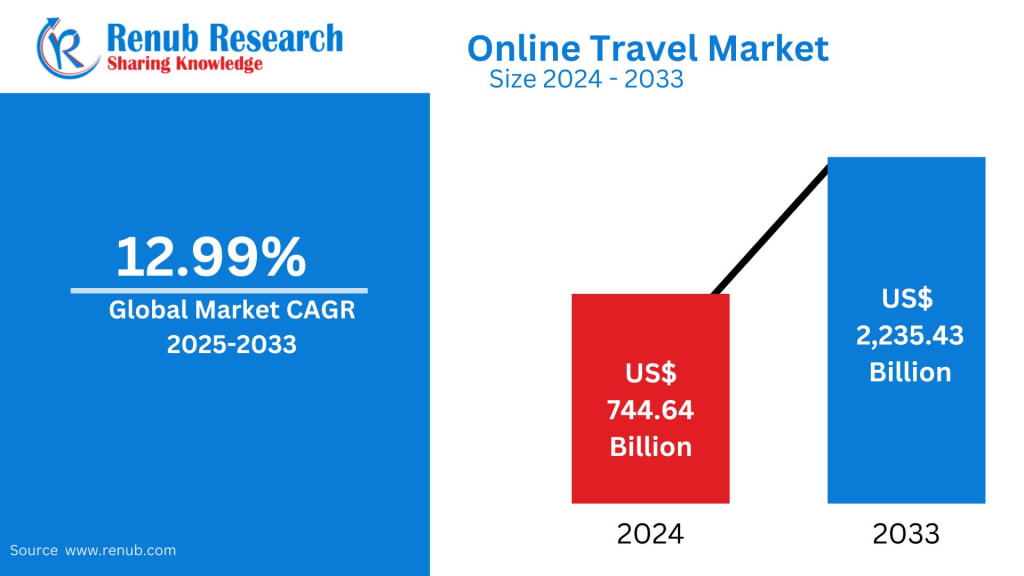
The Global Online Travel Market is entering its most transformative era, driven by rapid digitalization, rising consumer confidence in online transactions, and a new generation of travelers that prioritize mobility, personalization, and speed. According to Renub Research, the market is projected to reach a massive US$ 2,235.43 billion by 2033, rising from US$ 744.64 billion in 2024, and expanding at a strong CAGR of 12.99% between 2025 and 2033.
Some of the major forces behind this growth include the surge in solo travel, increasing access to high-speed internet, the widespread use of smart devices, and rising demand from corporate travelers. At the same time, travel platforms are enhancing user experience with AI, streamlined interfaces, mobile-first services, and secure payment ecosystems.
As consumers seek flexibility, deals, and convenience, the online travel ecosystem—comprising OTAs (Online Travel Agencies), meta-search engines, direct suppliers, and mobile travel apps—continues to expand its global footprint.
Online Travel Market Overview
Online travel platforms are fundamentally reshaping how people plan, research, and book holidays. From flight tickets to vacation packages and last-minute hotel deals, travel portals offer quick access, transparent comparison, and seamless payment options. The ability to browse destinations and book instantly—often in minutes—has made online platforms the default choice for millions of travelers.
Mobile apps and responsive websites now dominate user preferences, especially among young professionals and Millennial/Gen Z travelers. The role of social media has also intensified: before booking, consumers explore Instagram feeds, travel blogs, videos, and peer reviews to make informed decisions. Meanwhile, travel brands are leveraging influencer marketing and platform-led promotional campaigns to engage digital audiences.
As the global traveler becomes more tech-savvy, the online travel market is poised for sustained expansion throughout the forecast period.
Growth Drivers for the Online Travel Market
1. Rising Demand for Foreign Education
One of the strongest emerging drivers is the booming trend of studying abroad. Students relocating for education frequently need flights, long-term accommodation, travel insurance, and travel packages—all increasingly booked online.
Countries like China and India lead global outbound student mobility, with over:
1 million Chinese students studying overseas in 2021
508,000 Indian students in the same period
The United States hosted more than 833,000 international students, followed by:
UK – 601,000
Australia – 378,000
Germany – 376,000
Canada – 318,000
Online travel platforms capitalize on this trend by offering:
Discounted student packages
Flexible cancellation options
Budget-friendly accommodations
Visa assistance add-ons
The increasing global mobility of young students continues to strengthen cross-border demand within the online travel ecosystem.
2. Rapid Growth of Mobile & Internet Adoption
Unsurprisingly, the explosion of mobile internet access is directly fueling online travel bookings.
As of April 2024:
5.44 billion people (67% of the world’s population) used the internet
5.07 billion people (62.6%) were active on social media
Nearly 60% of all online time during Q3 2023 was spent on mobile devices
These numbers reflect a technological landscape where consumers research travel, compare prices, and book reservations in a matter of minutes.
Travel businesses are investing heavily in:
Mobile-friendly interfaces
App-only discounts
Push notifications for flash deals
Social media advertising
The result is a streamlined booking process that reduces friction and strengthens long-term customer engagement.
3. Competitive Pricing, Deals, and Loyalty Rewards
The online travel market is heavily competitive, leading brands to attract consumers with lower prices, bundled offers, and generous loyalty rewards.
A notable example occurred in July 2023, when Expedia Group redesigned its loyalty program, combining Expedia, Hotels.com, and Vrbo under a unified scheme. Members now earn 2% OneKeyCash for every dollar spent, enhancing stickiness and loyalty.
Financial institutions are also boosting online travel purchases. In March 2024, Wells Fargo introduced a rewards program enabling customers to transfer points to major travel loyalty programs. This aligns with the broader shift toward flexible, travel-centric financial products.
Technological innovations also play a role. In April 2023, Expedia introduced a ChatGPT-powered feature that allows users to plan trips through natural language conversations—a leap toward intuitive, AI-assisted travel planning.
These developments highlight the increasing emphasis on consumer-centric, value-driven travel experiences.
Challenges in the Online Travel Market
Despite strong momentum, the digital travel ecosystem faces important challenges.
1. High Development Costs & Cybersecurity Threats
As travelers frequently provide sensitive personal and financial details, travel platforms are prime targets for cyberattacks. Ensuring compliance with global data protection laws such as GDPR adds significant operational complexity.
Any data breach can severely damage brand reputation and user trust. Thus, cybersecurity remains a dominant cost factor for travel companies.
2. Delivering Personalization at Scale
Travelers increasingly expect recommendations tailored to:
Budget
Travel history
Preferred activities
Family or solo travel
Work–leisure (bleisure) preferences
Meeting this expectation at scale requires massive investments in:
AI and ML systems
Data analytics infrastructure
Real-time customer insights
Finding the right balance between human-like personalization and automated efficiency continues to be a major industry challenge.
Regional Analysis of the Online Travel Market
North America
North America remains a global leader owing to:
A strong e-commerce ecosystem
High smartphone penetration
Popularity of mobile booking apps
Dominance of major players like Expedia, Airbnb, and Booking.com
AI-driven recommendations, voice search adoption, and last-minute mobile deals continue to fuel growth.
Europe
Europe is another major powerhouse, though digital transformation varies by country. Germany—despite being Europe’s largest tourism market—still sees high offline bookings, though mobile adoption is rising steadily. The transition toward mobile-first travel will accelerate with rising 5G penetration.
Countries like the UK, Spain, and France remain strong contributors to the online travel economy.
Asia-Pacific
Asia-Pacific is the fastest-growing region, supported by:
A rapidly expanding middle class
Affordable smartphones
Government tourism initiatives
Growing demand for both domestic and international travel
India, China, Indonesia, Thailand, and Japan are major growth engines for OTAs.
India, specifically, is witnessing a digital travel boom:
Platforms like MakeMyTrip, OYO, Cleartrip dominate
Increasing demand for budget travel and flexible bookings
Skyscanner launched a Hindi interface in 2023
MakeMyTrip partnered with the Ministry of Tourism for a discovery map showcasing 600 hidden destinations
These initiatives reflect deep market localization and rapid digital adoption.
Middle East & Africa
Saudi Arabia is emerging as a key market, powered by Vision 2030, which aims to transform the kingdom into a global tourism hub. Platforms such as Almosafer are leveraging rising smartphone adoption and religious tourism (Hajj & Umrah).
Online Travel Market Segmentation
By Type
Package
Direct
By Service Type
Transportation
Vacation Packages
Travel Accommodation
By Payment Mode
UPI
E-Wallets
Debit/Credit Cards
Other
By Gender
Male
Female
By Booking Device
Mobile/Tablet
Desktop
By Region
Covers 30+ countries across North America, Europe, Asia-Pacific, Latin America, and Middle East & Africa.
Key Players — 4-Point Company Profiles
Airbnb
Expedia
Booking Holdings
TripAdvisor Inc.
Trip.com Group Ltd
MakeMyTrip Limited
Hostelworld Group PLC (HSW)
Trivago N.V
Despegar.com Corp
Lastminute.com Group
Each company is analyzed through its Overview, Key Executives, Recent Strategies, and Revenue Performance.
Final Thoughts
The Global Online Travel Market is positioned for a decade of unprecedented expansion. With mobility increasing, digital literacy rising, and travel aspirations evolving, online travel platforms are becoming the backbone of global tourism. AI-enabled personalization, mobile-first ecosystems, flexible payment options, and immersive travel technology are reshaping expectations and experiences.
As companies continue to innovate and consumers embrace digital convenience, the online travel market will remain one of the world’s most dynamic, competitive, and fast-evolving industries through 2033 and beyond.
About the Creator
Sushant. Renub Research
I’m Sushanta Halder, Digital Marketing Manager at Renub Research with 15+ years in SEO, content, PPC & lead generation. Passionate about data-driven growth strategies.
Keep reading
More stories from Sushant. Renub Research and writers in 01 and other communities.
Commercial Vehicle Market Size and Forecast 2025–2033
The commercial vehicle market is entering a defining decade, shaped by fast-changing mobility trends, expanding logistics operations, and the global transition toward sustainable transportation. According to Renub Research, the market is projected to grow from US$ 839.97 billion in 2024 to an impressive US$ 1388.10 billion by 2033, registering a CAGR of 5.74% during 2025–2033.
By Sushant. Renub Research2 months ago in 01
Handbags in Modern Fashion: Design, Function, and Consumer Perspectives
Handbags have long been more than simple accessories. Historically rooted in utility, they have evolved into cultural symbols reflecting personal style, social identity, and changing fashion trends. Today, handbags occupy a unique space where craftsmanship, branding, and consumer behavior intersect. From everyday carryalls to luxury-inspired designs, the handbag market continues to grow and diversify, especially among women seeking both practicality and visual appeal.
By charliesamuelabout 11 hours ago in 01
Bruce Lee and The God of War: Kuan Ti
It starts with love.. The Power to the God Of War and Wealth Walk into a Chinese restaurant (even in Oklahoma, USA), a Chinese police station, a kung fu martial arts studio or even a Chinese temple and you often see a red faced warrior holding a heavy quan-do (spear like weapon).
By WILD WAYNE : The Dragon King5 days ago in Chapters


Comments
There are no comments for this story
Be the first to respond and start the conversation.