
Global Layoff Wave across Tech sectors [2022-2023]
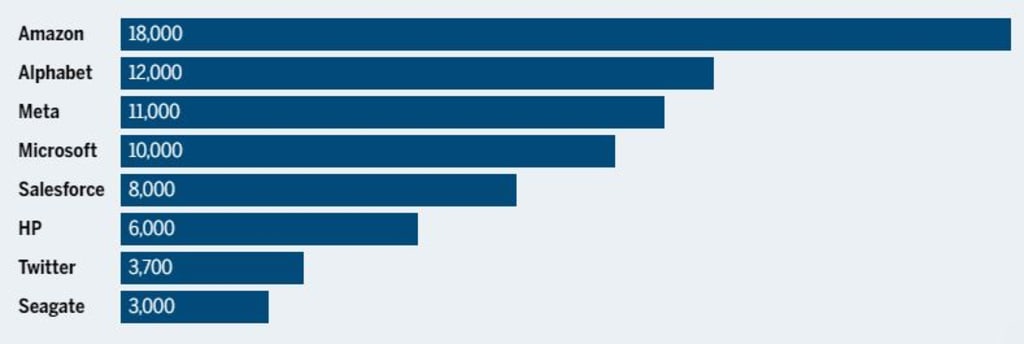
As the pandemic-induced market boom started subsiding in 2022, several market titans and tech giants have been downsizing their employees globally. Microsoft has laid off 10,000 jobs, Meta laid off 11,000, Amazon laid off 18,000 and Google's parent company Alphabet has joined the fray in the "Layoff wave" by downsizing 12,000 in January 2023.
Why Tech-titans are cutting jobs worldwide ?
There are several reasons why tech giants are laying off employees globally. Some of the main reasons include:
- Restructuring: Many tech companies are undergoing restructuring in order to streamline operations and reduce costs. This can involve cutting jobs in certain areas of the business, in order to make the company more efficient.
- Recession Fears: As per reports from World Bank & Internation Monetary Fund (IMF) regarding Economic Slowdown and possible recession in the upcoming months, Economists hae suggested companies to prepare for the worst case scenario.
- Weak Consumer Demand: The reason for poor consumer demand is due to the High Inflation rates in major economies like USA, UK, India, Japan, Europe and others. Geopolitical crisis and Pandemic were the driving factors for the soaring inflation.
- Automation: With advancements in technology, companies are able to automate many tasks that were previously done by humans. This can lead to layoffs as companies look to reduce labor costs.
- Mergers and acquisitions: When two companies merge, there may be overlap in certain areas of the business, leading to layoffs.
- Pressure from Investors: Tech start-ups and tech giant Google have faced huge pressure from investors to cut costs and tighten up the spending, which led to mass layoffs.
- Changes in the industry: The technology industry is constantly evolving and some companies may be struggling to adapt to changes in the market, which could lead to downsizing.
- Pandemic: The COVID-19 pandemic has also affected the economy and many companies are laying off employees to cut costs due to the lack of income.

WHY Recession fears drove up 2022 layoffs ?
Recession fears and layoffs are often closely linked, as economic downturns can lead to reduced demand for goods and services, which in turn can lead to job losses. During a recession, companies may face financial challenges and may need to cut costs to stay afloat. One way to do this is by reducing their workforce through layoffs.
Recession fears can also lead to a decrease in consumer and business spending, which can lead to decreased revenue for companies. This, in turn, can lead to downsizing and layoffs as companies look to cut costs.
In addition to job losses, a recession can also lead to decreased wages and benefits for those who are able to keep their jobs. This can lead to reduced purchasing power and a decrease in consumer spending, which can further exacerbate economic downturns.
Furthermore, recessions can also have a ripple effect on other industries and can lead to a decrease in GDP, an increase in the unemployment rate, and a decrease in housing prices and investment.
It's important to note that companies, government and central banks take actions to mitigate the effects of recession, such as stimulus packages, monetary policies and other measures. However, the impact of these actions can vary depending on the specific situation and the severity of the recession.

What's Next for the laid-off employees ?
The COVID-19 pandemic has had a significant impact on the global economy and has led to widespread job losses. The situation is likely to continue in the coming years, with many companies announcing mass layoffs in 2022 and 2023.
For employees who are affected by mass layoffs, the immediate concerns will likely be financial, such as how to pay bills and maintain their standard of living. They may also be worried about finding new employment, especially in a difficult job market.
To mitigate these concerns, employees who are affected by mass layoffs may want to consider the following options:
1. Unemployment benefits: Many countries have unemployment benefits programs in place to provide financial assistance to individuals who have lost their jobs. Employees should check with their local government to see if they are eligible for these benefits.
2. Job training: Many governments and organizations offer training programs to help individuals acquire new skills and improve their chances of finding new employment.
3. Networking: Networking can be an effective way to find new job opportunities. Employees should reach out to their professional contacts and let them know they are looking for work.
4. Entrepreneurship: Some employees may decide to start their own businesses. This can be a challenging and risky option, but it can also be very rewarding.
5. Retraining: For those who are laid off and have a specific skill set, considering retraining for a new career in a field that is in demand.

CONCLUSION
It's important to note that, while the situation may seem dire, there are steps that employees can take to mitigate the negative impact of mass layoffs. With the right approach and a willingness to adapt, individuals can find new job opportunities and move on with their careers.
It's also important to keep in mind that the global economy and job market are constantly changing, and it's possible that new opportunities may arise in the future.
About the Creator
Niko Royce Teixeira
Aspiring Entrepreneur and content creator. Willing to enlighten people about the unfiltered and unbiased opinions on Social, political, economic changes in the world
Keep reading
More stories from Niko Royce Teixeira and writers in 01 and other communities.
Blockchain Tracing: A Key Tool in Crypto Asset Recovery
The cryptocurrency ecosystem has expanded rapidly, with billions of dollars in digital assets now in circulation across thousands of blockchains. However, this growth has been accompanied by significant risks, including hacks, scams, phishing attacks, and user errors such as lost private keys or forgotten seed phrases. In 2025, reported losses from crypto-related incidents exceeded several billion dollars, highlighting the persistent vulnerability of digital assets. Unlike traditional banking systems with reversible transactions and centralized oversight, blockchain's decentralized and immutable nature makes recovery difficult once funds are transferred. As a result, blockchain tracing has emerged as an essential method for identifying fund flows, attributing activity, and supporting recovery efforts in actionable cases.
By Garry Oneal3 days ago in 01
Top Enterprise Software Development Companies in 2026
The use of enterprise software has become imperative in the efforts by businesses to optimize, become more efficient, and grow in a safe digital competitive space. The adoption of cloud technology, artificial intelligence, automation, and data technologies, especially within the current digital era, means that businesses are seeking the help of skilled software partners.
By Olivia Carter2 days ago in 01



Comments
There are no comments for this story
Be the first to respond and start the conversation.