
Global Desalination Market Trends & Summary
Rising Water Scarcity Accelerates Global Dependence on Desalination Technologies Worldwide


Freshwater scarcity has fast become one of the most urgent environmental and humanitarian issues of the 21st century. As climate change intensifies droughts, populations rise, and industrial demand expands, millions of people are facing growing challenges in securing clean, drinkable water. It is within this global crisis that the desalination market emerges as one of the most critical and fast-growing sectors of the water industry.
According to Renub Research, the global desalination market is projected to grow from US$ 17.64 billion in 2024 to nearly US$ 40.28 billion by 2033, expanding at an impressive CAGR of 9.61% between 2025 and 2033. Driven by technological advancements, government initiatives, and an urgent need for drought-proof water supplies, desalination is becoming an indispensable pillar of global water security.
This report breaks down the market by technology, application, region, and company performance to provide a comprehensive understanding of where the industry stands today—and where it’s headed.
Global Water Desalination Market Overview
Desalination is the process of removing dissolved salts, minerals, and contaminants from seawater, brackish water, or wastewater to produce fresh, potable water. The two dominant technologies powering the industry today are:
Reverse Osmosis (RO) – uses semi-permeable membranes to remove salts
Thermal Desalination – includes Multi-Stage Flash (MSF) and Multi-Effect Distillation (MED), where heat is used to evaporate and condense freshwater
While desalination has existed for decades, it has evolved into an economic and technological lifeline for regions with limited freshwater resources.
Countries like Saudi Arabia, the UAE, Israel, Australia, and Singapore rely heavily on desalination to meet municipal water needs. Meanwhile, industrial sectors — particularly oil & gas, manufacturing, and power generation — depend on desalinated water to maintain operations when traditional water sources fall short.
As worldwide water stress intensifies, desalination is no longer a choice; it is a necessity for millions.
Key Growth Drivers for the Global Desalination Market
1. Growing Water Scarcity
Water scarcity remains the single largest driver of the global desalination market. Population growth, climate change, and rapid industrialization are stressing existing surface and groundwater resources.
Key global water facts:
Nearly 4 billion people — two-thirds of the global population — face severe water scarcity at least once per year.
Over 2 billion people live in countries with inadequate water supply.
By 2025, half of the world’s population will live in water-stressed regions.
By 2030, up to 700 million people could be displaced due to extreme water shortages.
By 2040, 1 in 4 children will live in areas with extremely high water stress.
Desalination directly responds to this crisis by creating new, reliable water supplies independent of rainfall or depleted freshwater resources.
2. Technological Advancements in Desalination
Breakthroughs in membrane science, automation, and energy recovery systems are redefining what desalination can achieve. Technologies like next-generation RO membranes, nanofiltration, and smart digital monitoring systems have significantly improved efficiency and reduced operating costs.
Notable industry development:
December 2023 – R-evolution (Hexagon AB) announced a global desalination program utilizing digital twin technologies to improve efficiency and scalability in desalination plants.
These innovations allow desalination plants to operate with lower energy consumption, reduced maintenance, and improved sustainability—critical for long-term growth.
3. Government Initiatives and Infrastructure Investments
Governments across the Middle East, Asia-Pacific, and North America are investing heavily in desalination as part of national water security strategies. Policy support, public-private partnerships (PPPs), subsidies, and regulatory frameworks continue to accelerate plant construction.
Recent government actions:
September 2023 – Saudi Arabia established a Global Water Organization in Riyadh to strengthen global water security initiatives and invest in major projects worldwide.
April 2022 – Saudi Arabia launched a large-scale cloud seeding initiative to diversify water sources and reduce reliance on energy-intensive desalination.
These programs ensure long-term capital flow into desalination infrastructure.
Challenges in the Desalination Market
1. High Energy Consumption & Operational Costs
Despite improvements, desalination remains an energy-intensive process. Energy costs account for a major part of total plant operations, making the technology expensive for low-income nations.
Non-renewable energy use amplifies carbon emissions, complicating environmental sustainability goals.
2. Environmental Concerns
Desalination waste brine — highly concentrated saltwater — poses a threat to marine ecosystems when improperly discharged. Additionally, energy consumption increases carbon footprints.
Balancing water production needs with ecological responsibility remains a major challenge for the industry.
Market Segment Insights
Reverse Osmosis (RO) – The Market Leader
RO dominates the global desalination market due to its:
lower energy requirements
cost-effectiveness
continual improvements in membrane efficiency
RO systems are used widely for municipal and industrial applications. As research and development continue to optimize energy use and scale-up capabilities, RO’s dominance is expected to strengthen in the years ahead.
Municipal Desalination Market
With rapid urbanization and expanding populations, municipalities remain the largest consumers of desalinated water. Governments are investing in large-scale plants to ensure stable water supplies for households, cities, and public infrastructure.
Regions like the Middle East, Asia-Pacific, and the southwestern United States are leading municipal desalination adoption.
Industrial Desalination Market
Industries such as:
manufacturing
petrochemicals
oil & gas
power generation
rely on large volumes of purified water. With greater sustainability expectations and tighter water regulations, industrial desalination is becoming central to environmental compliance and resource planning.
Energy recovery and modular plant designs are accelerating adoption.
Seawater Desalination Market
Seawater desalination remains the largest water-source segment, dominated by countries with long coastlines and limited freshwater reserves. Advanced RO and MED technologies are making seawater conversion more energy-efficient and environmentally friendly.
Leading adopters include the UAE, Saudi Arabia, China, and Australia.
River and Brackish Water Desalination
River and brackish water desalination is gaining traction in agriculture, industry, and inland municipal applications. This segment benefits from:
lower salinity levels
reduced energy requirements
growing demand for treated water for irrigation and processing
Technologies like nanofiltration and RO continue to power this segment.
Regional Market Highlights
United States
Water stress in states like California, Arizona, and Texas is accelerating desalination adoption. The U.S. is prioritizing RO and renewable-powered desalination technology.
Recent development:
Nov 2024 – Kubota Corporation invested in OceanWell, a California-based startup pioneering deep-sea desalination.
Germany
Germany’s desalination market is driven primarily by industrial demand and sustainability goals. The nation is investing heavily in green desalination technologies.
Recent development:
Oct 2023 – Boreal Light completed Europe’s largest solar desalination system in Mykolaiv, Ukraine, producing 125 m³ of water per hour.
China
China's rapid urbanization and water scarcity are pushing large-scale desalination growth. Coastal cities are leading adoption, supported by strong government funding.
Recent development:
May 2024 – Veolia opened its first ion exchange regeneration plant in China, improving resource efficiency and water sustainability.
United Arab Emirates
The UAE is a global leader in desalination, continually building some of the world’s largest and most energy-efficient plants.
Recent development:
May 2024 – Veolia announced it will design the technology for the Hassyan RO desalination plant in Dubai, set to become the world’s largest solar-powered RO facility.
Desalination Market Segments
Technology: Reverse Osmosis, MSF Distillation, MED Distillation, Others
Application: Municipal, Industrial, Others
Water Source: Seawater, Brackish Water, River Water, Others
Regions Covered: North America, Europe, Asia-Pacific, Latin America, Middle East & Africa
Key Players Covered
Acciona
Dow
Evoqua Water Technologies
Siemens AG
DuPont
Doosan Enerbility
Toray Industries, Inc.
Xylem
Each company has been analyzed from four perspectives: overview, key persons, recent developments, and financial insights.
Final Thoughts
The global desalination market is experiencing a profound transformation driven by a perfect storm of climate stress, population growth, and technological advancement. As freshwater sources continue to deplete, desalination is evolving from an optional capability to a foundational necessity for national water security.
With governments, industries, and technology innovators committing substantial investment to sustainable water technologies, the sector is expected to show rapid expansion through 2033. Desalination's shift toward renewable energy integration and eco-friendly solutions will further solidify its role as a cornerstone of future water infrastructure.
In a world where demand for clean water will only rise, the desalination market is not just growing — it is becoming essential for humanity’s survival.
About the Creator
Janine Root
Janine Root is a skilled content writer with a passion for creating engaging, informative, and SEO-optimized content. She excels in crafting compelling narratives that resonate with audiences and drive results.
Keep reading
More stories from Janine Root and writers in 01 and other communities.
Power Transformer Market Size and Forecast (2025–2033): Global Expansion Driven by Renewable Energy & Grid Modernization
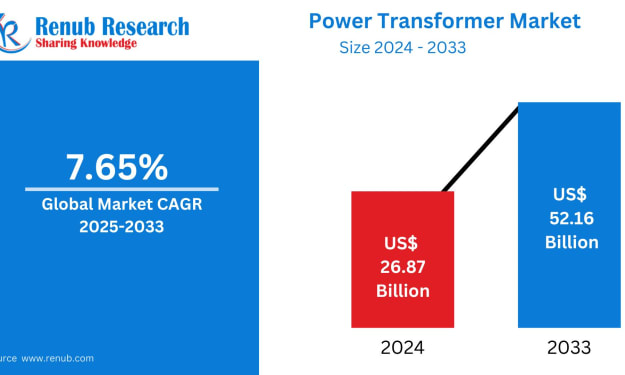
The global power transformer market is entering a phase of strong expansion, supported by massive investments in energy infrastructure, surging renewable power adoption, and national plans for grid modernization. According to Renub Research, the market, valued at USD 26.87 billion in 2024, is expected to nearly double, reaching USD 52.16 billion by 2033, expanding at a robust CAGR of 7.65% from 2025–2033.
By Janine Root 2 months ago in 01
The Complete Guide to Wi-Fi Hacking: How Networks Are Compromised and How to Protect Yours
The Invisible Threat to Your Wireless Network In our hyper-connected world, Wi-Fi has become as essential as electricity. From smart homes to remote work, we depend on wireless networks for virtually everything. Yet, this convenience comes with significant risks. Wi-Fi hacking represents one of the most pervasive and potentially damaging cyber threats facing individuals and organizations today. Understanding how these attacks work isn't just technical knowledge—it's a necessary layer of digital self-defense in our increasingly wireless world.
By Alexander Hoffmann5 days ago in 01


Comments
There are no comments for this story
Be the first to respond and start the conversation.