
Ghost kitchens and food delivery software- The duo that is redefining rules of food delivery
Food delivery software by Hyperzod

Online ordering is not a necessary evil. It’s the most exciting opportunity in the restaurant industry today. If you don’t use delivery apps, you don’t exist.
- Alex Canter, Founder and CEO, Ordermark
If there is anything that is truer than the fact that food delivery services have come a long way from the time they started, it is the understanding that ghost kitchens are on the rise everywhere around. If you are not familiar with the concept of a ghost kitchen, perhaps, you are missing out on a vital aspect of food delivery.
The term ‘ghost kitchen’, ‘cloud kitchen’, ‘dark kitchen’ or ‘virtual kitchen’ is used for a restaurant that doesn’t entertain traditional dine-in of customers. Instead, it just exists to fulfil online orders for delivery. In simple words, they are commercial kitchens that are optimized for food delivery service. i.e., they sell made-to-order food or meals via delivery for online orders received. For example, Si’s Chicken Kitchen in Chicago, US was launched by Si-Pie Pizzeria to sell chicken via Uber Eats to meet high demand in the area. Instead of adding chicken to their pizzeria's menu, Si's Chicken Kitchen is only available through Uber Eats as a virtual restaurant.
The idea behind cloud kitchens is that it can be set up in more affordable locations than those typically used for restaurants. In fact, the rising popularity of ghost kitchens isn’t surprising as they have lower overhead costs and hence are considered a lower cost alternative than operating a traditional brick and mortar restaurant. Such kitchens involve less risk as they have minimal waste and have a really flexible and adaptable menu that can be easily managed online. Food delivery software through their growing online presence have considerably assisted ghost kitchens by providing feasible and quick delivery solutions to them to be extended to the customers.
Ghost kitchens or the so-called virtual kitchens have contributed significantly to food deliveries becoming a fad in modern times. The level of convenience that they have to offer is unparalleled. In fact, we can all agree on the fact that food delivery services have made people’s lives easier to the core. Whether you don’t have time to cook or just want to relax and eat something delectable, ordering food online can come in pretty handy and hence, it is gaining widespread acceptance. Therefore, it’s no wonder that ghost kitchens are getting increasingly popular these days.
What’s more to the interest of culinary businesses is the fact that ascension of ghost kitchens and food delivery services is being majorly driven by several factors viz a viz increasing number of smartphone users, rising internet penetration, dual-income families, growing sedentary habits and other lifestyle changes and a growing liking towards seeking convenience; something which restaurants and food delivery start-ups can exploit in their favor. But to do so, they must look up to an efficient food delivery software that can really help them upscale. It is so advised because turbulent economic conditions and uncertain times like covid-19 pandemic, can seriously dent the chances of growth for businesses operating only physically.
The Covid-19 pandemic, restaurants, food deliveries and the fight for survival-
When the world was hit by the pandemic, there were less ways outside and more inside. People were asked to stay at homes and a majority of them were quarantined. Availing daily items of need in such circumstances became a challenge for consumers around the world. More so, alongside closure of other businesses, it was a terrifying and daunting period for several restauranteurs and food start-ups to make and generate sales. In fact, before the pandemic put thousands of establishments out of business, the US restaurant industry was growing 3 to 4 percent per year. Delivery sales were increasing at roughly twice that pace at around 7 to 8 percent. People were choosing convenience over and above a lot of things.
This trend towards convenience grew even more pronounced during the pandemic. As McKinsey & Company reports, between March and May 2020, when lockdowns in Europe and the United States were the most severe, the food delivery market spiked considerably. It continued to spike and maintained that trajectory, thereby growing throughout 2020 and into 2021.
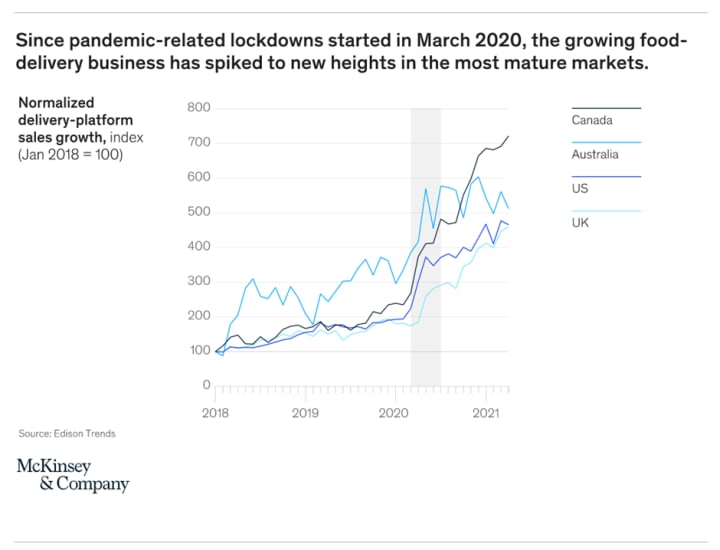
The most mature delivery markets worldwide—including Australia, Canada, the United Kingdom, and the United States—grew twofold (in the United States) to as much as fourfold (in Australia) in 2018 and 2019, as can be seen above. This exponential growth continued in 2020 and early 2021 to the point where these markets are now four to seven times larger than they were in 2018.
Though food deliveries spiked in several parts of the world, there have been restaurants that have suffered and have been closed due to the onslaught of pandemic. Having contained the customers and businesses in confines, the pandemic left them lurching in darkness for a while, initially when it hit. Since, people could no longer enjoy regular services due to safety restrictions, restaurant owners had to re-evaluate their operational models. In fact, the surge in tech-enabled delivery came as a meaningful silver lining for many.
One industry that seemed to have succeeded in revolutionizing and using the challenges of the pandemic to its advantage through food delivery software is the restaurant industry with the introduction of ghost kitchens. Even though ghost kitchens had already started picking up pace and becoming a trend, the pandemic made them a necessity for culinary entrepreneurs and food start-ups that still hoped to remain in business. And with some efficient food delivery software offering exemplary services around, they managed to do it as they availed last mile delivery solutions through ghost kitchens.
Now, with an increasing number of people warming up to ordering in, it's no surprise that food delivery software are wanted all the more by them. As online ordering ascends and gains pace, the online food delivery sector is expected to be worth a whopping $94 billion by 2024. Also included in this developing sector is the ghost kitchen. Having traversed a difficult path during the pandemic, it helped saw many businesses through by making last mile deliveries possible. Now being through it, the global ghost kitchen market is projected to be worth $71.4 billion by the year 2027.
Interesting statistics about ghost kitchens and food deliveries-
Other related statistics give us an insight about the growing craze for ghost kitchens everywhere around and how quickly they are treading the food delivery pathway. They are mentioned below.
• Euromonitor’s data suggests that the global ghost kitchen market size is highly likely to reach a whopping $1 trillion by the end of the year 2030.
• A study by Statista states that ghost kitchens will hold 50% of drive-through and takeaway food service markets. Apart from this, they’re most likely to account for 35% of ready meal, 30% of packed cooking ingredient, 25% of eat-in foodservice, and 15% of packaged snack markets by 2030.
• When the pandemic struck in 2020, fine dine sales dropped by over 90% and casual dining sales reduced by 75%, ghost kitchens saw an enormous increase in profits.
• As of now, China has around 7,500 ghost kitchens with India following it, at around 3,500. The United States has approximately 1,500 ghost kitchens and still counting.
• Uber Eats and Grubhub saw a 100% and 40% increase in revenues, respectively. Also, ghost kitchen trends point out that the delivery orders increased almost 70% in March 2020, while overall restaurant traffic dropped by 22%.
• Most virtual kitchens rely on third party food delivery software and apps. Data suggests that the number of food delivery app users increased from 36.4 million users in 2019 to more than 45 million in 2020. Furthermore, it’s estimated that this growth will continue by 2023.
• Upserve’s study indicates that around 60 percent of all restaurant orders made by the millennials in the United States are mostly delivery or takeout.
• According to a study done by market man, it is expected that the popularity of food delivery services could lead to full automation of the production of various menu items and dishes during the next five to ten years.
• Making out from the trends of ghost kitchens in 2021 and 2022, roughly 50% consumers have absolutely no problem in ordering from a restaurant with no physical storefront. At the same time, it also appears that customers are still skeptical about ghost kitchens and they can opt for a delivery option, if provided by restaurants.
• In a study by PitchBook, statistics reveal that there are 125 leading companies in the ghost kitchen industry. They have 510 investors and have closed 306 deals. Some of the prominent ghost kitchens include DoorDash, Deliveroo and Rebel Foods.
• Known as one of the largest ghost kitchen companies, a UK start-up known as Karma Kitchen is the most prominent cloud kitchen in Europe. It raised over €300 million in only one round of funding in July 2020.
• An average ghost kitchen start-up investment is between $20,000 and $30,000, which isn’t a lot. Ghost kitchens usually have lower start-up costs than regular restaurants.
• Ghost kitchen trends reveal that those who ordered from DoorDash spent the most in the fourth quarter of 2021. The quarterly spending of Uber Eats’ customers was $239, while Postmates and Grubhub customers spent the least ($168 and $158, respectively).
How bankable can ghost kitchens be?
Ghost kitchens, as it appears from their growth and statistics, are having a great going and they can be incredibly profitable. Since they specifically focus on food delivery, they generate huge profits at a low cost. Moreover, the way consumers are wanting food deliveries and businesses are responding to such needs, it’s way easier for them to make money with ghost kitchens than restaurants. Having a robust food delivery software can really push a ghost kitchen to explore the myriad benefits that lie therein.
However, it’s not as easy as it sounds. Only those who’ve mastered last mile deliveries by managing the food, labor and operational costs can expect profits. That’s why it’s crucial for businesses to optimize expenses, have menu pricing and devise marketing strategies accordingly.
Future of food delivery and ghost kitchens
With convenience becoming the most after thing and with food businesses increasingly boarding the online platform, they all look set to take a good flight and the future appears incredibly promising for them.
There are major investments happening in the space, with some significant fundraises, including Wolt (which raised $530 million in January 2021), REEF Technology ($700 million in November 2020), and Rebel Foods ($26.5 million in July 2020), and consolidation, including Uber’s acquisition of Postmates (for $2.65 billion in December 2020) and Just Eat Takeaway’s acquisition of GrubHub (for $7.3 billion in June 2021). Two recent IPOs—DoorDash in December 2020 and Deliveroo in March 2021—say a lot about the future of food delivery sector and the excitement and growth that lies there.
As and by the number of ghost kitchens increase with the passage of time and the food delivery landscape expectedly shifts further in the times to arrive, new challenges, opportunities, and decision points will also emerge for a complex web of players—including delivery platforms, aggregators, restaurants, ghost kitchens, drivers, consumers, and other tech enablers.
Brick and mortar restaurants are likely to face stiff competition from their online counterparts i.e., online food delivery businesses. The pressure on traditional restaurants could be tightened further by the proliferation of ghost kitchens and other delivery-first and delivery-only restaurant models. Since these lower-overhead businesses can afford to pay the platforms’ higher commissions, they are often featured more prominently in the platforms’ apps. They may also be able to lower the service fees placed on customers. Increasingly, a greater share of delivery volume is likely to go their way at the expense of traditional restaurants, some of which may be forced to consider whether they can afford to continue playing in the delivery space at all.
At the same time, ghost kitchens also present an opportunity for restaurants, which may choose to supplement their on-premises facilities with remote locations devoted exclusively to delivery.
Going forward, the food delivery space is poised for further expansion as the circumstances normalize, people adapt to impending technologies and more digitalization makes way into the food delivery ecosystem. Restaurants and culinary entrepreneurs will need to devise aggressive corporate and business level strategies and adapt accordingly, think carefully about how to partner with delivery platforms, and experiment with new and innovative ways of doing business.
Winding up
Ghost kitchens and food delivery platforms will probably evolve as they gradually learn to leverage customer data to improve the user experience and find advanced ways to reduce the costs associated with delivery and bring more reformed delivery experiences. Customers too, of all generational cohorts, are increasingly adopting and enjoying the last mile delivery experiences. Now, as investors pour money into delivery platforms, dark kitchens, new brands, and other infrastructure and services, the companies on the receiving end will face substantial pressure to live up to investors’ expectations.
The questions, therefore are-
How ready is your business to fulfil the customers’ and investors’ expectations?
And, how good are your business’s culinary skills so as to make the most of ghost kitchen and food delivery expansion that is happening around?
About the Creator
Dr. Shamael Zaheer Khan
Dr. S.Z. Khan is a revered academic. He brings a unique blend of theory and practice to his position as Vice President (Marketing & Strategy) at a leading SaaS firm. He is also an expert contributor to several platforms of repute.
Keep reading
More stories from Dr. Shamael Zaheer Khan and writers in 01 and other communities.
The rise and growth journey of food delivery apps in the world of hyperlocal e-commerce
The way the world eats and satisfies its hunger is changing dramatically. Not very long ago, people preferred cooking food at home or even if they wanted to get food from outside, there were not many options available. But, food delivery in present times has quickly shifted gears and changed for good. Its rise, most importantly has been due to the fact that consumers everywhere around have started to prefer convenience over and above everything.
By Dr. Shamael Zaheer Khan3 years ago in 01
Understanding the Cultural Importance of Handbags
Handbags have played a meaningful role in fashion and daily life for centuries. Historically, handbags were created out of necessity, designed to help people carry personal belongings such as money, tools, or documents. Over time, they evolved into carefully designed accessories that combine practicality with aesthetics. Today, handbags are widely recognized as symbols of personal style, social identity, and changing fashion values.
By charliesamuel7 days ago in 01
2026 Career Reality How You Become a Mobile App Developer
In 2026, the question how do you become a mobile app developer is no longer answered by learning a stack and shipping an app. A tectonic shift inside the Google ecosystem has tied developer relevance to AI Retrieval, Zero Click behavior, and entity-level trust, creating direct career risk for those who build without authority awareness.
By Mike Pichai5 days ago in 01



Comments
There are no comments for this story
Be the first to respond and start the conversation.