
GDS vs Direct Booking APIs: Which One to Choose?
Discover the pros and cons of GDS and Direct Booking APIs. Learn which option fits your travel business needs for better efficiency, reach, and flexibility.

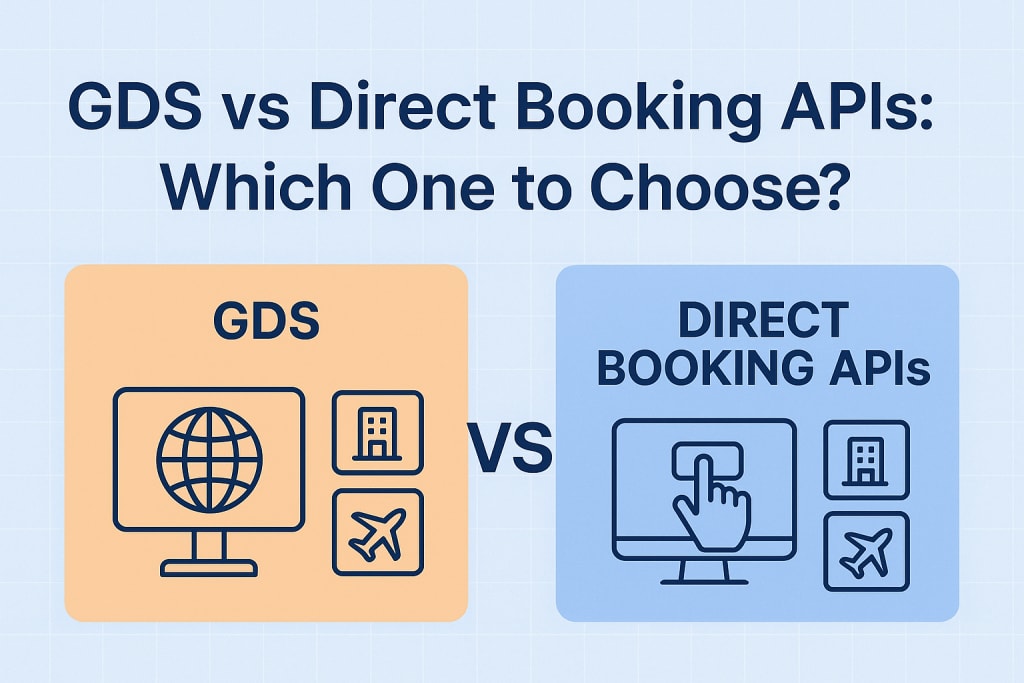
In the fast-paced travel industry, the way you connect with suppliers can make or break your booking efficiency, customer experience, and profitability. Two popular options dominate the landscape: Global Distribution Systems (GDS) and Direct Booking APIs. Many travel companies rely on global distribution system to seamlessly access a centralized network of travel suppliers worldwide, while Direct Booking APIs allow you to connect directly with airlines, hotels, or other providers without going through intermediaries.
The choice between the two isn’t as simple as picking the latest technology or the cheapest option it depends on your business model, target market, and long-term strategy. Let’s break down what each option is, how they differ, and when it makes sense to choose one over the other.
What is a GDS (Global Distribution System)?
A Global Distribution System is a centralized platform that connects travel agents, online booking websites, and corporate travel systems to a wide network of suppliers such as airlines, hotels, car rental companies, and cruise lines.
With a GDS, you gain access to real-time availability, pricing, and booking capabilities across thousands of suppliers, all from a single interface. Popular GDS providers include Amadeus, Sabre, and Travelport, each offering vast coverage and long-standing relationships with suppliers.
In simple terms, a GDS acts like a giant digital marketplace for the travel industry, streamlining the booking process for agencies and helping suppliers distribute their inventory globally.
What is a Direct Booking API?
A Direct Booking API enables your travel platform to connect directly to a supplier’s reservation system, bypassing intermediaries. This could mean linking straight to an airline’s ticketing system, a hotel chain’s booking engine, or even a cruise operator’s inventory.
Direct APIs pull real-time data including availability, rates, and promotions—directly from the source. This setup often leads to better control over pricing, faster updates, and the possibility to negotiate exclusive deals with suppliers.
While Direct APIs can be cost-effective in the long run, they require more integration effort, as you may need to connect with multiple suppliers individually to achieve the same level of inventory as a GDS.
Key Differences Between GDS and Direct Booking APIs
Cost and Commission Structure
GDS: Usually involves booking fees or commissions paid to the GDS provider, which can add up for high-volume bookings.
Direct Booking APIs: Often come with lower per-transaction costs and allow for more favorable negotiated rates, but the initial integration cost may be higher.
Inventory and Availability
GDS: Offers a massive inventory from thousands of suppliers globally—ideal for agencies serving multiple markets.
Direct Booking APIs: Limited to the suppliers you choose to integrate with, which means less global coverage but potentially more exclusive or niche inventory.
Speed and Performance
GDS: Efficient for large-scale searches but may face slight delays due to the intermediary layer.
Direct Booking APIs: Often faster response times since they connect directly to the supplier’s system, reducing latency.
Integration Complexity
GDS: One integration unlocks access to thousands of suppliers, making setup relatively straightforward.
Direct Booking APIs: Requires multiple integrations for multiple suppliers, increasing development and maintenance efforts.
Flexibility and Customization
GDS: Standardized structure, which limits customization of booking flows and special offers.
Direct Booking APIs: High flexibility—you can design your booking experience, pricing logic, and promotions according to your business goals.
When to Choose GDS vs Direct Booking APIs
Ideal Scenarios for GDS
- You need broad global coverage and instant access to thousands of suppliers.
- Your agency serves multiple travel sectors (flights, hotels, car rentals, cruises).
- You prefer a single integration for faster setup.
- You rely on established supplier relationships and don’t need heavy customization.
Ideal Scenarios for Direct Booking APIs
- You want lower transaction costs and more control over pricing.
- You have strong relationships with specific suppliers.
- Your focus is on niche markets or exclusive deals.
- You’re building a customized booking experience and need flexibility in design and data handling.
Conclusion
Choosing between GDS and Direct Booking APIs ultimately comes down to your business goals, target audience, and operational priorities.If your priority is reach and convenience, a GDS is the way to go it’s fast to set up and offers access to a massive global network. If your focus is on cost control, speed, and customization, Direct Booking APIs may be a better fit.
Many modern travel businesses adopt a hybrid approach, using GDS for broad coverage and Direct APIs for key partnerships or exclusive inventory. By carefully assessing your needs and leveraging a reliable GDS integration service, you can choose the approach or combination that delivers the most value to your business and customers.
About the Creator
Nico Gonzalez
Hi, I'm Nico Gonzalez! I'm passionate about technology, software development, and helping businesses grow. I love writing about the latest trends in tech, including mobile apps, AI and more.
Keep reading
More stories from Nico Gonzalez and writers in 01 and other communities.
What is Required to Build an AI Agent?
AI agents are no longer just futuristic concepts they're becoming everyday tools for businesses of all sizes. From helping customers in real-time to making smart decisions without constant human input, AI agents are transforming how work gets done.
By Nico Gonzalez7 months ago in 01
Understanding Crossdressing Culture and Modern Crossdresser Shops in Australia
Crossdressing refers to the act of wearing clothing traditionally associated with another gender. Throughout history, people have practiced crossdressing for cultural, theatrical, personal, or social reasons. Historical records show that crossdressing has appeared in many civilizations, including ancient societies where clothing and gender roles were more fluid than often assumed.
By James Mburu5 days ago in 01
Multi Directional Forklift: The Future of Flexible Warehouse Handling
Modern warehouses and logistics centers rely heavily on efficient material‑handling equipment. Among the many machines used in warehouses, the Multi Directional Forklift stands out as one of the most versatile solutions for handling complex loads in tight spaces. As storage facilities become more compact and demand faster operations, businesses are increasingly adopting advanced forklifts that maximize space, safety, and productivity.
By charliesamuel5 days ago in 01
📢 Raise Your Voice Thread: 03/05/2026
Our “Raise Your Voice Threads” are hosted most alternating Thursdays at 12PM ET to offer creators more avenues to uncover exceptional stories on Vocal. As we are continuously searching for fresh creators and inspiring stories, this thread provides an opportunity to exchange and discuss the stories that have moved and motivated us on Vocal.
By Raise Your Voice by Vocal5 days ago in Resources




Comments
There are no comments for this story
Be the first to respond and start the conversation.