
From Tedious to Terrific: How AI is Reshaping How We Work
AI for Work


From Tedious to Terrific: How AI is Reshaping How We Work
Artificial Intelligence (AI) is no longer a futuristic fantasy; it's a powerful and increasingly ubiquitous partner in our daily work lives. Far from simply replacing human jobs, AI is fundamentally transforming how we approach tasks, boosting efficiency, fostering creativity, and freeing up countless hours for more strategic and fulfilling endeavors. From the individual freelancer to the sprawling multinational corporation, AI is helping people work smarter, not just harder.
Automating the Mundane: Reclaiming Time and Focus
One of the most immediate and impactful ways AI assists people in their work is by automating repetitive and time-consuming tasks. Think about the hours spent on data entry, scheduling appointments, categorizing emails, or generating basic reports. These "grunt work" tasks, while necessary, often drain energy and focus that could be better spent on higher-level thinking.
AI tools, powered by machine learning and natural language processing, can now handle these chores with remarkable speed and accuracy. For example:
Email Management: AI-powered inbox assistants can prioritize emails, draft responses, summarize long threads, and even schedule follow-ups, ensuring important communications are never missed.
Data Processing: Instead of manually inputting data into spreadsheets, AI can extract information from documents, images, and even spoken words, then organize and analyze it instantly. This is invaluable in fields like finance, research, and logistics.
Scheduling and Calendar Management: AI-driven scheduling tools can coordinate meeting times across multiple participants, factoring in time zones and preferences, eliminating endless back-and-forth emails.
Customer Service: Chatbots and virtual assistants handle a large volume of routine customer inquiries, providing instant answers and freeing up human agents to tackle more complex or sensitive issues.
By taking over these monotonous tasks, AI allows individuals to reclaim significant portions of their workday. This liberated time can then be dedicated to creative problem-solving, strategic planning, client relationship building, or even professional development – aspects of work that truly leverage human intelligence and empathy.
Augmenting Intelligence: Enhancing Decision-Making and Creativity
Beyond automation, AI acts as a powerful intelligence augmenter, providing insights and capabilities that were previously impossible for humans alone.
Advanced Data Analysis: AI algorithms can sift through massive datasets, identifying patterns, correlations, and anomalies that would be missed by the human eye. This is revolutionary for fields like market research, financial analysis, and scientific discovery, enabling data-driven decisions that are faster and more accurate. Predictive analytics, fueled by AI, helps businesses forecast trends, manage inventory, and anticipate customer needs with greater precision.
Content Generation and Assistance: Large Language Models (LLMs) like those powering generative AI tools can assist with writing, brainstorming, and content creation. From drafting initial emails and marketing copy to summarizing complex documents and generating presentation outlines, AI can jumpstart creative processes and overcome writer's block. For designers, AI image generators can produce visuals from text prompts, accelerating the creative workflow.
Personalized Learning and Development: AI can analyze an individual's skills and learning gaps, then recommend tailored training programs and resources. This personalized approach fosters continuous skill development, helping people adapt to evolving job markets and stay competitive.
Decision Support Systems: In critical fields like healthcare, AI assists doctors in diagnosing diseases by analyzing medical images and patient data, offering a second opinion or flagging potential issues. In legal settings, AI can review vast quantities of documents to identify relevant cases and precedents.
Facilitating Collaboration and Accessibility:
AI also plays a crucial role in improving collaboration and making work more accessible.
Meeting Summarization: AI-powered tools can transcribe meetings in real-time, identify key discussion points, action items, and even assign tasks, ensuring that no detail is lost and follow-ups are streamlined.
Language Translation: AI breakthroughs in natural language processing have made real-time translation remarkably accurate, breaking down communication barriers in global teams and expanding business opportunities.
Accessibility Tools: AI powers features like speech-to-text and text-to-speech, enabling individuals with disabilities to interact with technology and perform tasks that might otherwise be challenging.
In conclusion, AI's role in the workplace is evolving from a novel concept to an indispensable partner. By automating tedious tasks, enhancing analytical capabilities, fostering creativity, and improving collaboration, AI empowers individuals to focus on what humans do best: innovate, strategize, and connect. While questions about job displacement persist, the prevailing narrative is one of augmentation and enablement, where AI helps people achieve unprecedented levels of productivity and job satisfaction, ultimately redefining what it means to be effective in the modern working world
About the Creator
BELAJAR AI
In the digital era, video content has become one of the most powerful tools for communication, marketing, education, and entertainment.
https://belajarbarengdigital.blogspot.com/
Keep reading
More stories from BELAJAR AI and writers in 01 and other communities.
The Power of AI Video Creation: How Artificial Intelligence Is Revolutionizing Visual Content Production
In the digital era, video content has become one of the most powerful tools for communication, marketing, education, and entertainment. However, traditional video production often requires a large budget, technical expertise, and significant time investment. Fortunately, the emergence of Artificial Intelligence (AI) is transforming the landscape of video creation. With AI-powered tools, producing high-quality videos has become more accessible, efficient, and cost-effective—even for beginners.
By BELAJAR AI10 months ago in 01
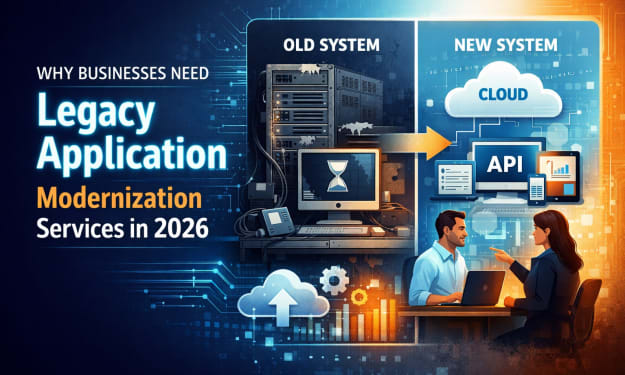
Why Businesses Need Legacy Application Modernization Services in 2026
Digital transformation is no longer optional for modern organizations. As businesses adopt cloud computing, AI automation, cybersecurity frameworks, and scalable digital platforms, many companies still rely on outdated legacy software systems built years or even decades ago. While these systems once supported business growth, they now limit innovation, increase operational risks, and create security vulnerabilities.
By keith laurance6 days ago in 01
AR Try-On Features - Building for Retail Apps 2026
AR try-on features are a vital bridge today. They connect physical shopping with digital efficiency. In 2026, these tools are no longer experiments. They are now basic requirements for modern brands. Brands use them to reduce high return rates. They also use them to boost consumer confidence. Developers face a new challenge this year. The question is no longer about basic possibility. Instead, teams must achieve pixel-perfect results. Low-latency performance is now the primary goal.
By Devin Rosarioa day ago in 01



Comments
There are no comments for this story
Be the first to respond and start the conversation.