
From SEO to GEO: Adapting to the Age of AI Answers
A roadmap for businesses navigating AI-powered search results.

More and more search queries today are being answered directly by AI systems. Instead of scanning a page of links, users are increasingly met with synthesized responses that feel complete on their own.
For businesses, that means a top ranking is no longer the guarantee it once was. You can hold the first position, but if your insights aren’t part of the AI’s answer, you risk being invisible in the very moment decisions are forming.
Search has shifted from positions to presence, and marketers can’t afford to ignore this turning point.
So, What Is GEO?
Think of how people used to search. You’d type a keyword, scan the top few results, and decide which site to click. Today, the experience is different: you ask a question, and an AI pulls together the answer for you.
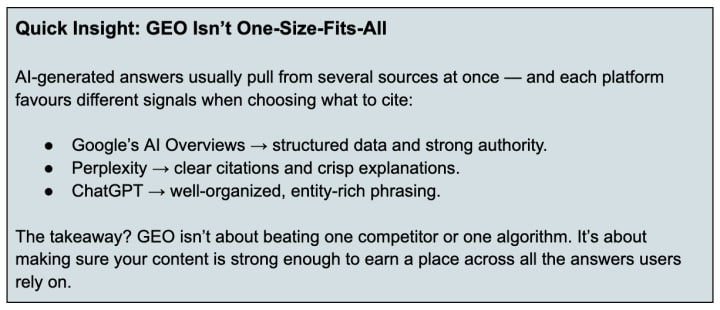
Generative Engine Optimization, or GEO, is about making sure your insights are part of that answer. It’s not about stuffing keywords or chasing backlinks. It’s about presenting ideas in a way machines can understand and trust.
Here’s the real difference: GEO shifts the goal from being the destination to being part of the conversation. Your brand doesn’t just show up on a results page — it shows up in the knowledge that people actually consume.
Clearing Up the Misconceptions
Whenever a new term enters digital marketing, it usually comes with a cloud of confusion — and GEO is no exception. Some dismiss it as just “SEO with a different name,” while others assume it will replace every other optimization approach. Neither is true.
Myth 1: GEO replaces SEO
Not at all. SEO still matters for discovery. Without it, your content may not even be indexed. GEO builds on top of SEO by making sure that once you’re found, your content is also used inside AI-generated answers.
Myth 2: GEO is just another version of AEO
Answer Engine Optimization (AEO) is designed for quick, one-line responses — think snippets or voice search. GEO goes further, positioning your expertise inside multi-source, paragraph-level answers that feel like a conversation.
Myth 3: Ranking is enough
This is the biggest misconception. In an AI-first world, ranking doesn’t guarantee visibility. What matters is being cited — woven directly into the response itself.
Myth-Buster Highlight
The mistake many businesses make is treating GEO like a checklist. In reality, it’s a strategic layer that works alongside SEO and AEO, not instead of them.
The Stakes of Getting GEO Right
Generative Engine Optimization is more than a technical adjustment — it’s a shift in how success is measured online. To see why it matters, it helps to look at it in terms of gains and risks.
What You Gain with GEO
- Sustained discovery: Even as clicks from traditional SERPs decline, being cited in AI-generated answers keeps your brand present.
- Authority through repetition: The more often AI systems reuse your insights, the more credibility your brand earns in the eyes of users.
- Influence early in the journey: GEO puts your expertise in front of people while they’re still researching, shaping trust before buying decisions are made.
What You Risk Without GEO
- Invisible discovery: If your content isn’t cited, you’re absent from the very answers users rely on.
- Competitors as default experts: Brands that get cited repeatedly become the voices people trust — and displacing them later is difficult.
- Higher costs: Without organic presence in AI answers, staying visible often means relying on paid ads, which drives up acquisition costs.
- GEO isn’t just a growth lever — it’s a guardrail against losing ground. The difference lies in whether your expertise becomes part of the answer or fades from view.
What GEO Looks Like in Practice
Treating GEO as a static checklist is the fastest way to miss its value. Instead, think of it as a set of principles that guide how your content should evolve in an AI-first search world.
- Write for intent, not just keywords: Generative engines look for answers to questions, not just matches for phrases. Content that anticipates intent — defining terms, explaining processes, clarifying concepts — is far more likely to be cited.
- Signal structure and context: Clear headings, schema markup, and consistent terminology help AI systems understand and trust your content. Think less about how humans skim and more about how machines parse.
- Refresh with authority: Recency matters. Updating articles with new data and examples improves your chances of being reused. Authority isn’t just built by being old and established — it’s reinforced by staying relevant.
- Expand beyond text: Generative search is becoming multimodal. Infographics, charts, and videos, when properly tagged and described, can strengthen your presence as much as written copy.
Conclusion: GEO as the Next Discipline
Generative Engine Optimization isn’t a trick to test once and forget — it’s the direction search is moving. As AI systems continue to grow more central to how people find information, the brands that adapt now will have their expertise woven into the answers users trust most.
The real takeaway is this: GEO isn’t about chasing algorithms. It’s about aligning your content with how people actually search today — through AI, across platforms, and with higher expectations for clarity and authority.
Those who treat GEO as an ongoing discipline will set the pace in their industries. Those who wait will be left trying to catch up in a conversation already dominated by others.
About the Creator
Max Mykal
I’m Max, a Digital Marketing & SEO specialist with 4+ years of experience. At LenGreo, I help industries like Biotech, Cybersecurity and iGaming grow with tailored strategies. Let’s connect to drive your business forward!
The Mandela Effect Destroyed My Marriage...
The first time my wife Amanda and I realized we had completely different memories of a shared experience was during a dinner party in 2018 when we were telling friends the story of our engagement, which I remembered as happening on a beach in California during sunset with me nervously fumbling the ring box while trying to kneel in the sand, but Amanda interrupted to correct me, saying that no, the proposal had happened at the restaurant afterward, inside by the window table, and I laughed and said she was confused, that the restaurant was where we had celebrated after I proposed on the beach, but she insisted with increasing frustration that I was the one misremembering, that we had never gone to the beach that evening at all, and our friends exchanged uncomfortable glances as they watched us argue about a fundamental moment in our relationship that apparently existed in two completely different versions depending on which of us was telling the story. We eventually agreed to disagree to avoid ruining the dinner party, but the incident bothered both of us deeply, and over the following weeks we started comparing memories of other shared experiences and discovered to our growing alarm that we diverged on numerous significant details, remembering different conversations, different timelines, different people being present at important events, as though we had lived parallel but distinct versions of the same seven-year relationship.
By The Curious Writera day ago in 01
ICO Marketing Explained: A Beginner’s Roadmap for 2026
The blockchain industry continues to evolve rapidly, and Initial Coin Offerings (ICOs) remain one of the most powerful fundraising mechanisms for blockchain startups and Web3 projects. Even though the crypto market has matured significantly over the past decade, ICOs in 2026 are experiencing a resurgence due to improved regulatory clarity, stronger investor protection frameworks, and advanced marketing technologies that help projects reach a global audience. However, launching a successful ICO is not just about developing a great blockchain product; it requires a well-structured marketing strategy that builds trust, generates awareness, and attracts the right investors. ICO marketing has transformed dramatically compared to the early days of crypto fundraising. In the past, many projects relied on hype and aggressive promotion to raise funds, but today's investors are far more informed and cautious. They expect transparency, detailed roadmaps, credible teams, and strong community engagement before investing in a token sale. As a result, ICO marketing in 2026 focuses on strategic storytelling, community building, influencer collaborations, data-driven campaigns, and regulatory compliance.
By Jack santo7 days ago in 01
A Transparent Look at Vocal Challenges and Top Stories
Almost three years ago, we shared a resource article that served as a place for people to suggest new challenge prompts. We thought it would be a good idea to refresh that thread, and take the opportunity to answer a few common questions about top stories, how challenges are judged and how submissions are reviewed.
By Vocal Curation Team4 days ago in Resources


Comments
There are no comments for this story
Be the first to respond and start the conversation.