
Freelancer vs Design Studio: The New Decision Matrix for Startups
Feeling the friction of first design hires? Here’s how startups can make the right UX choice. Weigh cost, complexity, and scale with a decision framework designed to fit your growth stage.


You're building something new. Funding just landed, or maybe you’ve hit a major milestone. And now it’s time to give your product the design love it deserves. But there’s one nagging question that keeps surfacing: Do we bring in a freelance designer or partner with a design studio?
The question isn’t just about cost — it’s about flexibility, expertise, speed, and whether your product is ready to scale. And making the wrong choice can leave your team stuck with design debt or worse, a misaligned user experience.
If googling “freelancer vs design studio for startups” got you here, well done. Because this isn’t your average pros and cons guide. This offers a clear decision matrix to help you navigate that choice. No sweeping recommendations. Just real scenarios, outcomes, and questions you can actually use to make the right call for where your startup is right now.
Freelancers: Pros and Cons
Freelancers can be a great fit when you're looking for flexibility, speed, and budget-friendliness. Especially in the early days of your product, working with a talented solo designer might be the fastest way to iterate.
Pros
Lower cost: Freelancers typically charge less than studios; often $30–$100/hour depending on experience and location.
Flexible engagement: You can scale their hours up or down as your needs evolve.
Specialized skills: Need just UI design or just mobile UX? There’s likely a freelancer who fits that niche.
Cons
Limited capacity: A single person can only handle so much. If timelines compress or requirements grow, you might hit a bottleneck.
No built-in collaboration: You’ll often need to manage project communication and coordination yourself.
Inconsistency risk: If you work with different freelancers over time, maintaining design consistency can become a challenge.
Startups that already have a product team or technical co-founder often prefer freelancers for quick implementation or short-term needs. But the trade-off is you’ll be responsible for tying the pieces together.
Design Studios: Pros and Cons
Design studios are built for breadth and scale. They're structured teams that can handle everything from strategy and UX research to interface design and developer handoff.
Pros
Team-based expertise: Studios often bring together UI/UX designers, researchers, branding specialists, and even content strategists.
Scalable support: You won’t outgrow them quickly. Studios can grow with your product.
Strategic input: More than execution, studios can guide design decisions aligned with your product vision.
Cons
Higher investment: Studios typically charge $75–$250/hour or offer project pricing that starts around $10K and scales fast. But the quality of work is often worth the price.
Less day-to-day flexibility: They follow a structured process. This is good for quality, but less nimble than a freelancer on Slack. However, most design agencies encourage routine collaboration between your team and theirs, with dedicated project coordinators.
Not always ideal for micro-tasks: If you just need a landing page revamp, a studio may be overkill. But if the task is a part of a bigger plan, you might invest in an agency for the convenience of consistency.
Startups entering a funding round or building toward product-market fit often turn to studios to establish a design foundation that can scale with them. But the key is matching the scope of your needs to the level of support.
The Decision Matrix: Fit, Complexity, Cost, and Scale
Instead of racking your brains about which option is better, it’s smarter to ask: What does your startup need right now?
Here’s a simplified matrix to help:
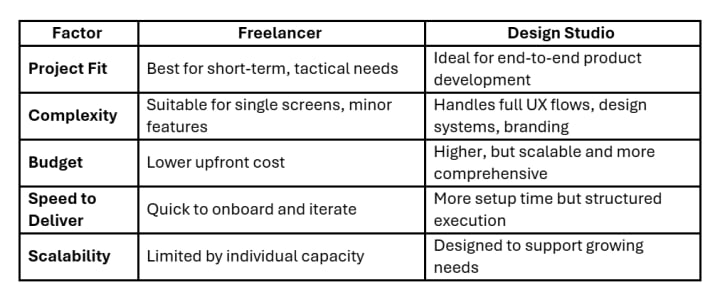
Think of it less as a “versus” and more as a “matchmaking” exercise between your project needs and the team structure that fits them best.
To sum it all up, these quick and simple answers could help you find more clarity:
When should startups work with a design agency vs freelancer?
Startups should consider freelancers when they need quick-turnaround work on a limited budget, or when internal product leadership can provide a clear direction.
A design agency is a better fit when building from scratch, launching a complex product, or preparing for scale. Especially if design strategy is part of the equation.
Cost difference between freelance designer and design studio
Freelancers usually charge $30–$100/hour. Studios range from $75–$250/hour or offer project-based pricing (starting from $10K+).
While freelancers offer lower upfront cost, studios may deliver more value in large, complex projects by reducing design debt and accelerating time-to-market.
What skills do design studios have that freelancers don’t?
Design studios offer cross-functional teams, combining UI/UX, research, branding, and strategy — often within a structured process.
Freelancers may have depth in one area but typically lack the range and collaborative ecosystem of a studio.
Startup Snapshot: How One YC Company Used a Studio to Scale
Take a look at real-world examples toaid your decision-making process further:
Tovala (YC W15) needed a high-fidelity prototype to pitch investors and validate product-market fit. Instead of patching together designs via freelancers, they hired a compact remote design studio that delivered a fully interactive, branded MVP in 4 weeks.
The result? Faster alignment with investors and a design system that scaled post-Series A.
This isn’t a knock against freelancers. In fact, they used them earlier for small iterations. But as the stakes grew, they shifted toward a team that could match their speed and strategy.
So, When Should You Hire a Professional UI UX Design Team?
There’s a clear inflection point when a freelancer isn't enough:
- You’re planning a product launch and need consistency across mobile and web.
- Your design feedback loop has slowed due to bandwidth or coordination issues.
- You're fundraising and need your product to feel investor-ready.
- You’re building features that need research, testing, and UX validation.
In these cases, it’s often smarter to hire a professional UI UX design team, even if it’s a small, remote one. Today’s studios aren’t all based in San Francisco. Many remote-first teams offer global expertise with flexible pricing that matches startups’ needs.
Final Word: Choose Based on Fit, Not Hype
The right design partner isn’t about prestige or pricing. Look for what your startup actually needs to move forward.
If you’re bootstrapping and moving fast, a talented freelancer can be your secret weapon. If you’re building toward growth or need a partner who can plug into product strategy, a design studio may be the better long-term bet.
Either way, design isn’t a luxury anymore; it’s foundational. And the earlier you find the right partner, the faster you’ll build something users actually want to use.
About the Creator
Neha Singh
A passionate UX designer dedicated to crafting intuitive and impactful experiences, I thrive on sharing innovative ideas and insights with the business community.
Keep reading
More stories from writers in 01 and other communities.
Blockchain Tracing: A Key Tool in Crypto Asset Recovery
The cryptocurrency ecosystem has expanded rapidly, with billions of dollars in digital assets now in circulation across thousands of blockchains. However, this growth has been accompanied by significant risks, including hacks, scams, phishing attacks, and user errors such as lost private keys or forgotten seed phrases. In 2025, reported losses from crypto-related incidents exceeded several billion dollars, highlighting the persistent vulnerability of digital assets. Unlike traditional banking systems with reversible transactions and centralized oversight, blockchain's decentralized and immutable nature makes recovery difficult once funds are transferred. As a result, blockchain tracing has emerged as an essential method for identifying fund flows, attributing activity, and supporting recovery efforts in actionable cases.
By Garry Oneal7 days ago in 01
Top Enterprise Software Development Companies in 2026
The use of enterprise software has become imperative in the efforts by businesses to optimize, become more efficient, and grow in a safe digital competitive space. The adoption of cloud technology, artificial intelligence, automation, and data technologies, especially within the current digital era, means that businesses are seeking the help of skilled software partners.
By Olivia Carter5 days ago in 01


Comments
There are no comments for this story
Be the first to respond and start the conversation.