
Forget Burj Khalifa and Shanghai Tower: Saudi Arabia Prepares a 1-Kilometer-Tall Skyscraper
Saudi Arabia is once again aiming for the sky—literally.

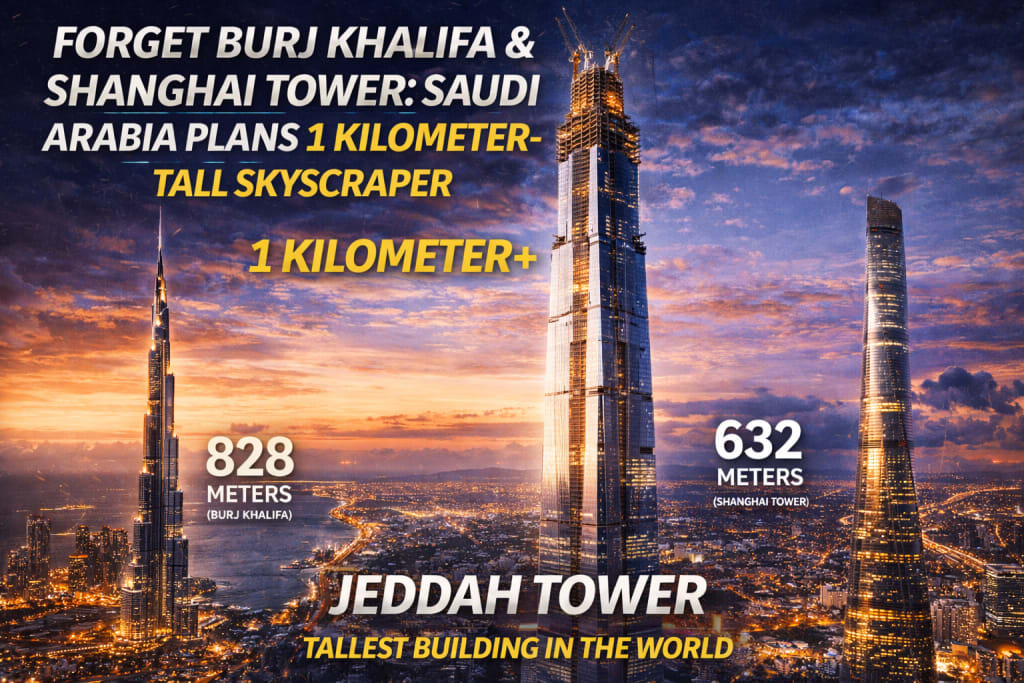
While iconic giants like Dubai’s Burj Khalifa and China’s Shanghai Tower have dominated global skylines for years, a new architectural titan is quietly rising along the Red Sea coast. Known as Jeddah Tower, this ambitious project is designed to exceed 1 kilometer in height, making it the tallest building ever conceived—and the first in history to cross the kilometer mark.
More than just a record-breaking skyscraper, Jeddah Tower represents Saudi Arabia’s bold vision for the future: a statement of economic diversification, global relevance, and engineering mastery in the 21st century.
A New Giant in the Global Skyscraper Race
For decades, the race to build the world’s tallest structure has symbolized national pride and technological progress. The Burj Khalifa, standing at 828 meters, redefined what was possible when it opened in 2010. Shanghai Tower followed with its sleek 632-meter design, showcasing China’s rapid urban evolution.
Now, Saudi Arabia is preparing to leap far beyond both.
Planned to rise over 1,000 meters (3,281 feet), Jeddah Tower will not just edge past its competitors—it will redefine the very concept of “supertall” architecture. If completed as planned, it will stand as the tallest man-made structure on Earth by a significant margin.
Designed by the Minds Behind Burj Khalifa
The architectural vision for Jeddah Tower comes from Adrian Smith + Gordon Gill Architecture, the same firm responsible for the Burj Khalifa. Their experience in ultra-tall structures plays a critical role in tackling the immense challenges posed by a kilometer-high building.
The tower’s aerodynamic, tapering form is carefully engineered to reduce wind resistance and structural stress. At extreme heights, wind—not gravity—becomes the dominant force, and even small design miscalculations can have major consequences. Advanced wind-tunnel testing and computer modeling have shaped the tower’s final form, ensuring stability, comfort, and safety.
A Vertical City in the Sky
Jeddah Tower is not intended to be a single-purpose landmark. Instead, it is designed as a mixed-use vertical city, combining luxury, business, and lifestyle experiences under one roof.
Planned features include:
- Luxury hotels operated by global hospitality brands
- High-end residential apartments and condominiums
- Premium office and commercial spaces
- Observation decks offering panoramic views from unprecedented heights
To support daily life across more than 230 floors, the tower will house hundreds of high-speed elevators, some traveling faster than 10 meters per second. Vertical transportation at this scale is an engineering feat in itself, requiring innovative solutions to minimize wait times and energy consumption.
From Delays to Renewed Momentum
The journey of Jeddah Tower has been anything but smooth.
Construction began in 2013, but progress slowed dramatically around 2018 due to financial, political, and logistical challenges. For several years, the project appeared stalled, fueling speculation that it might never be completed.
That narrative has changed.
Between 2023 and 2025, construction officially resumed with renewed funding and strategic backing. Reports indicate that the structure has already climbed beyond 80 floors, with new levels being added at an accelerating pace. If momentum continues, industry observers suggest the tower could reach completion around 2028, though timelines for projects of this scale always remain fluid.
Engineering at the Edge of Possibility
Building beyond one kilometer presents challenges unlike any previously faced in construction history:
- Extreme wind loads increase dramatically with height
- Foundation pressure must support unprecedented vertical mass
- Material logistics become exponentially more complex
- Human comfort at high altitude requires advanced climate and pressure controls
To address these issues, engineers are using ultra-high-strength concrete, deeply anchored foundations, and next-generation structural systems. Every component—from elevators to glass panels—must be custom-designed to perform reliably at extreme elevations.
A Symbol of Vision 2030
Jeddah Tower is inseparable from Saudi Arabia’s Vision 2030, the Kingdom’s long-term strategy to diversify its economy beyond oil. The project aligns with national goals to expand tourism, attract foreign investment, and position Saudi cities as global destinations.
Throughout history, iconic structures have symbolized national ambition—the Eiffel Tower, the Empire State Building, and the Burj Khalifa among them. Jeddah Tower aims to join that lineage, signaling Saudi Arabia’s intent to compete on the world stage not only economically, but culturally and architecturally.
Economic Impact and Urban Transformation
The tower is a centerpiece of the broader Jeddah Economic City development, an ambitious urban project expected to generate:
- Tens of thousands of jobs
- New residential and commercial districts
- Increased international tourism
- Long-term economic stimulation for the region
If successful, the project could transform Jeddah into a global hub linking Africa, Asia, and Europe—leveraging its strategic Red Sea location.
Sustainability and Global Scrutiny
As excitement builds, so does scrutiny.
Mega-skyscrapers are often criticized for their environmental footprint, energy demands, and long-term operational costs. In an era increasingly focused on sustainability, Jeddah Tower’s efficiency, water usage, and carbon impact will be closely examined.
Developers have emphasized modern energy systems and efficient design, but global observers will be watching carefully to see how the tower performs once operational.
The Future of Skylines
Whether Jeddah Tower becomes a flawless triumph or faces ongoing challenges, its impact is undeniable. It pushes architectural ambition into uncharted territory and raises a fundamental question: How high is too high?
What is certain is this—Saudi Arabia’s kilometer-tall skyscraper is more than concrete and steel. It is a declaration of intent, a bet on the future, and a reminder that human ambition still seeks to challenge gravity itself.
Final Thoughts
As the Burj Khalifa and Shanghai Tower fade into history’s record books, Jeddah Tower is poised to redefine the skyline of the world. Its rise marks a pivotal moment in architecture, engineering, and global competition.
If completed as planned, it won’t just be the tallest building ever built—it will be a lasting symbol of a nation determined to shape the future from the ground up… and far beyond the clouds.
About the Creator
Adil Ali Khan
I’m a passionate writer who loves exploring trending news topics, sharing insights, and keeping readers updated on what’s happening around the world.
Keep reading
More stories from Adil Ali Khan and writers in 01 and other communities.
Crypto.com CEO Buys AI.com for $70 Million, Bets Big on AI Agents With Super Bowl Launch
The race to dominate the artificial intelligence economy just took a dramatic turn. Kris Marszalek, co-founder and CEO of Crypto.com, has reportedly purchased the premium AI.com domain for a staggering $70 million, making it one of the most expensive domain acquisitions in internet history. But this purchase isn’t just about owning a valuable digital asset—it’s the foundation of a bold new AI platform that Marszalek believes could redefine how people interact with technology.
By Adil Ali Khan3 days ago in 01
The Role of Strategic Communication in Business Success: Aligning Vision, Culture, and Execution
Strategic communication is one of the most powerful yet often overlooked drivers of business success. While companies invest heavily in strategy development, technology, and talent acquisition, the ability to clearly communicate vision, priorities, and expectations ultimately determines whether those investments translate into meaningful results. When communication is intentional and aligned with business goals, it connects leadership vision to daily execution, strengthens organizational culture, and improves overall performance.
By Warren Fersterabout 13 hours ago in 01



Comments
There are no comments for this story
Be the first to respond and start the conversation.