
FlutterFlow vs OutSystems: Which is Better for Enterprise Apps?
Comparing Features, Pricing, Scalability & Security to Choose the Best Low-Code Platform for Enterprise Apps

According to an OutSystems report, roughly three-fourths of businesses surveyed plan to create ten or over ten apps by the end of the current year. Can you imagine the pressure this will put on developers?
They must ensure their efficiency remains unchanged, but productivity exceeds nearly double. This is where low-code app development platforms like FlutterFlow and Outsystems will come to the rescue of developers. But what about enterprise apps? The challenge is discovering which is better for enterprise app development: FlutterFlow or Outsystems.
When it comes to enterprise app development, both FlutterFlow and Outsystems are low-code platforms. This enables businesses to swiftly develop mobile apps using a visual interface without requiring technical expertise in coding. However, both these platforms serve a unique purpose for developing enterprise applications.
In this write-up, we will compare these two powerful platforms with such simplicity that it will help you make a wise call when you finish reading this content. But, for that, you need to read this blog thoroughly. Let's proceed with the basic definitions of both these platforms.
What is FlutterFlow?
Flutterflow is a visual app development platform that allows users to develop mobile apps swiftly without requiring coding experience. As a C-Suite executive, I find the FlutterFlow platform helpful because it can quicken the app development process and curtail development costs. You do not have to depend on specialized app development resources to achieve the right results.
With the help of its drag-and-drop interface and pre-built components, you can attain swift prototype development and make required iterations as per your requirements. FlutterFlow for enterprise development helps provide agile and scalable solutions with the reliability to perform in large-scale deployments and complex integrations. However, to learn which is better for enterprise app development - FlutterFlow or OutSystems- you must go through this entire blog.
What is OutSystems?
OutSystems is a low-code platform that requires some technical knowledge to get started. It helps to deploy, design, and manage custom enterprise-grade apps easily. Appreciation to its user-friendly interface and all-inclusive integration capabilities, this platform helps fasten digital transformation efforts. This enables organizations to respond to market demands and counter the challenges faced in their business operations.
Thanks to this platform’s exclusive property of scrutinizing performance in real-time and immaculately integrating with existing IT infrastructure, you can expect your newly developed apps to strive for business growth without zero effect on current operations.
So, all in all, OutSystems is a tactical tool for businesses that need to maintain agility and improve the efficiency of their operations while still keeping the security and scalability of their current system intact to win the race in this competitive business age.
If you’ve followed along, you likely have doubts—and that’s fair. How do we settle the FlutterFlow vs. OutSystems debate when they seem so similar?
We will clarify all your doubts. Please keep reading the forthcoming sections, and slowly but gradually, all the doubts that have clouded your mind will become clear.
Check-Out Our Lastest Blog:- A Project Manager’s Guide to Building Your First EdTech MVP with FlutterFlow
FlutterFlow Vs. OutSystems: Features Comparison
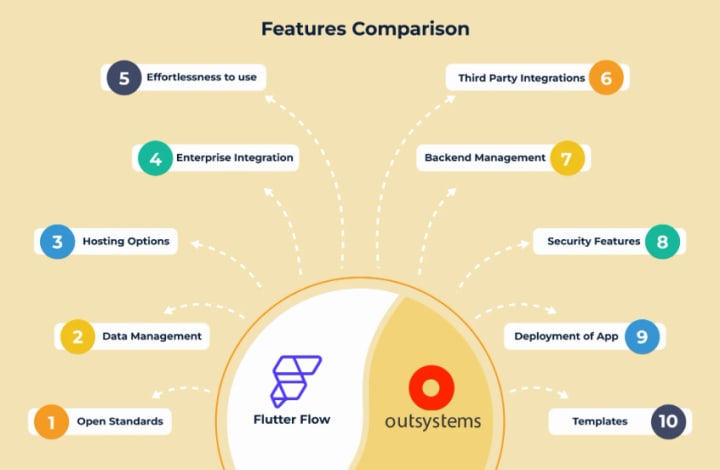
Features Comparison between FlutterFlow and OutSystems
Each low code/no code platform has its own features that make it different from the other. Let us look at some of the comparative features of FlutterFlow and OutSystems that will help us firm our grip over the low code platform comparison to move ahead in our write-up.
1. Open Standards vs. Proprietary Language
The FlutterFlow platform uses open standards, which makes it easy to integrate and use for multiple projects. It can also be used for projects requiring quick deployment across multiple platforms. The flexibility offered by this platform can come in handy while developing many projects.
OutSystems uses a proprietary language that improves the application's performance and security. This form of language can prove to be Mckenna's Gold for enterprises looking to add state-of-the-art features and stringent security and provide complete control over the development process. Thanks to this platform's customized environment, it can be used to develop strong and secure applications specifically to meet your business's diverse needs.
2. Data Management
FlutterFlow provides simple data management, which is apt for simplistic projects where the user-friendliness of the application and swift setup are crucial. On the other hand, OutSystems has cutting-edge data management capabilities, making it perfect for extremely security and confidentiality-oriented large organizations that need to manage complex data securely.
Read the Full Blog:-https://www.thirdrocktechkno.com/blog/which-is-better-for-enterprise-app-development-flutterflow-or-outsystems/
About the Creator
Keep reading
More stories from thirdrocktechkno2024 and writers in 01 and other communities.
EdTech App Development with FlutterFlow | A Complete Guide
As we write, the EdTech industry has breached the US $340 billion valuation. It is estimated to cross US $ 605 billion by the time 2027 approaches. This makes it an excellent opportunity to begin developing educational technology apps. With platforms like FlutterFlow, a no-code app builder, startups can create a basic version of their EdTech app quickly and cost-effectively. No-code development simplifies app creation for everyone. This is your chance to join the future of educational technology and contribute to improving it.
By thirdrocktechkno2024about a year ago in 01
The Siren Dilemma
At 2:14 a.m., Jake seriously considered dying quietly. Not because he wanted to. Not because the pain in his chest wasn’t concerning—it was. Very concerning. The kind of pain that makes you sit upright in bed and whisper, “Hmm. That doesn’t feel… decorative.”
By nimesh tandel2 days ago in 01
How to Make-Sure HVAC Code Compliance During the Design Phase with BIM
Let's be honest: nobody wants to spend their weekend staring at a red-stamped "Failed Inspection" notice or redesigning a ductwork layout because it’s clashing with a structural beam that wasn't on the original drawing. It’s frustrating, expensive, and a total momentum killer.
By lisa Browna day ago in 01




Comments (1)
They both sound interesting! Good to know!