
FinTech vs TechFin: Understanding the Differences in 2026
FinTech vs TechFin explains how financial institutions and technology companies approach digital finance differently. Learn the key distinctions, roles, and trends shaping 2026.

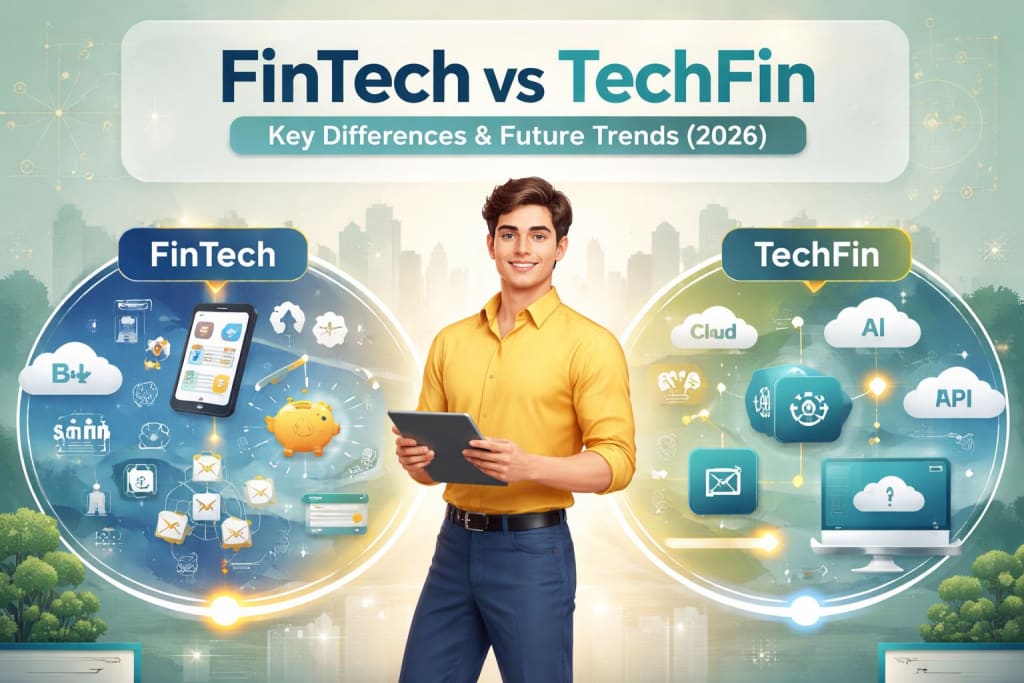
Look, I reckon most of y'all have heard "FinTech" tossed around like it's the only game in town. Thing is, there's a whole other player that's been quietly building an empire — and it's called TechFin.
Proper different beasts, these two.
Here's the catch. Both are blowing up the traditional banking scene, but they're coming at it from opposite ends. One's a bank trying to act like a tech company. The other? A tech giant deciding it fancies being a bank. And in 2026, this isn't just industry chatter anymore — it's reshaping how we all handle money.
What Jack Ma Saw Coming Back in 2016
Right, so Jack Ma (yeah, the Alibaba bloke) coined the term "TechFin" back in 2016 at a China Conference. Brilliant timing, that. He said something I've been thinking about for ages: "Fintech takes the original financial system and improves its technology. TechFin is to rebuild the system with technology."
Mate, that's not just clever wordplay. That's the entire bloody difference right there.
See, FinTech companies start with finance and bolt on tech. TechFin companies start with tech and add finance as another service. Same ingredients, completely different recipes.
Where the Money's Actually Going
Let's talk numbers because they're proper mental. The global fintech market hit $340.10 billion in 2024, but here's where it gets interesting — by 2032, we're looking at $1,126.64 billion. That's not growth, that's a bloody explosion.
But wait, there's a twist. Global fintech investment in H1 2025 dropped to roughly $44.7 billion, the lowest in five years. What gives? The market's getting pickier, is what. No more throwing money at every shiny app with "pay" in the name.
Thing is, over 78% of internet users now engage with at least one FinTech service monthly. We're all using this stuff whether we realize it or not.
FinTech: Banks Trying to Be Cool
FinTech started when traditional banks realized they were becoming dinosaurs. Mobile banking, peer-to-peer lending, robo-advisors — all that jazz. They're taking centuries-old banking and making it work on your phone.
Here's what FinTech actually does:
- Digitizes existing banking services
- Makes transactions faster and cheaper
- Removes paperwork (thank god)
- Targets underserved markets
- Still operates within traditional banking rails
Companies like Square, PayPal, Revolut — they're all FinTech. They started with a financial problem and used technology to fix it. Classic approach, really.
The data's mental though. Mobile banking market's projected to hit $1,824.7 million by 2026, growing at 12.2% CAGR. Not bad for glorified bank apps, yeah?
TechFin: When Tech Giants Get Greedy (In a Good Way)
Now TechFin's where things get properly interesting. These are companies like Apple, Google, Amazon, Alibaba — tech behemoths who looked at finance and thought, "Reckon we could do that better."
And honestly? They're not wrong.
See, TechFin companies already have something banks would kill for: massive user bases and ridiculous amounts of data. When Apple launched Apple Pay, they didn't need to convince anyone to download a new app. Your iPhone just... did payments now. Simple as that.
Teams working in this space, like those at mobile app development california, understand this shift isn't just about technology — it's about fundamentally rethinking how financial services get delivered.
What makes TechFin different:
- Technology comes first, finance is just another feature
- Built on existing massive platforms
- Data-driven from day one
- No legacy systems holding them back
- User experience obsessed
Google Pay didn't start as a bank. Amazon didn't begin by offering loans. But now they do, and they're bloody good at it because they understand their users better than any traditional bank ever could.
The Real Difference Nobody Talks About
Here's what nobody's telling you: it's not about what they do, it's about why they exist.
FinTech exists to make finance better. TechFin exists to make their tech platforms stickier. Big difference, that.
Think about it. When Stripe processes payments, they're solving a financial problem. When Apple adds Apple Pay, they're keeping you locked into their ecosystem. Both work brilliantly, but the motivations are miles apart.
What 2026 Actually Looks Like
Right, let's get real about where this is all headed.
Tord Topsholm, CEO of 0TO9 and former head of Northmill Bank, puts it bluntly: "Going into 2026, we have to be honest: building a fintech start-up in Europe has become close to impossible unless you already look like a bank".
Harsh, but he's not wrong. Regulation's gotten heaps tighter. The easy money's gone. Winners need deep pockets now.
But here's the kicker: embedded finance is about to go absolutely mental. US embedded finance transaction value is set to exceed $7 trillion by 2026. That's finance baked into everything you use, not just banking apps.
💡 Patrice Mesnier (Oldenburg Capital Partners): "Too many players are chasing the same opportunities. Expect consolidation, not expansion. The winners will be those solving institutional problems."
💡 Jacob Bennett (Crux Analytics): "Consumer fintech is oversaturated. Funding flows to whichever start-ups solve institutional problems, and in 2026, that means B2B infrastructure."
The AI Revolution That's Already Here
By late 2025, 43% of banks were deploying AI in internal functions like risk, compliance, and fraud prevention. That's not future tech — that's now.
Autonomous agents are taking over fraud detection. Real-time payment systems are killing off the 3-5 day wait times. Agentic AI is making decisions humans used to make, only faster and more accurately.
Wild, innit?
Future Trends Nobody's Prepared For
Let me break down what's actually coming, backed by proper data:
Stablecoins Going Mainstream
Payment stablecoins could hit $3.7 trillion by 2030 under bullish scenarios. Not "might" — "could." Big difference. The infrastructure's being built right now.
Tokenization Explosion
Currently $30 billion in assets are tokenized globally, but institutional adoption is accelerating in 2026. Real estate, bonds, even art — all getting tokenized.
Agentic Commerce
Your AI won't just suggest purchases. It'll make them. With your permission, obviously, but still. Visa and Mastercard are building frameworks for this right now.
Regulatory Reckoning
Regulation has grown so complex it favors incumbents, while innovation is treated as a risk, as Topsholm warns. 2026's going to separate the amateurs from the professionals real quick.
Who Wins This Battle?
Neither. Both.
Look, the truth is FinTech and TechFin are going to merge eventually. They're already blending at the edges. Traditional banks are building tech platforms. Tech companies are getting banking licenses.
The real winners? Companies that understand both worlds. Those that can combine financial expertise with technical innovation without getting bogged down by legacy thinking or regulatory nightmares.
As Raunaq Malik from Expedia Group advises: "First, always start with understanding the problem, not jumping straight to solutions. Know the business context, user needs, and operational constraints before making design decisions".
That's the mindset that'll dominate 2026 and beyond.
What This Means For You
Whether you're building a startup, investing in the space, or just trying to understand where your money's going — here's the bottom line:
If you're a traditional bank: You're not competing with other banks anymore. You're competing with every tech company that decides finance looks like easy money.
If you're a tech company: Finance is harder than it looks. Regulation's brutal, margins are thin, and trust takes years to build.
If you're a user: You're about to have more choice than ever. And confusion, honestly. But mostly choice.
The distinction between FinTech and TechFin is blurring, which is probably good news for all of us. Competition breeds innovation. Innovation makes things better and cheaper.
And in 2026, we're living through the most transformative period in financial services history. The war between tech-first and finance-first is creating products neither could've built alone.
Mental times, these. But proper exciting, yeah?
About the Creator
Keep reading
More stories from Sherry Walker and writers in 01 and other communities.
AI in Transportation: How It’s Shaping Mobility in 2026
Look, I get it. You're stuck in traffic again, late for work, watching the minutes tick by. Been there, mate. But here's the thing. AI in transportation is fixin' to change all that, and I'm not talking some far-off sci-fi dream. This stuff is happening right now, in 2026, on roads you probably drive every day.
By Sherry Walkerabout 5 hours ago in 01
Customized Modular Systems for Asphalt Hot Mix Plant Efficiency
Asphalt mixing plant manufacturers are developing customized modular material handling integration systems for asphalt hot mix plants tailored to varying production capacities. These systems are designed to meet specific production process demands, enhancing overall integration efficiency. By focusing on customization, manufacturers improve operational flexibility and ensure that asphalt production aligns with the individual requirements of each project, ultimately leading to better performance and resource optimization.
By Macroad Asphalt Planta day ago in 01




Comments
There are no comments for this story
Be the first to respond and start the conversation.